90 years of Temple Entry Proclamation: The struggles, politics and people behind a historic reform
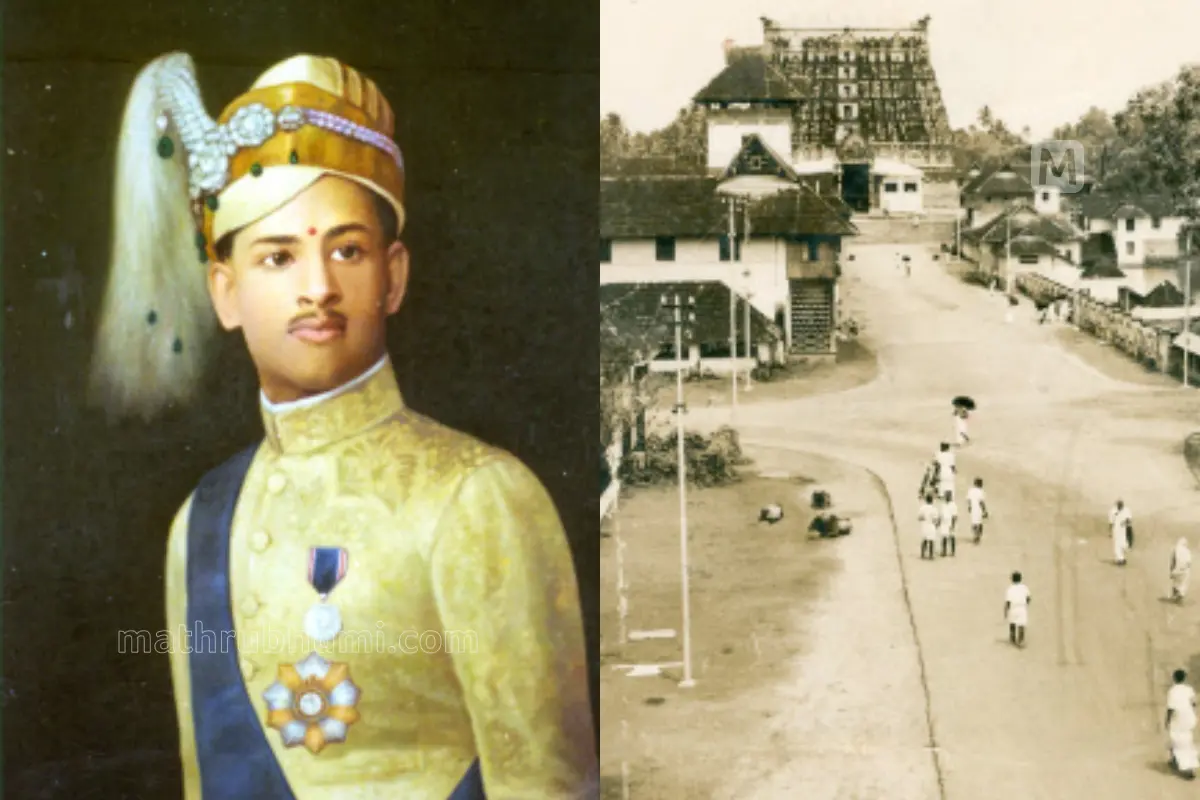
On November 12, 1936, the last ruling Maharaja of Travancore, Maharaja Chithira Thirunal Balarama Varma, signed the historic Temple Entry Proclamation, abolishing caste-based restrictions that prevented people from oppressed communities from entering Hindu temples under his government. As Kerala marks the 90th anniversary of the historic decree this year, its significance extends beyond the royal order that brought the restrictions to an end.
Speaking to Mathrubhumi English, noted Historian MG Sasibhooshan said the proclamation should not be viewed as an isolated act of royal benevolence, but as the outcome of a chain of events that had reshaped Travancore’s social and political landscape.
“I don’t see the Temple Entry Proclamation as a single, isolated event. It has to be seen as the culmination of a chain of events,” he opined.
Historian Manu S Pillai, who describes the proclamation as an extraordinary measure for its time, points to the strength of caste prejudice in the 1930s and the resistance that even relatively limited reforms had encountered.
“It was certainly extraordinary. Remember, this was a period when caste prejudices were still violently strong, and the very idea of ‘impure’ groups gaining access to sacred spaces was, in powerful, conservative circles, a scandalous proposition.”
A promise made to Gandhi
The story of the Temple Entry Proclamation goes back to the Vaikom Satyagraha of 1924-25, when Mahatma Gandhi is said to have raised the question of temple entry with the young Chithira Thirunal, then 12 years old. According to the account, Gandhi asked the prince whether he would allow people from oppressed communities to enter temples when he became ruler. The young prince reportedly agreed, promising that it would happen during his reign.
Gandhi also raised the issue with Maharani Sethu Lakshmi Bayi, who was then serving as Regent. Unlike the young prince, she did not offer a commitment, pointing out that she was only a temporary ruler. Historian M. G. Sasibhooshan says both episodes are true, but cautions against giving the entire credit for the eventual reform to the Maharaja.
“The incident is true. But the credit for implementing temple entry belongs to CP Ramaswami Iyer. That doesn’t mean Chithira Thirunal had no role. Discussion of temple entry was alive within the royal family itself.”
Sasibhooshan offers a sympathetic interpretation of Sethu Lakshmi Bayi’s response, arguing that her position as Regent limited what she could promise.
“That was all she could say, given her position. She didn’t say it shouldn’t be given. She only said she was not the ruler.”
Pillai also draws attention to Sethu Lakshmi Bayi’s role in the Vaikom road-access reforms, which demonstrated how difficult it was to dismantle caste restrictions even when the demand concerned public roads rather than entry into temples.
“We know, for instance, from the Vaikom Satyagraha how difficult it was to open up even Travancore’s public roads in the 1920s to all castes and communities. Maharani Sethu Lakshmi Bayi, who did this, had to build consensus, open three roads around Vaikom to begin with, and then over time slowly allow free road access. It took about five years for that reform to be formally extended across the whole state.”
The experience, Pillai suggests, provides an important backdrop to the resistance that surrounded the demand for temple entry. The Vaikom Satyagraha’s immediate demand was access to public roads around the Vaikom Mahadeva Temple, but its wider challenge to caste-based exclusion helped bring the question of social equality into public debate.
Years of agitation and a changing social climate
The demand for temple entry had gathered momentum well before the 1936 proclamation. In December 1917, social reformer T. K. Madhavan raised the issue in an editorial in Deshabhimani, taking the demand for temple entry into the public domain. The Vaikom Satyagraha of 1924-25 further strengthened the wider campaign against caste-based discrimination. Although its immediate demand was the right of oppressed communities to use the public roads surrounding the Vaikom Mahadeva Temple, the agitation brought questions of caste exclusion and social equality into sharp focus.
In November 1932, the Travancore government constituted a committee to examine the question of temple entry. The issue had by then acquired wider political and social significance, with growing discontent among the Ezhava community and discussions about conversion adding to the pressure for reform. Gandhi also engaged with Ezhava leaders over the possibility of conversion and urged them not to leave Hinduism. Historian A. Sreedhara Menon viewed the Temple Entry Proclamation as an offshoot of the Abstention Movement, which had challenged caste-based inequalities in Travancore.
Pillai points out that the committee’s recommendations did not favour unrestricted access to temples for marginalised communities.
“With Temple Entry, there was an enquiry committee constituted by the Travancore Government which in 1934 essentially recommended against going for absolute, unhindered temple access for marginalised groups. It offered all kinds of compromises, middle ground, and so on.”
He says the Ezhava community’s sustained mobilisation, combined with growing calls for conversion, eventually increased the pressure on the Travancore leadership to act.
“But yes, remember that this was not a case of the Maharajah one fine day deciding to make a reform. For years, the Ezhava community in particular had been agitating and mobilising for better, more respectful treatment as a group. This mobilisation combined a moral angle (exemplified by religious leaders like Sri Narayana Guru) with growing economic heft as well. By the mid-1930s, Ezhava leaders were running out of patience with Vaikom Satyagraha-style slower, incremental reforms, and there were calls for the community to convert to other faiths. This is what ultimately pushed the rulers to act.”
For Pillai, the decision also needs to be understood in the context of Travancore’s political and religious identity. He argues that the prospect of a large section of the Ezhava community leaving Hinduism was a significant concern for a state whose rulers were deeply invested in its identity as a Hindu principality.
“Chithira Tirunal, his Dewan, and mother were all Hindu consolidationists and deeply wedded to Travancore’s identity as a Hindu state. Travancore already had a sizeable Christian population—viewed with suspicion and at times hostility by the maharajah’s government—and if a big chunk like the Ezhavas departed the fold, it would threaten the principality’s Hindu identity. This played a major role in Chithira Tirunal’s decision to act when he did.”
Sasibhooshan, meanwhile, points to the support the demand received from sections of the upper-caste community, including those who took part in the Savarna Jatha, which campaigned in support of the rights of communities denied access.
“Even people of the so-called upper castes fully supported this idea. The Savarna Jatha is often assumed to have been for the upper castes. It was a march by upper castes on behalf of those denied entry. Satyavrata Swami and many of Sree Narayana Guru’s disciples were from those communities,” he noted.
Sasibhooshan also stated that some Bhagavathy temples had, for centuries, allowed avarnas to enter at specific intervals, sometimes once every three or 10 years.
“Take the Venganoor Neelakeshi Mudippura. Avarnas were allowed in once every three years, at festival time. Ayyankali was a devotee there. When you can only enter once in three years, the demand to enter on the other days only grows stronger. Even the Ayyankali biographies don’t mention this. I learned it from his grandson, my classmate,” he added.
Who made the proclamation possible?
While Chithira Thirunal’s role is central to the story, both historians underline the contribution of other members of the Travancore leadership, particularly Dewan CP Ramaswami Iyer and the Maharaja’s mother, Junior Maharani Sethu Parvathi Bayi.
Pillai says the proclamation was not simply the result of an individual ruler’s decision. He argues that the support of influential Hindu authorities and the religious credentials of the state’s leadership helped the reform gain acceptance among conservative sections.
“Credit must be given not just to the Maharajah but also his mother and the Dewan for seeing the proclamation through. They persuaded and brought on board powerful Hindu authorities (such as the Azhvanchery Thamprakkal, the highest dignitary among Brahmins in Kerala), and it helped that the Maharajah was a devout Hindu, and his Dewan was a Brahmin. The reform could not, for instance, have acquired legitimacy among conservative people if it had been passed under the two previous Dewans—one a white man and the other a Muslim. So the conviction of the state’s top leadership and their pro-Hindu credentials were integral to the success of the move.”
Pillai says the Maharaja, his mother and the Dewan acted decisively after the earlier committee had proposed compromises rather than unrestricted temple access.
“But then Sir CP Ramaswamy Iyer, Maharajah Chithira Tirunal, and his mother Junior Maharani Sethu Parvathi Bayi acted boldly and in 1936 with a stroke of the ruler’s pen, passed the reform.”
Sasibhooshan, while crediting C. P. Ramaswami Iyer for implementing temple entry, does not dismiss the Maharaja’s contribution. He says the issue had been discussed within the royal family, and Chithira Thirunal was part of a wider group of progressive voices.
Gandhi’s visit and the proclamation’s wider impact
The proclamation’s significance was soon reflected in Gandhi’s visit to Kerala in January 1937. On January 13, he entered the Sree Padmanabhaswamy Temple with a group of Dalit devotees who had previously been denied access.
Sasibhooshan recalls another incident from Gandhi’s tour, at Ettumanoor, which he says was documented by an 11-year-old schoolboy who witnessed the visit. The boy was MN Govindan, later known as the father of filmmaker G. Aravindan.
“A boy of eleven, studying at the Ettumanoor school, later wrote about it. That boy was MN Govindan, the father of the filmmaker G. Aravindan. The school bell rang; teachers and children all poured out to see Gandhi. He didn’t enter the temple himself, but he took the Harijans in. He was a storm that day,” recalled Sasibhooshan.
The impact of Travancore’s decision was not confined to the princely state. The proclamation was a pioneering measure in the context of temple entry reforms in princely India and British India, and other rulers followed developments in Travancore closely.
Sasibhooshan recalls meeting a Thanjavur Maratha prince who told him that the Travancore decision had been watched with considerable interest.
Pillai says the proclamation received widespread attention, including from nationalists and newspapers in India and abroad. However, he notes that not all prominent figures welcomed it without reservations.
“It was a major highlight—nationalists like Mahatma Gandhi welcomed it, as did major newspapers, critics, etc. It made it to the press around the world. However, figures like BR Ambedkar were more lukewarm to the proclamation because, as he wrote, it was fear of the ‘cessation’ of a large group like the Ezhavas from the Hindu fold that had inspired the move.”
Pillai also cautions against equating the proclamation with the immediate and universal removal of caste-based restrictions. He says its implementation was uneven, particularly in rural areas, and that private temples were not covered by the decree.
“In fact, despite the ruler’s proclamation and some initial enthusiasm, in rural areas it would take till the 1950s for the reform to be actually implemented. Private temples were also outside its remit, so major shrines that were not government-owned or controlled continued to prevent access to Dalits. I think the proclamation applied basically to some 1800 state-run temples.”
He says the decision was announced without warning, partly to prevent opposition from organising protests. The suddenness of the move, however, also produced resentment among some sections of the establishment.
“There was also a backlash. The decision was taken suddenly and not even the Devaswom Commissioner, for example, knew it was coming. This was done to prevent any time for agitation or protests. Indeed, even the Senior Maharani did not know, and as an old fashioned incrementalist, she did not approve of the manner in which the reform was passed and kept her distance from it.”
The response outside Travancore was also far from immediate. Pillai points to the resistance in Cochin, where the reform took considerably longer to arrive.
“While in Travancore, once the royal proclamation was made, disgruntled parties had no option but to swallow this fait accompli, elsewhere the backlash was clearer. In Cochin, for instance, priests from Travancore were forbidden from serving in temples–it would take more than a decade for a similar reform to be passed. Yet for all these problems, the proclamation of 1936 was a sensation.”
The Kaimal who opened Koodalmanikyam
Sasibhooshan also recalled the little-known story of Tachudaya Kaimal, the hereditary head of the Koodalmanikyam temple in Irinjalakuda, who extended the principle of temple entry to avarnas in his jurisdiction.
A disciple of Chattampi Swamikal, the Kaimal issued a declaration allowing avarnas to enter the temple after Travancore announced its proclamation.
“As part of the Temple Entry Proclamation, he issued a declaration that avarnas could enter the Koodalmanikyam temple in Irinjalakuda.”
The move angered the Cochin royal establishment, where temple entry reform would take several more years. Sasibhooshan says the Cochin Raja found another ground to act against the Kaimal.
“The Cochin Raja couldn’t bear that the Kaimal had allowed temple entry. So he took him up in a different case.”
The Kaimal was accused of violating the rules governing his position by marrying. He was removed and moved to Travancore, where his family owned land in Aluva. The dispute eventually reached the British Paramountcy.
Sasibhooshan says the Kaimal defended his decision by citing examples from religious and institutional traditions, including the Archbishop of Canterbury, the sage Agastya and the absence of a rule requiring all sanyasis to remain unmarried.
“He made three points. One: the Archbishop of Canterbury can marry, so why can’t I? Two: there is no law that all sanyasis must stay unmarried. Three: Agastya, one of the Saptarshis, had a wife named Lopamudra.”
He also argued that marriage was preferable to the practice of keeping concubines followed by some of his predecessors.
“He said, ‘The people before me all kept concubines. I didn’t like that, so I married a woman. What’s wrong with that? If you want to dismiss me, go ahead.’”
According to Sasibhooshan, the British Resident accepted the argument and ruled that the Kaimal should continue in office.
The response elsewhere in the region, however, was far from immediate. Cochin issued its temple entry proclamation only on December 20, 1947, after the Madras government’s legislation of June 12 that year. Even then, the Cochin Maharaja exempted the royal family’s temple, Sree Poornathrayeesa, from the law.
A model for other states
Pillai argues that the proclamation’s significance extended beyond Travancore because it made it harder for conservative groups elsewhere to oppose similar reforms. He says the identity of the people who implemented it was central to the measure’s wider acceptance.
“It was a major highlight and really made it difficult for conservatives to criticise similar reform movements elsewhere. As I mentioned earlier, the background of the people who issued the proclamation mattered. If, for instance, the reform was done by the British Government, it could have been attacked as imperial interference. If it was done by a non-Hindu minister, that would also have allowed orthodox factions to delegitimise the move.”
He says the fact that the reform was introduced by the leadership of a Hindu-ruled state gave it a particular significance in the wider debate over temple entry.
“The fact that three committed champions of Hinduism in a Hindu-ruled, Hindu-oriented state had passed it gave Temple Entry a special resonance. If in a state where the Maharajah ruled as the servant of Lord Padmanabhaswamy—a deity—could open up temples, there was no excuse for rulers elsewhere to avoid the issue–so went the argument. That was a big achievement insofar as social reform questions went.”
Beyond the story of royal benevolence
Nearly nine decades later, Sasibhooshan remains cautious about accounts that portray the proclamation primarily as the result of the Maharaja’s personal generosity. He acknowledges Chithira Thirunal’s role but argues that the decision must be understood against the wider tide of social reform and political mobilisation sweeping the country.
“Gandhian agitation was sweeping India. Chithira Thirunal showed the progressiveness to absorb it, and we shouldn’t belittle that. But all the progressive people of the time were on one side of the scale, and the Maharaja and Sethu Lakshmi Bayi were on that side too,” he said.
For Sasibhooshan, recognising the Maharaja’s contribution does not require overlooking the people and movements that made reform possible.
“He was certainly progressive, no doubt. We don’t take him lightly. That’s my view,” he added.
Pillai’s account, meanwhile, places the proclamation at the intersection of social mobilisation, religious identity and political calculation. While acknowledging its extraordinary impact and the attention it attracted beyond India, he also underlines the limits of the reform: its implementation took years in some areas, and communities continued to face restrictions at temples outside the decree’s scope.
The Temple Entry Proclamation was therefore both a landmark royal intervention and the outcome of a longer struggle. Its passage in 1936 changed the legal position of oppressed communities in Travancore, but the gap between the decree and its implementation showed that ending a formal restriction did not, by itself, erase entrenched social discrimination.