India's sky eye returns: ISRO prepares to launch GISAT-1A satellite
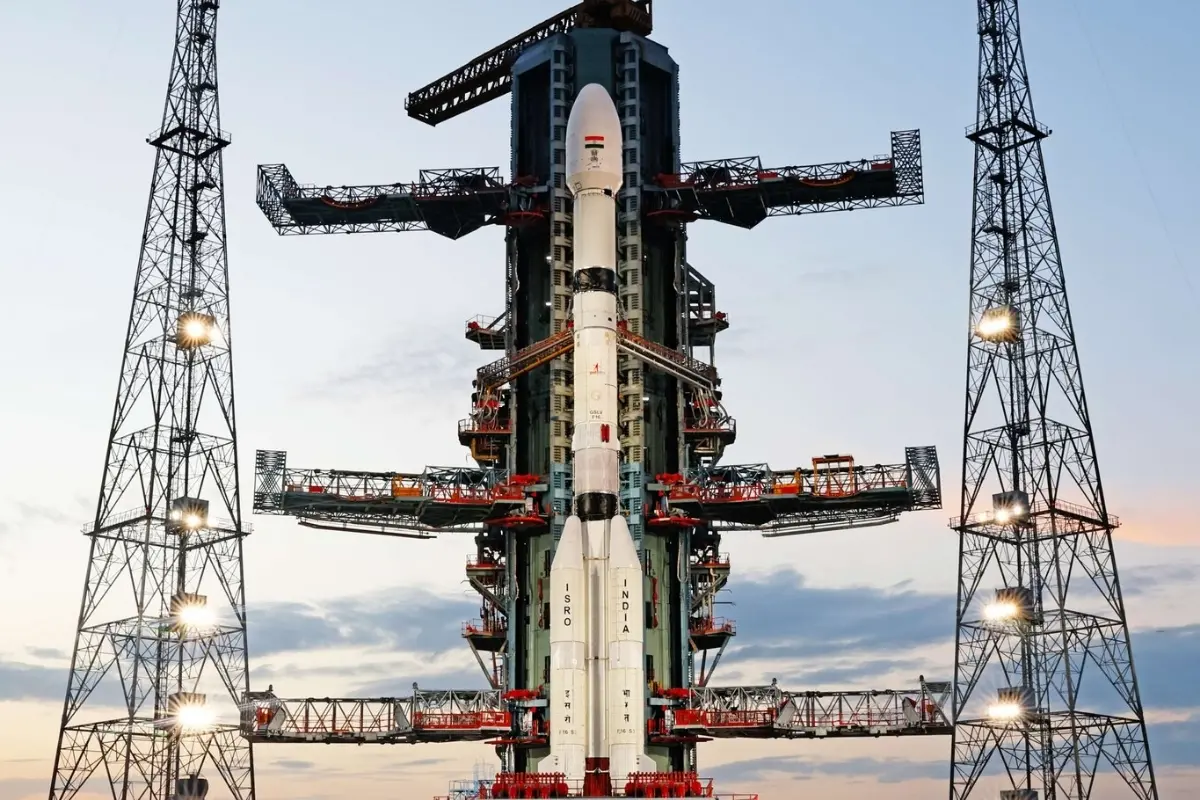
India is preparing for a launch that carries both hope and an old memory. On 4 September 2026, at 02:55 AM IST, the GSLV-F17 rocket will rise from the Second Launch Pad at the Satish Dhawan Space Centre, SHAR, Sriharikota. It will carry GISAT-1A, also called EOS-05, and this will be the nineteenth flight of the GSLV family.
The story begins in August 2021. ISRO tried to send GISAT-1, then called EOS-03, on the GSLV-F10 rocket. The first two stages worked properly, but the third stage, the super-cold cryogenic stage, refused to ignite. A leaking valve let pressure escape from the liquid hydrogen tank, too little fuel reached the engine, and the satellite was lost. Five years later, ISRO has come back to finish that unfinished work.
What makes this satellite special is its address in the sky. It will sit in what is called geostationary orbit, nearly 36,000 kilometres above the Earth, moving at the same speed as our spinning planet, so it appears to stand still over one place. Most Earth-watching satellites fly much lower and see a place for only a few minutes each day. GISAT-1A will hang almost fixed above India, like a camera fitted on a very tall pole. It can photograph a chosen area every five minutes and cover the whole Indian landmass every thirty minutes, at about 42-metre detail.
That steady view is exactly why the mission matters. Floods, cyclones, crop stress and forest fires change within hours; they do not wait for a satellite to fly past once a day. The rocket will first drop the satellite into a long oval path around the Earth. From there, the satellite will fire its own small thrusters, again and again, climbing step by step to its final parking spot high above India. That oval path comes as close as 170 kilometres to Earth and stretches out to 28,934 kilometres.
The timing is delicate. Two PSLV rockets failed one after the other, PSLV-C61 on 18 May 2025 and PSLV-C62 on 12 January 2026, both during third-stage firing. Another satellite, NVS-02, reached its transfer orbit but its own thrusters failed, leaving NavIC, India's home-grown system like GPS, with only three healthy satellites.
One telescope, three cameras- that is the simple secret of GISAT-1A. The 700 mm Ritchey–Chrétien telescope is the big eye of the satellite. It is a 70-centimetre-wide two-mirror telescope, like a high-powered telephoto lens made of mirrors, from the same design family used in Cartosat-2A. Light from Earth first strikes a curved main mirror, then a smaller second mirror, before reaching the detectors. This 70-cm telescope gives a sharp, wide view from 36,000 kilometres, and without it the satellite would simply be blind.
The first camera takes pictures in six colour-like bands, blue, green, red and near-infrared, at about 42-metre resolution, roughly two cricket pitches placed end to end. This six-colour camera shows how green the crops are, where floodwater is spreading, and how a cyclone's clouds are growing. Because it refreshes a chosen patch every five minutes and the whole country every thirty minutes in clear weather, it works like live land television rather than a once-a-day photograph.
The second camera splits light into 158 very thin slices, from near-ultraviolet through visible to near-infrared, at about 318-metre resolution. Each slice catches less light, so this 158-slice camera gives a coarser picture, but the extra colours reveal the fingerprint of plants, soil and water. A farmer can be warned that a crop is under stress even before the leaves look yellow to the naked eye.
The third camera looks in 256 narrow bands of short-wave infrared, roughly 0.9 to 2.5 micrometres, at about 191-metre resolution. Our eyes cannot see this light, but the infrared camera is excellent for spotting minerals, dry vegetation, soil moisture and heat signatures during disasters. All three cameras look through that same single telescope.
The flat electronic antenna is not a camera but the mouth of the satellite. Instead of turning a heavy dish, it swings its radio beam instantly, so huge picture files reach Indian ground stations within minutes.
Finally, the satellite's own body, the platform that holds all these cameras, is built to turn fast and then hold perfectly still. From 36,000 kilometres, even a small shake would smear the image. Weighing 2,367 kilograms, it is designed for seven to ten years of work, and every part is made in India.
On launch morning, questions hang in the air. Will the super-cold stage light up? Will the cameras cut through haze? The whole nation quietly waits.
(Girish Linganna is an award-winning science communicator and a Defence, Aerospace & Geopolitical Analyst. He is the Managing Director of ADD Engineering Components India Pvt. Ltd., a subsidiary of ADD Engineering GmbH, Germany.)