Is India's procurement policy killing its aerospace future?
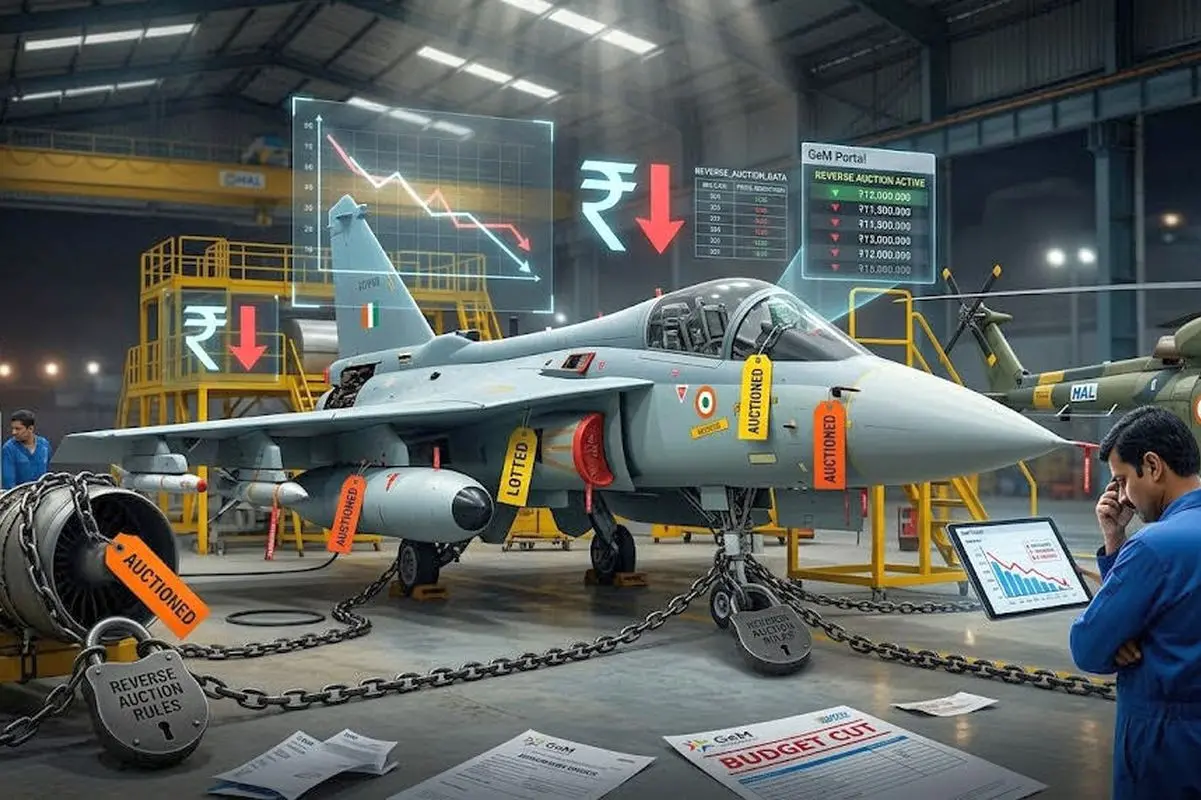
India wants Hindustan Aeronautics Limited (HAL) to become a global aerospace player -- a peer of Boeing, Airbus, Lockheed Martin, Embraer and Dassault. At the same time, the government funnels HAL's supplier ecosystem through two procurement instruments built on an assumption that is fundamentally incompatible with aerospace: that the lowest price wins.
Those two instruments are the Government e-Marketplace (GeM) and the Reverse Auction (RA). Together, they are quietly hollowing out the qualitative vendor base that any serious aerospace OEM must cultivate over decades -- the very thing that separates a global aerospace nation from a license-production shop.
This author argues that unless this procurement philosophy is reformed for aerospace-grade work, HAL will remain structurally incapable of becoming a global aerospace power.
What these procedures actually do
The GeM is India's national public-procurement portal, mandatory for most government and PSU buying. When large-value items are procured, they typically go through a bid-to-RA flow: vendors submit technical and financial bids; technically qualified bidders are then forced into a live online auction where they keep dropping their prices until the clock runs out. The lowest quote -- "L1" -- wins.
Also Read: Why global wars are making the Indian dream more expensive
As GeM-focused consultants routinely counsel sellers, public procurement on the platform is "mathematically ruthless": even if you are technically qualified, being ₹1 higher than a competitor means you lose the contract. There is no weighting for experience, craftsmanship, engineering depth, or past performance beyond meeting a binary qualification threshold.
For commodities -- staplers, toner, ceiling fans, uniforms -- this works reasonably well. For an aero-engine turbine blade, a flight-control actuator, or composite airframe skin, it is a category error.
Aerospace is not a commodity market
Global aerospace procurement is not organised around lowest price, and for good reason. A single substandard fastener, poorly heat-treated shaft, or counterfeit electronic component can bring down an aircraft, ground a fleet, or trigger a billion-dollar airworthiness directive.
That is why Boeing, Airbus and every other Tier-1 OEM operate qualification-based sourcing regimes.
Boeing mandates AS9100 aerospace quality management certification as non-negotiable, NADCAP accreditation for special processes (welding, heat treatment, NDT), First Article Inspection Reports (FAIR), Production Part Approval Process (PPAP) documentation, and a tracked Enterprise Supplier Performance Measurement score.
It maintains an Approved Supplier List and runs a "Premier Bidder" program that rewards green-rated quality and delivery performance -- not the cheapest quote.
Airbus explicitly selects partners on quality assurance, risk management, industrialisation maturity, qualification discipline, series-production capability, and sub-tier supplier management -- publishing its ASR/GRAMS/GRESS requirements and training suppliers to meet them over years.
Neither company would dream of putting a critical flight-safety part on a ticking-clock reverse auction. They treat suppliers as long-term development partners, co-investing in tooling, process qualification, and design maturity. A good aerospace supplier is not found -- it is built over 5–15 years.
Indian procurement policy, as applied to HAL, is trying to buy the output of such relationships without ever allowing them to form.
A movie already seen in its own science labs
This is not hypothetical. India has already been burned by forcing a lowest-price e-marketplace onto a technically demanding domain.
After GeM was made mandatory for publicly funded scientific institutions, universities and research laboratories in 2020, Indian scientists raised a sustained outcry about substandard equipment and consumables delivered through the portal -- poor reagents, unreliable instruments, and vendors who won on price but could not deliver research-grade quality.
The government ultimately had to reform the system in 2025, allowing researchers and institutions to buy equipment outside the portal in many cases.
The lesson is clear: when quality is a prerequisite rather than a preference, an L1 portal actively destroys value.
Aerospace is even less forgiving than a biology lab. The feedback loop in science is a failed experiment. In aerospace, it is a crash.
Why reverse auctions are structurally wrong for aerospace
The professional procurement literature -- including guidance from the US Government Accountability Office, the International Institute of Building Enclosure Consultants, and mainstream sourcing research --- has documented the same failure modes repeatedly:
1. Race to the bottom. Suppliers in a live auction cut into their own margins to win. To make the numbers work post-award, they have to cut corners -- cheaper raw material, looser tolerances, compressed inspection, skipped process steps. In aerospace, these are precisely the shortcuts that create hidden defects.
2. Commoditisation of non-commodity work. A reverse auction inherently treats all technically qualified bidders as interchangeable. It strips out the value of deep engineering expertise, proprietary processes, decades of tribal knowledge, and proven in-service reliability. A machine shop that has been making landing-gear components flawlessly for 30 years is priced against one that just cleared the qualification threshold yesterday.
3. Destruction of the qualitative supplier base. Quality-focused suppliers eventually walk away. They cannot sustain the unit economics of winning at L1 prices while maintaining aerospace-grade quality systems, documentation, traceability, and AS9100 overheads. The ones who remain are either the ones who compromise or the ones large enough to cross-subsidise the loss -- neither is healthy.
4. No incentive to invest in R&D. If every contract is won on the cheapest quote, no supplier will put money into developing new alloys, new composites, new processes, or new test infrastructure. India therefore never builds indigenous capability in the tier-2 and tier-3 layers that actually define an aerospace nation.
5. False savings. The GAO review of US federal reverse auctions found agencies indirectly paying tens of millions in platform fees through awardees -- and frequent re-tendering when low bidders underperformed. Rework, field failures, and warranty claims in aerospace make these "savings" look trivial.
6. Unsuitable for complex, specification-driven work. Even reverse-auction vendors themselves acknowledge the format is best for simple commodities and poorly suited to complex technical jobs with precise specifications — exactly the category aerospace components fall into.
What this means for HAL specifically
HAL is not just any PSU. It designs, manufactures, repairs and overhauls combat aircraft, helicopters, aero engines, avionics, and space-grade hardware. It exports to Airbus, Boeing and GE Aviation. Its order book has crossed ₹2.5 lakh crore -- eight times its annual turnover.
For an organisation of this profile, the current procurement regime causes concrete damage:
Tier-2/Tier-3 suppliers are being eroded. The MSMEs that should be HAL's equivalent of Spirit AeroSystems, Safran's sub-tier network, or the Mittelstand machining shops around Airbus in Toulouse are being ground down by L1 pricing. Many exit aerospace altogether and move into less demanding sectors where margins exist.
Qualified vendors quietly stop bidding. The best domestic suppliers -- the ones with AS9100, NADCAP, real metallurgical labs, in-house NDT, and traceability -- increasingly skip HAL tenders they know will devolve into reverse auctions. They focus on Airbus, Boeing, Safran and Collins subcontracts instead, where quality is rewarded.
Foreign premium suppliers disengage. Global vendors with the IP and craftsmanship HAL needs for high-end programs will not bid into a reverse auction against cut-price competitors. This pushes HAL toward whoever will play the L1 game -- not the most capable partner.
Schedule slippage and rework explode. HAL has for years been criticised -- including in internal audits and by the Indian Air Force -- for delivery delays and quality issues on flagship programs. A good chunk of this traces back upstream to a supplier ecosystem that was selected on price.
Export competitiveness suffers. You cannot credibly sell a combat aircraft internationally if the country's own air force publicly questions your quality and timelines. The supplier base feeds directly into that reputation.
Also Read: HAL's success cost aircraft-maker the AMCA throne?
Even HAL itself now competes on L1 terms for its own future. The Advanced Medium Combat Aircraft (AMCA) Development-cum-Production Partner, for which HAL was effectively disqualified on one EoI criterion, is now being decided among Tata, L&T and Kalyani primarily on who comes in as L1. The country's next stealth fighter development partner is being chosen the way one would choose a vendor for steel cabinets.
What global aerospace powers do instead
No country has produced a world-class aerospace industry on a reverse-auction diet. Instead, the successful models share a few common features:
* Strategic supplier selection based on technology, track record, and long-term fit -- not per -- unit price.
* Multi-year framework agreements with price-escalation clauses tied to input costs, so suppliers can plan capital investment.
* Co-development and risk-sharing partnerships where the OEM and supplier share R&D cost and intellectual property.
* Performance-based contracting: awards based on total cost of ownership (quality, delivery, reliability, lifecycle cost), not headline bid price.
* Qualification-based shortlists with narrow tenders among pre-approved Tier-1s, and price treated as one input among many — not the only one.
* Investment in Tier-2/Tier-3 ecosystems through supplier development programs, funded certifications, and long-term volume commitments.
These are the building blocks HAL needs. None of them survive in a mandatory GeM-plus-reverse-auction regime.
A caveat: Why these systems exist
It is worth acknowledging the legitimate reasons GeM and reverse auctions were introduced. India's public procurement has historically been riddled with corruption, favouritism and opaque vendor relationships.
A transparent, auditable, lowest-quote-wins portal is a genuine anti-corruption tool, and it has saved the exchequer real money on routine purchases. The intent is not malicious -- it is a blunt instrument applied too uniformly.
The fix is therefore not to scrap transparency or accountability. It is to recognise that aerospace, defence and strategic technology procurement need a different, equally auditable framework -- one that embeds quality, lifecycle cost, and strategic capability into the evaluation itself, and that allows genuine long-term partnerships without creating opportunities for favouritism.
Several concrete reforms would help HAL without sacrificing transparency:
* Exempt flight-safety-critical and strategic aerospace procurement from mandatory GeM-RA flows, just as scientific research procurement was eventually exempted after the quality crisis.
* Mandate Quality-Cum-Cost Based Selection (QCBS) for aerospace items, where technical score carries 70–80% weight and price only 20–30% -- a well-established global norm.
* Institutionalise Long-Term Agreements (LTAs) with qualified aerospace vendors, with transparent price-discovery at entry and contractual escalators thereafter — removing the annual L1 scramble.
* Fund a HAL-led supplier development program for MSMEs, covering AS9100 certification costs, NADCAP process qualification, and capital equipment grants in exchange for long-term supply commitments.
* Adopt Total Cost of Ownership evaluation that accounts for rework, warranty, rejection rates, delivery reliability, and in-service failures — not just sticker price.
* Create an "Aerospace Approved Supplier List" analogous to Boeing's ASL or Airbus's qualified supplier network, with rigorous auditing and genuine consequences for poor performance but real continuity for good performers.
* Build audit and integrity mechanisms into the new framework — third-party technical audits, disclosure norms, and independent review — so that moving away from pure L1 does not open the door to the old problems GeM was created to solve.
A country becomes a global aerospace power by building, over generations, a dense ecosystem of highly qualified suppliers who are protected, nurtured and challenged by a sophisticated prime contractor. That is how the US, France, the UK, Germany, and increasingly China did it.
India's GeM portal and reverse auction system, applied without exception to HAL, does the opposite: it commoditises skill, penalises quality, starves R&D, and sends the best suppliers elsewhere. It treats the aerospace industry as if it were a stationery cupboard.
As long as HAL's critical supply chain is awarded to whoever can drop a bid by one more rupee in the last thirty seconds of an online auction, HAL will not lead the world in combat aircraft, engines, avionics, or any other serious aerospace category.
It will remain a competent license-builder and MRO house, years behind the global frontier -- which is a significant achievement, but not the global power India's strategic ambitions demand.
If India genuinely wants HAL to fly with Boeing and Airbus, it must first stop procuring its wings at the lowest bid.
The author is a Defence, Aerospace & Geopolitical Analyst.