From Bolero to electric scooters: Ramkripa Ananthan’s design journey at MBIFL 2026
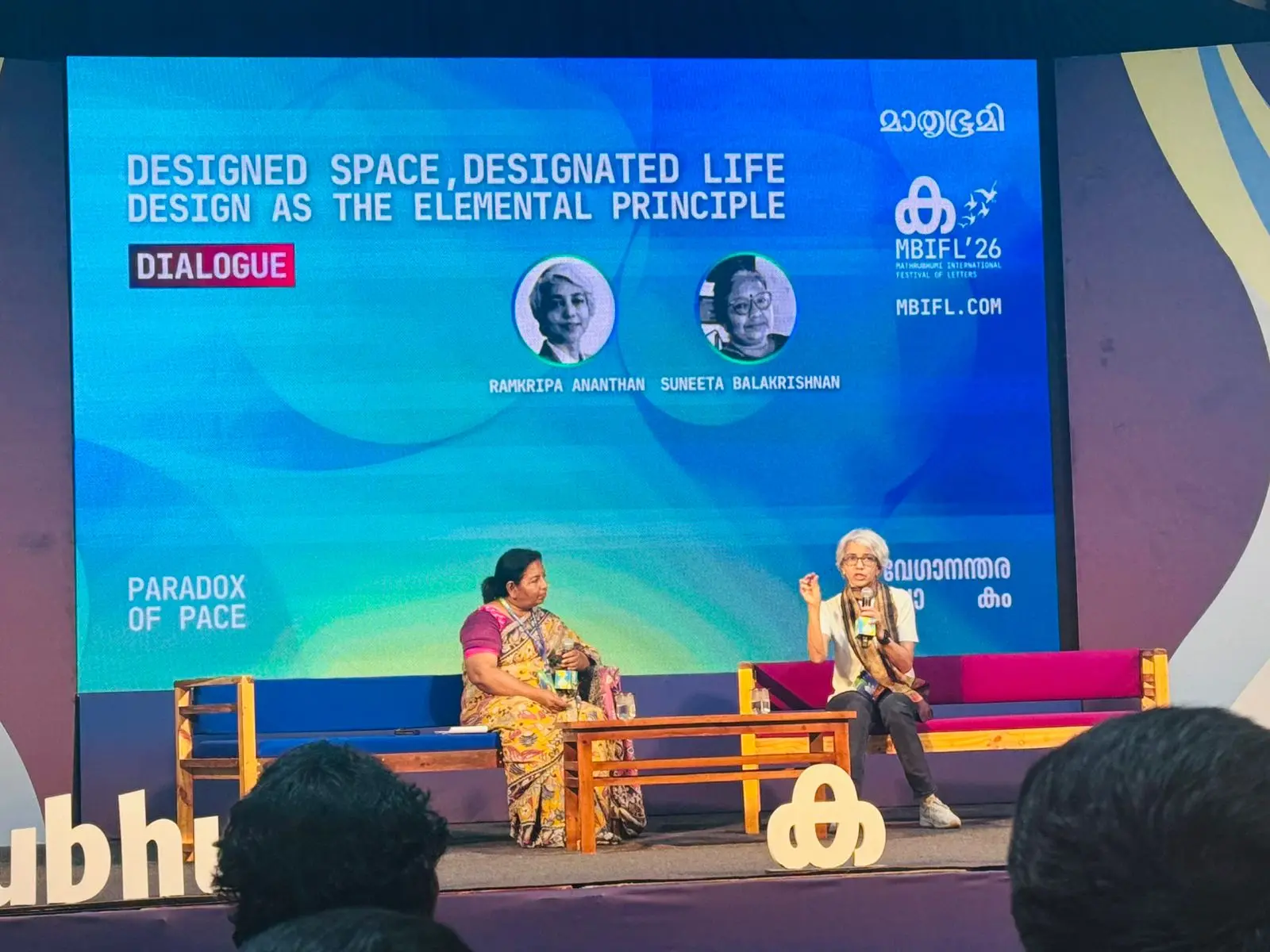
She sits easily in the chair, legs crossed, shoulders relaxed, dressed in a white tee and jeans, a soft shawl thrown on almost as an afterthought, sneakers firmly planted on the floor. Short hair, a slim, fit frame, and the unmistakable air of someone who trusts her body because she has tested it—on roads, on motorcycles, inside factories and design studios. When Ramkripa Ananthan begins to speak, it is her voice that surprises you first: low, baritone, steady. Gentle, yet carrying authority. For nearly an hour, she talks about machines—and somehow makes them feel deeply human.
That tone sets the rhythm for Designed Space, Designated Life: Design as the Elemental Principle, her session at MBIFL 2026. For Ananthan, design is not about aesthetics or surface styling. It is a way of thinking, a way of negotiating complexity, and ultimately, a way of living in the world.
Trained as a mechanical engineer at BITS Pilani, Ananthan insists she loved engineering from the beginning. “I really enjoyed it,” she says, recalling her early years as a practising engineer. Three years in, influences began to converge—a flatmate planning to study industrial design, a brother nudging her towards a master’s degree, and a lifelong pull towards the arts. Her father’s background in textiles had already given her an instinctive feel for colour, texture and pattern. When she encountered design formally, it felt less like a detour and more like a convergence—everything she was drawn to finding a single direction.
ALSO READ | 'Taking away joy is strategic': Priyamvada Mehra on cult life and freedom
Detour
The turning point came during her master’s course, when Toyota entered the Indian market and asked students to conduct user research. That, she says, was when things truly clicked. Design was not about sketching beautiful cars; it was about understanding people, systems and constraints. It was complex, layered, and endlessly engaging.
Her career would go on to mirror India’s own automotive evolution. At Mahindra, she thought she would stay for two years. Instead, she found herself at the centre of defining moments—working on the first generations of the Bolero and the Scorpio, shaping interiors that would go on to influence how Indian SUVs were experienced. “People would call me asking about car sketches,” she recalls with a smile. “But car design isn’t about sketching cars.”
Cars to two-wheelers
Three years ago came another sharp turn: from cars to two-wheelers, from Mumbai to Bengaluru, and from legacy automotive systems to the fast-churning world of electric vehicles at Ola Electric. “It was dramatic,” she admits. “Traumatic, even.”
Electric mobility forced her back into the position of a student. Power ranges were changing in real time. Old assumptions had to be unlearnt. She found herself surrounded by younger, fiercely opinionated teams—no one arriving before 11 am, but staying late into the night. “It felt like going back to school,” she says, without complaint.
ALSO READ | Inside ‘the intoxication of words’: Jeet Thayil on how poetry is born
Known for SUVs, Ananthan found herself drawn to two-wheelers—fewer wheels, but an entirely different design universe. SUVs push through air with brute force; sporty motorcycles must slice through it. Roadsters demand bulk, mass and proportion. Sport bikes prioritise speed and aerodynamics. “I don’t understand why so many people in South India like riding like that,” she jokes, “but if that’s what the customer wants, you design for it.”
Customer-centricity, she stresses, is the one constant across all design—whether fashion, products or vehicles. Functional needs meet emotional ones. Design decisions live on roads for decades. As a motorcycle rider herself, Ananthan’s understanding is visceral, grounded in experience rather than abstraction.
Some of her most intuitive design decisions, she says, came from everyday frustration. She has always been terrible with keys—losing cycle keys in college, misplacing spares, eventually painting her bicycle bright yellow so it couldn’t be stolen. Today, many of the vehicles she has worked on are keyless. Technology, she reflects, has allowed design to become far more intuitive over the past 25 years.
ALSO READ | ‘I’m an artist, not an activist’, says Omar Bin Musa at MBIFL 2026
Regulations, emissions norms and sustainability goals have transformed the industry as well. India’s decarbonisation efforts, she notes, are genuinely impressive. Technology and design exist in a constant feedback loop, reshaping each other. She recalls a customer survey from 15 years ago, when people scoffed at the idea of navigation systems in cars. “Why would we need maps? We’ll just ask someone on the street,” they said. Today, we are hyper-dependent on navigation—and increasingly disconnected from people. Another paradox, she observes, neatly echoing the festival’s theme.
AI and design
Artificial intelligence, she believes, will fundamentally alter how design is done. What once took weeks now happens in moments. Voice commands are replacing touchscreens. Software already responds across languages, though it demands intense testing. For young designers, she says, the challenge is no longer speed, but relevance. “What can you add?” she asks.
Ethics, too, surface repeatedly—not as theory, but as practice. Two-wheelers, she reminds the audience, are intrinsically unsafe. Design must respond. Perhaps the future lies in a bike that simply will not start unless the rider wears a helmet.
Toward the end of the conversation, Ananthan reflects on personal milestones. She doesn’t have a bucket list—not in the conventional sense. But if there were one thing she would like to do, it would be to write a book, she said.
As the session winds down, it is clear what drives her every day. Her guiding principle, lived rather than prescribed, is simple and unvarnished:
“Work very, very hard,” she said.