Chandrachud's mixed legacy
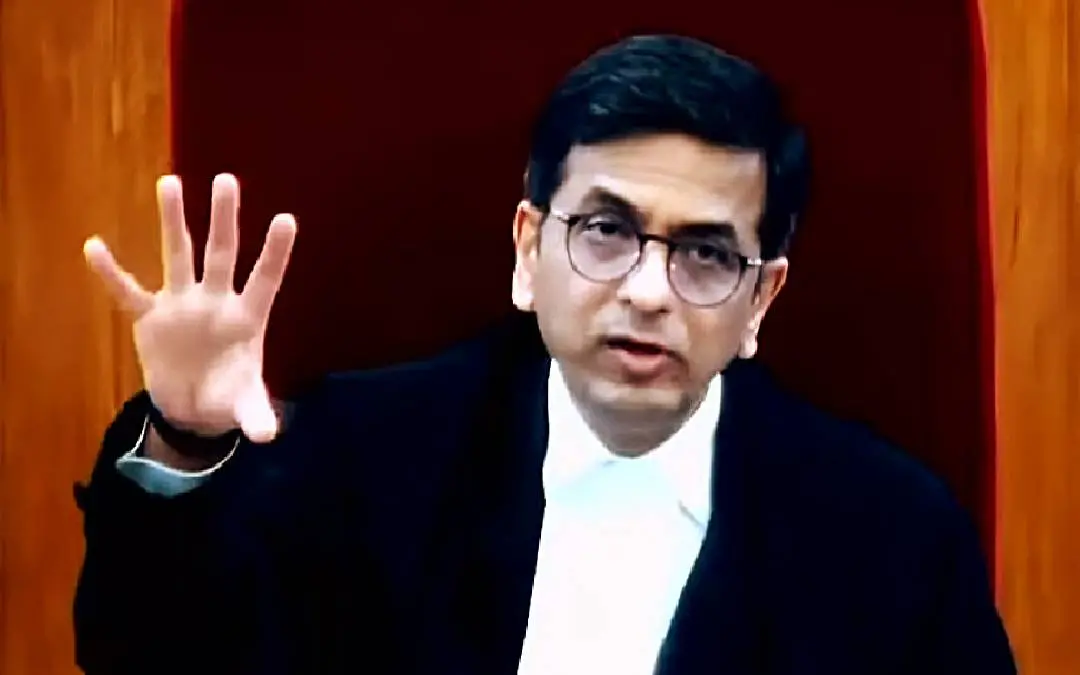
Dhananjaya Yeshwant Chandrachud, the fiftieth Chief Justice of India (CJI), who retires today on November 10 after precisely two years in the office, leaves a mixed legacy. As one of the critical authors of many landmark judgments, since he joined as a judge in the apex court in 2016 and subsequently as the CJI in 2022, Chandrachud was expected to surpass the legacy of his father, who had the longest innings as CJI. Proclaiming privacy as a fundamental right in the famous Puttaswamy case. Chandrachud even found a judgement delivered by the bench headed by his father, YV Chandrachud, during the Emergency period that held a contrary view as severely flawed.
However, some of Chandrachud’s controversial decisions and actions have grievously blotted his copybook on and off the court. Unsparing critics like senior lawyer Dushyant Dave even called Chandrachud’s tenure quite disappointing given the Harvard Law graduate’s erudition and intelligence. Dr Mohan Gopal, former director of the National Judicial Academy of the Supreme Court, lamented that Chandrachud's many verdicts reinforced the “doctrine of deference” towards the political executive, which is dangerous to democracy. According to Dave, Prime Minister Modi's powerful persona overawed Chandrachud. It hardly augurs well for the Indian Supreme Court, once called one of the world's most potent judicial bodies, that India’s position has been falling steadily in every global index of democracy and human rights during the past decade under the watch of our Chief Justices, including Chandrachud. Except during the Emergency, never had so many prominent human rights activists and political opponents of the central government been incarcerated, denied bail or hunted down as now.
Nevertheless, one has also to make judgements on relative terms. One must compare Chandrachud's innings with those of others who held the position during this period. In this perspective, one must compliment Chandrachud and his predecessors, Justices UU Lalit and N V Ramana, for one crucial service. Among all those who occupied the exalted seat of the CJI in the past decade, these three deserve the maximum credit for one important thing. They tried with some success, to restore the credibility of the country’s highest court, which had been on a slippery slope since 2014. With all their warts, these three CJIs helped the apex court, at least on certain occasions, to rediscover its spine, which had gone missing after Modi assumed power. Perhaps the disappointment over Chandrachud springs mainly from the higher expectations placed on him.
Interestingly, at least three of the many landmark judgments Chandrachud participated in directly affected Kerala. The most significant was the Sabarimala verdict of 28 September 2018, which privileged constitutional morality and gender equality over religious faith and rituals. Chandrachud was part of the five-member bench that revoked the ritualistic ban on women of menstrual age entering the shrine with one judge dissenting. Notwithstanding his self -proclaimed temple-going Hindu identity, Justice Chandrachud’s concurring judgement noted that prohibiting the entry of women into the temple was not an “essential religious practice” and that Lord Ayyappa’s devotees didn’t constitute a “religious denomination” under Article 26. Though the historic order was frozen subsequently following mass agitations, review petitions and the apex court referring the verdict to a larger bench, it underscored the supremacy of the core values enshrined in the Indian constitution.
Another of Chandrachud’s crucial judgements related to Kerala was on the 2017 Hadiya case, often known as the “Love Jihad case”. Hadiya, originally from a Hindu family from Vaikom, converted to Islam and married her Muslim lover, which was opposed by her parents, who called it a case of “Love Jihad”. In May 2017, the Kerala High Court upheld Hadiya’s parents’ view and nullified the marriage. But on April 9, 2018, the Supreme Court’s three-member bench consisting of CJI Dipak Misra, Justices AM Khanwilkar, and Chandrachud set aside the High Court’s verdict. It upheld an adult’s fundamental right to choose a spouse. Chandrachud, in his concurrent judgement, expressed his “anguish with the grievous miscarriage of justice which took place in the present case and to formulate principles in the expectation that such an injustice shall not again be visited either on Hadiya or any other citizen”.
In April 2023, the bench headed by CJI Chandrachud upheld the media rights unequivocally when it lifted the telecast ban on the Media One TV channel imposed by the Central government. “The Press has a duty to speak truth to power and present citizens with hard facts… A homogenised view on issues that range from socio-economic polity to political ideologies will present grave dangers to democracy,” observed the judgement.
A judge who authored over 600 judgements during his eight years of tenure in the apex court, he was part of several landmark verdicts that upheld the supremacy of the Indian Constitution, human rights, rights of minorities and gender equality. They recognised privacy as a fundamental right, decriminalised homosexuality or adultery, gender equality, marital rights, media freedom and so on. He was also instrumental in striking down the 2018 Electoral Bond scheme, which was perceived as one of the most opaque and corrupt projects related to political funding in India’s post-independence history. His last verdict upheld the rights of minorities in the education sector at a time when state -led majoritarianism is becoming pervasive in every sphere.
However, critics have found certain severe flaws in some of these landmark cases too. Chandrachud's refusal to book the political parties illegally benefiting from the electoral bonds was widely deplored. Similarly, an earlier directive in the Hadiya case by the apex court bench that had Chandrachud also to the National Investigation Agency (NIA) to probe the alleged “terrorist” angle in Hadiya’s marriage was heavily criticised.
However, what critics found Chandrachud’s verdicts most problematic were in politically sensitive cases. The worst was the Ayodhya verdict. The five-judge Supreme Court bench, led by CJI Ranjan Gogoi, in November 2019, directed that a Ram temple be built on the contested site and allotted a separate five-acre plot for a mosque. Chandrachud was a member of the bench, which made this highly discriminatory decision even after finding that the Masjid demolition was unpardonable! The verdict formed one of the most damaging assaults in independent India on secularism enshrined as fundamental to the republic in the constitution. Even more pathetic was Chandrachud's recent statement that this decision was taken under the guidance of God.
‘Very often, we have cases to adjudicate but don't arrive at a solution. Something similar happened during the Ayodhya case in front of me for three months. I sat before the deity and told him he needed to find a solution," he said in a public meeting. What role do the rule of law and the constitution have when gods directly guide our judges?
Another of Chandrachud's controversial verdicts was the full endorsement by a five-member bench headed as CJI in 2023 of the central government’s abrogation of Article 370, which bestowed special status to Jammu and Kashmir. Many critics find it legally flawed and deferential to the central government.
Chief Justice of India D Y Chandrachud’s residence
Notwithstanding the mixed responses to his judgements, Chandrachud’s conduct and ways outside the court have mostly been impeccable, though some critics found him too media-savvy. However, Prime Minister Modi’s “personal” visit to Chandrachud’s home in September to participate in the family’s private Ganesh Pooja under the full glare of video cameras crossed every norm of propriety expected in the conduct of the heads of executive and judiciary. Sadly, the incident inflicted a grievous blow on the image of India’s judiciary, which is not just expected to be independent but also seen as independent.
However, a question remains. Is it fair to personally hold an individual, even if the person is the CJI, accountable for the serious institutional problems haunting the system ? Probably not. Yet, Chandrachud’s ambiguous legacy showcases the tension between upholding constitutional ideals and navigating the complex political landscape of modern India.