Buddhadeb: The Shipwrecked Sailor
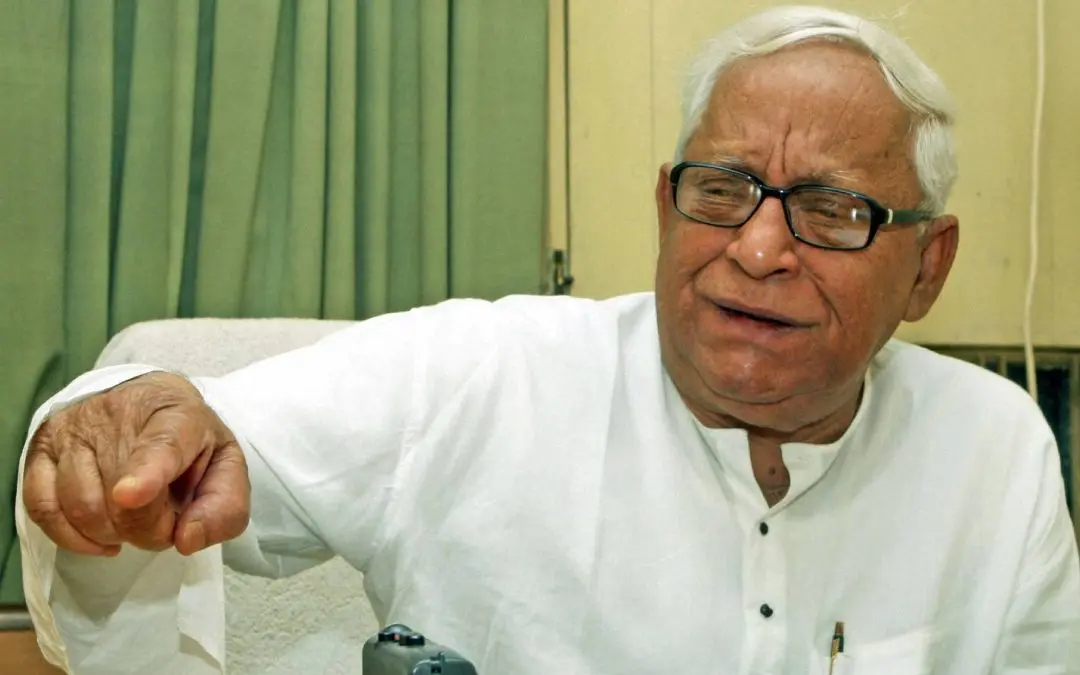
It was the cold November of 1980. I had just finished university and accompanied my father on a long tour through many states. Visiting Calcutta (the city had yet to change her name) was what I looked forward to most, having grown up admiring Bengali literature, cinema, politics and football. My excitement overflowed when we met Mrinal Sen and his wife, Geeta, at the maestro's residence on 14 Beltala Road. Mrinalda came with us when my father told him we were going to the CPI(M) headquarters on Alimuddin Street. Sen wanted to pay homage to a departed comrade whose body was kept in state at the party office.
I saw many prominent leaders at the party office, including Chief Minister Jyoti Basu, who I had only seen in photographs. It was only three years after the Left Front formed its first government to begin its historic three-decade-long unbroken innings in power. Then, I followed my father into a smaller room where I saw a thick-glassed young man in the traditional white Bengali dhoti-kurta with a burning cigarette between his fingers. He was Buddhadeb Bhattacharya, then a 33-year-old rising star in Bengal CPI(M) and the Minister of Information.
For the next hour, I sat wide-eyed, listening to the excited conversation between my father and his younger comrade, meandering through literature, cinema, politics, etc. I remember Buddhadeb speaking passionately in his Bengali-accented English about a new Latin American author named Gabriel Marquez and his One Hundred Years of Solitude. I had little clue that the author and his novel would soon win the Nobel or become household names even in Kerala.
In my young and romantic imagination, Buddhababu personified everything I adored in my Bengali fantasy: his radical politics, passion for literature, cinema, and sports or even his kurta and Kolhapuri sandals. I even thought he resembled my favourite Bengali hero, Soumitra Chatterjee of Apur Sansar.
Aptly called Bengal’s last Bhadralok Communist, Buddhadeb, who died recently at 80, was born into a North Kolkata Brahmin family of priests, Sanskrit scholars, and writers that included the revolutionary poet Sukanta Bhattacharjee. Communism stole Buddha's heart at the Presidency College, the crucible of Calcutta’s radical politics, where he graduated in Bengali literature. The scion of the priestly family turned a confirmed atheist.
After a brief teaching stint, Buddhadeb became CPI(M)’s full-timer and was made the state secretary of the DYFI during the late sixties. Those were CPI(M)’s hard days, with the Naxalite movement weaning away the youth like a magnet, followed by the violent Emergency reign under Siddharth Sankar Ray. Besides Buddha, many youngsters helped the party weather the crisis. They included Biman Basu, Shyamal Mukherjee, Anil Biswas, Nirupam Sen, Subhash Chakraborty and others- all groomed by the formidable CPI(M) State Secretary Pramode Dasgupta. In recognition, the party elevated Buddha and many others to the State Committee.
Their sacrifices and sufferings did not go unpaid. In 1977, the Left Front (LF) rode a huge popular wave to sweep the assembly elections to begin its long hegemony. Among the victorious debutants was Buddha, who won from Kashipur in North Kolkata. He was also made the Minister for Information thanks to his cultural interests. However, in the next election, Buddha narrowly lost against Congress's PK Ghosh, although the LF won again. Yet, he was inducted into the party Central Committee with other prominent young leaders like Prakash Karat and Sitaram Yechury. In 1987, Buddha shifted to Jadavpur, where he won four times subsequently and held important portfolios in every LF government.
But in 1993, Buddha surprised everyone by resigning from the cabinet. This followed his disagreements with the mighty Jyoti Babu over growing corruption within the administration. However, unlike what usually happens to dissenters in CPI(M), Buddha was found indispensable as Basu’s health declined. He returned to the ministry soon and later took over the critical Home portfolio.
Signs of political change were already on the horizon. The Marxists, who reigned supreme for two decades and pushed Congress to insignificance, began to be challenged for the first time by the rise of a young and firebrand leader. Her name was Mamata Banerjee. The wiry 29-year-old grabbed national attention as a giant killer who upset the mighty Marxist Somnath Chatterjee in the Jadavpur Lok Sabha seat in 1984. After a brief and bitter stint in the Union cabinet, Mamata returned to Bengal and took over the dormant Congress. Vowing to oust the Reds, she orchestrated continuous agitations against the mighty CPI(M), often leading to unprecedented street violence. For the first time, the Basu government, known for its impeccability until then, got embroiled in several allegations. Another shocker was the electoral victory of a BJP leader in the 1998 Lok Sabha polls. The CPI(M) began mulling over whether it was time for Basu to move over. Buddha was made the Deputy Chief Minister. In 2000, the 86-year-old Basu quit after 23 years in office after becoming India’s longest-serving Chief Minister.
The 56-year-old Buddha’s assumption as Bengal’s new Chief Minister at the dawn of the new century marked a generational change, not just chronologically. The Left assumed a new face and perspective, and Buddha became the Mr Change. By then, many tectonic changes had transformed the world. The global Communist dream withered with the Soviet collapse and Chinese Communism’s hitting unabashedly the Capitalist Road. In India, the Narasimha Rao-Manmohan Singh duo buried Nehruvian Socialism to usher in unbridled capitalism and open the floodgates to private capital. States like Karnataka and Andhra Pradesh set out on the Rao-Singh path and received massive global investments in the newly emerged Information Technology.
As a good Marxist, Buddha knew consciousness alters by altering objective reality. He began speaking a new lingo unheard of among Bengal’s Marxists, openly wooing private capital and deriding bandhs and other notorious forms of labour militancy. Buddha was also profoundly disturbed by the widespread charges that the Red Rule devastated Bengal’s industries, which once topped the country. He pledged to re-industrialise Bengal and provide jobs to her unemployed youths. The new Buddha captivated the middle class and snuffed out the Mamata-driven anti-incumbency wave. The LF swept the polls again in 2006, and the vast mandate made Buddha even more hurried and confident. The day he took over as the new Chief Minister, Buddha announced Ratan Tata’s decision to set up its Rs 1000 crore Nano car project in Singur.
Buddha soon became a darling of the corporates, the middle class and the “bourgeois” media, which lauded the “Brand Buddha” and called him the Indian Deng Xiaoping. The apostle of India’s tryst with liberalisation, Manmohan Singh, called Buddha the country’s best CM. The new Buddha had no time or inclination to spend in Nandan, Kolkata’s film complex he founded, among poets and filmmakers, or write plays and translate Marquez or Mayakovsky.
Buddha never foresaw the rainbow coalition ranging from the far Left to the far Right that rose against him, including sections within his party. They motivated the Singur's poor farmers against the new project, which would take away their fertile farms. Buddha’s promise of prosperity and project to move farmers from low-income livelihoods to industrial jobs cut no ice. Hungry for an opportunity, Mamata sprang like a tigress and capitalised on the crisis. Soon, violent protests broke out in Nandigram village against another business project, leading to firings, deaths, rape and arson.
Yet, like a man possessed, Buddha ignored all warning bells, even from Basu. The farmer protests snowballed into a mass civil movement in which even Buddha’s comrades from the cultural arena rallied behind Mahasweta Devi, the Bengali literary world's matriarch. The CPI(M), smugly unaware of the deep corrosion set into its vitals from long years in power, rampant corruption, opportunistic fellow-travellers and a criminalised organisation, crumpled like a house of cards.
The 2011 elections marked the Bengali Left’s apocalypse as the Trinamool tornado swept it away into the Bay of Bengal. Even Buddha, “Bengal’s Messiah”, was humbled by Manish Gupta, who served as Chief Secretary under him by 16684 votes. It was a rare apocalypse in history, almost akin to the fall of the Soviet Union. The Left, which hegemonised the Bengali social and cultural psyche for over a century and shone as a political polyester until just two years ago, sank without a trace. Over a decade has since passed without any sign of a rebirth.
The honest and well-meaning Buddha could not bear the cataclysm. He collapsed physically and mentally. Once a hero, the Chief Minister became the arch-villain to all, including his comrades. Citing health reasons, Buddha withdrew from active politics to lock himself into a shell until he breathed his last. The recluse reminded me of the zombified Comrade Sreedharan in Adoor Gopalakrishnan’s Mukhamukham, a film the cineaste Buddha loved, unlike his Kerala comrades.
Buddha’s life looked like a metaphor for the evolution of Bengal’s Left from vibrant youth to its bloated middle age to the near-comatose twilight. The very genies that Buddha or his party let out from the bottles seem to have consumed them. The land struggles that drowned them owed their obstructive militancy to the Left’s past. The “apolitical developmentalism” that Buddha uncorked spiralled out of control and devoured him eventually. It was like bucking- a wild horse throwing off its rider.
Yet, however flawed, Buddha’s transformation was driven solely by noble intentions for his state and people. Unlike his many comrades, he was untouched by selfish pursuits. He belonged to the legacy of his many illustrious predecessors who chose simplicity, sacrifice and high thinking until they breathed their last. Even as Chief Minister, Buddha lived with his wife Mira and son Suchetan in their two-room apartment, where he died too. The book by Marquez that Buddha translated was “The Story of the Shipwrecked Sailor.” It is a nonfiction work on “a primitive, instinctual existence in the face of a catastrophe and consequent solitude.” Can anything else sum up Buddha’s life better?