
Users can also explore information covering 524 metropolitan areas and more than 3,100 counties, with additional tables and charts providing access to the underlying data.
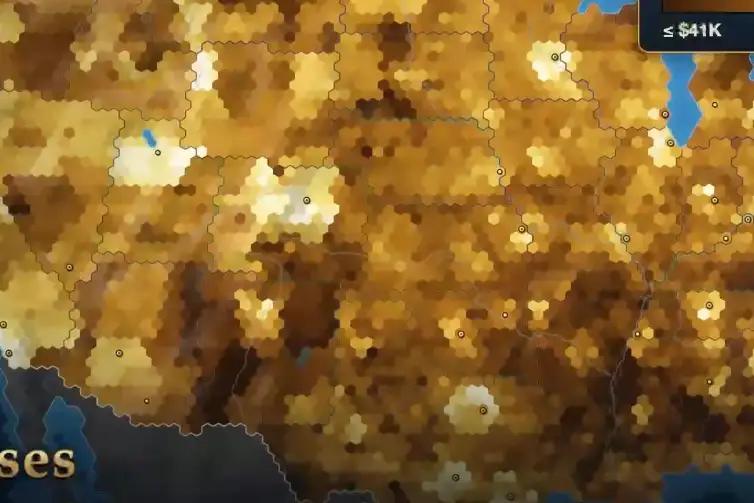
Artificial intelligence is increasingly changing how software is developed, with coding tools now capable of building complex applications with minimal human intervention. In a recent experiment, AI researcher Andrej Karpathy used Anthropic's Claude Code to create an interactive, game-inspired map of the United States using real-world data.
The project took approximately seven hours to complete and involved generating nearly 45,000 lines of code while combining information from dozens of public databases into a single interactive platform.
Karpathy shared details of the experiment in a social media post on Thursday, November 26, explaining how he asked Claude to populate a map resembling the popular strategy game Civilisation with real data about the US.
"I asked Claude to populate a Civilisation-style game map with real data from the US. Opus 5.5 downloaded and parsed a ton of public data and 7 hours and 45K lines of code later... it works."
He said the result was an unexpectedly engaging application that could potentially be developed further into a full-fledged game.
"I don't exactly know where I was going with this, but it's really fun to browse and play with. Possibly it can be expanded or built into a game. I only have half of my weekly Claude quote left, though, so someone else will have to take over."
How Claude Code built the interactive US map
The application combines information gathered from 31 different sources, including government databases and public datasets, to offer a detailed picture of the United States.
Instead of presenting the information through conventional maps and statistical dashboards, the project adopts the visual language of Civilisation. It divides the country into hexagonal geographical sections, with each tile covering approximately 25 km.
The individual sections can display different categories of real-world information, including population, household income, employment, power generation facilities, mines, airports, national parks, universities and natural disasters.
The game-inspired presentation also assigns characteristics to locations based on their economic and industrial activities. Economic output, for instance, is represented through a gold-based system, while cities receive attributes reflecting their dominant industries.
San Jose, California, known for its technology industry, is represented by a 'Campus', while Detroit, traditionally associated with automobile manufacturing, appears as 'Motor City'.
Employment information is also incorporated into the map, allowing users to explore the occupational composition of different cities and understand how economic activity varies across regions.
The platform offers 19 different ways to examine the country's geographical and socioeconomic characteristics, including income levels, educational patterns and natural disasters.
Users can also explore information covering 524 metropolitan areas and more than 3,100 counties, with additional tables and charts providing access to the underlying data.
The project draws on datasets from several US government agencies, including those responsible for population statistics, economic activity, employment, energy, weather, geological surveys, aviation and national parks. By bringing these datasets together on a common geographical grid, the application allows users to compare different aspects of the country through a single interface.
Who is Andrej Karpathy?
Andrej Karpathy is an artificial intelligence researcher, computer scientist and educator known for his work in deep learning, computer vision and neural networks.
He was among the founding members of OpenAI, where he worked on deep learning research and helped develop educational resources on artificial intelligence. He later joined electric vehicle maker Tesla as director of artificial intelligence, leading its computer vision team working on the company's Autopilot technology.
Karpathy returned to OpenAI in 2023, working on areas including model training and synthetic data generation. He left the company in 2024 and subsequently focused on independent research and educational projects.
In May 2026, he joined Anthropic's pretraining team, which works on large-scale training runs that establish the foundational capabilities of the company's AI models.
He also has an academic background from Stanford University, where he completed his PhD in computer science and helped develop and teach the university's popular CS231n course on convolutional neural networks for visual recognition.
Published: 29 Nov 2026, 03:13 pm IST


ABOUT THE AUTHOR

Related Topics
Disclaimer: Kindly avoid objectionable, derogatory, unlawful and lewd comments, while responding to reports. Such comments are punishable under cyber laws. Please keep away from personal attacks. The opinions expressed here are the personal opinions of readers and not that of Mathrubhumi.