
Lionel Messi’s Argentina career began with a red card and ended with a goal, bringing an extraordinary 21-year international journey full circle.
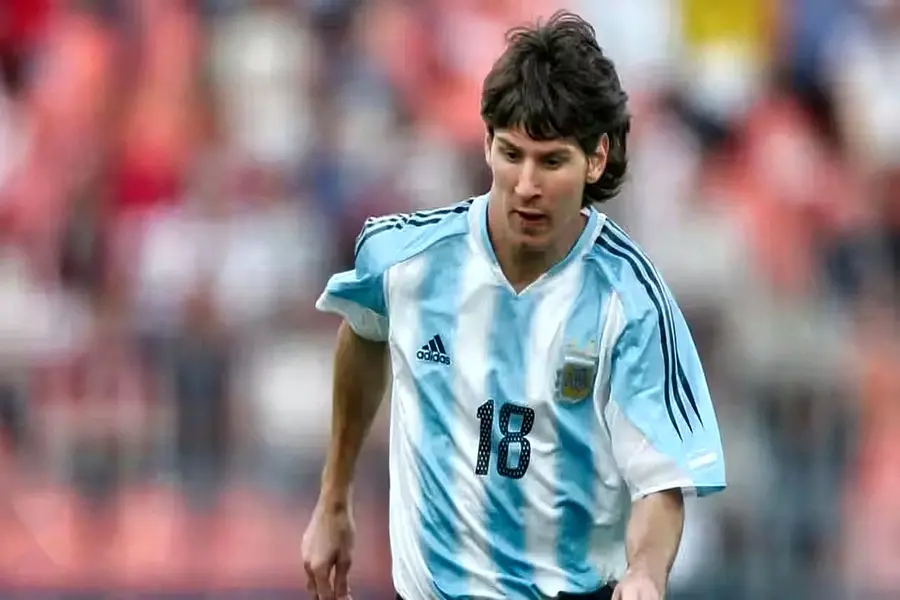
As many as 21 years separated the two moments, but the contrast could hardly have been greater.
On August 17, 2005, an 18-year-old Messi walked onto the pitch in Budapest for his senior Argentina debut against Hungary.
He had only just emerged as one of the country's brightest young talents after starring at the FIFA Under-20 World Cup, where he helped Argentina win the title and claimed both the Golden Boot and Golden Ball.
Then came a debut nobody could have scripted.
Coach Jose Pekerman sent Messi on in the second half, replacing Lisandro Lopez. Within seconds, the teenager clashed with Hungary defender Vilmos Vanczak.
Messi tried to free himself after Vanczak grabbed his shirt, and the defender caught him with his arm. German referee Markus Merk showed him a straight red card.
FIFA records Messi's time on the pitch at just 47 seconds. The Argentine Football Association's own account puts it at 92 seconds, reflecting a difference in how the incident is timed.
Either way, his first senior appearance ended almost as soon as it began. Among the Argentina players on the field that night was Lionel Scaloni.
After 21 years, Scaloni was no longer Messi's teammate. He was the Argentina coach standing beside him for his final farewell.
On October 6, 2026, Messi walked out at Buenos Aires' Monumental Stadium for the last time in Argentina colours. This time there was no uncertainty about who he was or what he meant to the country.
A giant No. 10 jersey bearing the word "GRACIAS" stood on the pitch. More than 85,000 supporters packed the stadium. Messi entered alongside his children and was visibly emotional during the national anthem. Unlike his first appearance, he didn't leave early.
Messi started Argentina's friendly against Benin and helped his team win 3-0. He assisted Nicolas Otamendi's goal early in the second half before scoring from the penalty spot in the 71st minute.
It was a fitting final contribution from a player who had spent more than two decades trying to give Argentina what it wanted most.
The teenager who once left the pitch in Budapest after a red card was now leaving the Monumental after scoring in his final Argentina appearance, with the stadium standing to celebrate him.
Between those two nights came almost an entire footballing lifetime.
Messi endured World Cup disappointment, three consecutive major tournament final defeats between 2014 and 2016, and criticism from sections of Argentine football fans who questioned whether he possessed the same emotional connection to the national team as Diego Maradona.
After Argentina lost the 2016 Copa América final to Chile, Messi briefly announced his international retirement.
But the story changed.
He returned, became Argentina's captain under Scaloni and eventually led the country to the Copa América title in 2021, the Finalissima in 2022 and, most importantly, the 2022 FIFA World Cup in Qatar. He later added another Copa América title in 2024.
By the time he played his final match, Messi had become Argentina's record goalscorer and appearance holder, finishing his international career with more than 200 appearances and 125 goals according to pre-match Reuters reporting.
That is what makes the symmetry so striking.
His Argentina story started with a teenager being sent off. It ended with a legend scoring one last time.
In Budapest, Messi was the unknown kid who had barely been given time to introduce himself. In Buenos Aires, he needed no introduction.
The red card that once threatened to become the defining image of his Argentina debut had become nothing more than the opening scene of a 21-year story.
The final image was fittingly different: Messi, the No. 10, celebrating a goal before turning to the people who had spent years watching him, doubting him, defending him, loving him, and, eventually, refusing to let him leave without saying goodbye.
Published: 07 Oct 2026, 07:50 am IST
ABOUT THE AUTHOR

Related Topics
Disclaimer: Kindly avoid objectionable, derogatory, unlawful and lewd comments, while responding to reports. Such comments are punishable under cyber laws. Please keep away from personal attacks. The opinions expressed here are the personal opinions of readers and not that of Mathrubhumi.