
The victory also gave the packed Monumental one final chance to celebrate the player who helped Argentina win two Copa América titles and the 2022 World Cup.
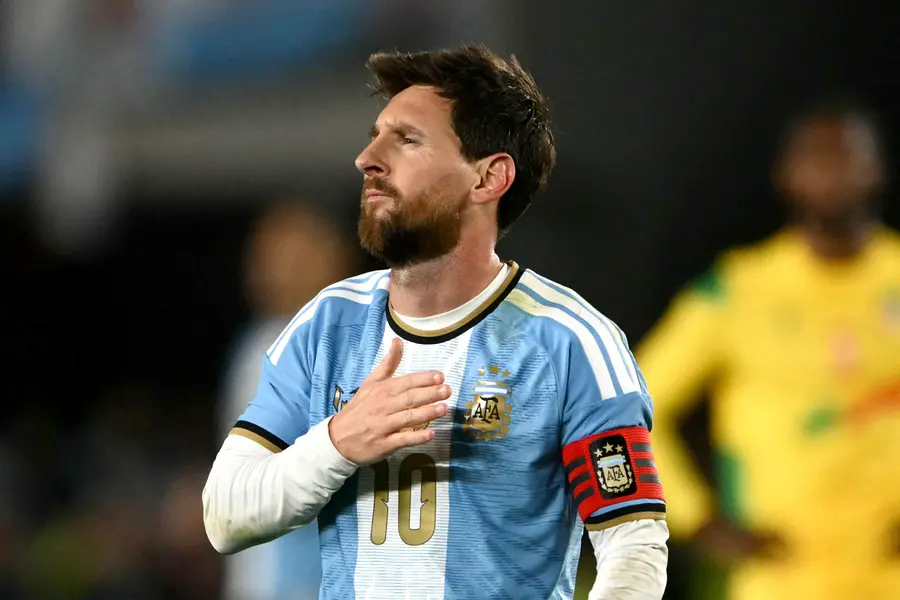
Lionel Messi signed off from international football in fitting fashion, scoring in his final appearance for Argentina as the team beat Benin 3-0 in Buenos Aires on Tuesday.
Playing his final match for the national team, Messi converted a penalty in the 71st minute at a sold-out Estadio Monumental, sending the ball to his right and sparking a huge celebration from the home crowd.
The goal made it 3-0 and marked the final strike of Messi’s 21-year Argentina career.
Argentina had taken control in the second half through goals from Nicolás Otamendi and Nico Paz, with Messi providing the assist for both.
The home side then won a penalty, and there was little doubt about who would take it. Messi stepped up and calmly buried the spot kick to give Argentina a three-goal lead.
It was a fitting ending for the 39-year-old, who leaves the national team as its record goalscorer and one of the most decorated players in its history.
The victory also gave the packed Monumental one final chance to celebrate the player who helped Argentina win two Copa América titles and the 2022 World Cup.
Messi will continue his club career with Inter Miami, but Tuesday’s match marked the end of his remarkable international journey.
The Argentine soccer federation turned Tuesday’s game — Messi’s 208th — into a national farewell billed as “the last tango.” More than 85,000 tickets to Buenos Aires’ largest stadium sold out in 90 minutes, later fetching over $2,500 on resale sites. Players from Argentina’s 1978, 1986 and 2022 World Cup-winning squads, along with their families, joined the tribute.
Accompanied by his three sons, Messi emerged onto the field to fireworks, his eyes glistening. Chants of “ME-SSI! ME-SSI!” rolled through the stands as fans bowed toward him. A giant replica of his No. 10 Argentina jersey was unfurled across the pitch, bearing a simple message: “Gracias.”
During the 2000s and 2010s, Messi amassed trophies with his club and won die-hard fans from Barcelona to Bangladesh. Yet a major championship for his own country eluded him.
Where the world saw a supernatural talent, some at home saw an outsider who had never played professionally in Argentina and seemed to buckle under the weight of their expectations. Argentine crowds chanted “Diego, Diego,” invoking Diego Maradona, the larger-than-life hero of Argentina’s 1986 World Cup victory — and reminding Messi of the standard he had yet to meet. Messi’s quiet reserve, so at odds with Maradona’s defiant swagger, fueled doubts about his patriotism.
After Argentina lost a third consecutive final in 2016, Messi briefly quit the national team.
“There’s some resentment by the people that stay in Argentina for those who leave, this sense of, ‘They think they’re better than us,’” said Rabinovich, adding that he identifies with Messi as a fellow teenage migrant, having moved to Canada during Argentina's 2001 economic crisis, around the time Messi left for Europe. “The old-school Argentines would say, ‘Diego is the Argentine. Messi is soft, a little Spanish boy.’”
The turning point came in 2021, when Argentina beat Brazil to win the Copa América, South America’s championship, for the first time in 28 years. Messi collapsed to the turf as his teammates, delirious, ran to hug him. The player long accused of feeling too little could not stop sobbing.
“Winning clearly disarmed his critics. That’s how soccer works in Argentina,” said Diego Murzi, a sports sociologist at Conicet, Argentina’s national scientific research council. “Criticism of things off the field goes hand in hand with defeats on it.”
The World Cup victory the following year in Qatar sealed his place as a national hero. Messi had delivered the one prize that had eluded him, and millions of Argentines poured into the streets in collective ecstasy, his name in their chants and his No. 10 on their backs.
“I’ll never forget it. I’d never experienced anything like that, being out there with everyone, celebrating together,” said Antonia Correa, 70, a kiosk owner recalling that day as she waited for a bus in Buenos Aires on Tuesday. “We saw that he wasn’t just an extraordinary player, but an excellent human being.”
In recent weeks, newspapers have hummed with nostalgic tributes and murals celebrating Messi have sprung up across the country. La Nación, a leading Argentine daily newspaper, released “Immortal,” a documentary chronicling his final World Cup run, and published a 196-page special edition devoted to his career. The iconic Obelisk in downtown Buenos Aires on Tuesday glowed sky blue and white, the colors of the national flag. And in Patagonia, a 26-meter (85-foot), 70-ton statue of Messi kneeling with the World Cup trophy has towered over passing motorists since June.
Across Argentina, fans who grew up watching Messi as their parents watched Maradona now carry him on their skin, in tattoos of him kissing the World Cup trophy. It was easy to believe the world’s greatest player would always be one of their own. Now even Messi’s No. 10 shirt has no designated heir, with coach Lionel Scaloni saying the decision would wait until after his final match.
“I don’t think we’ll have somebody like him again, somebody with that sort of enduring power,” said Pablo Brescia, a University of South Florida professor who writes about Argentine culture and soccer. “Like Maradona, he’ll be unique — a figure that can’t be repeated.”
Messi’s contract with Inter Miami runs through the 2028 season. But the charged ritual of watching him carry Argentina’s hopes and anxieties into every match is ending.
“Watching Messi play, you felt anything could happen,” Murzi said. "I’ve seen him do things that I don’t think I’ll ever see another player do.”
Published: 07 Oct 2026, 07:15 am IST
ABOUT THE AUTHOR

Related Topics
Disclaimer: Kindly avoid objectionable, derogatory, unlawful and lewd comments, while responding to reports. Such comments are punishable under cyber laws. Please keep away from personal attacks. The opinions expressed here are the personal opinions of readers and not that of Mathrubhumi.