
India's men's football team has plunged to 142nd in the FIFA rankings, their lowest since 2016.
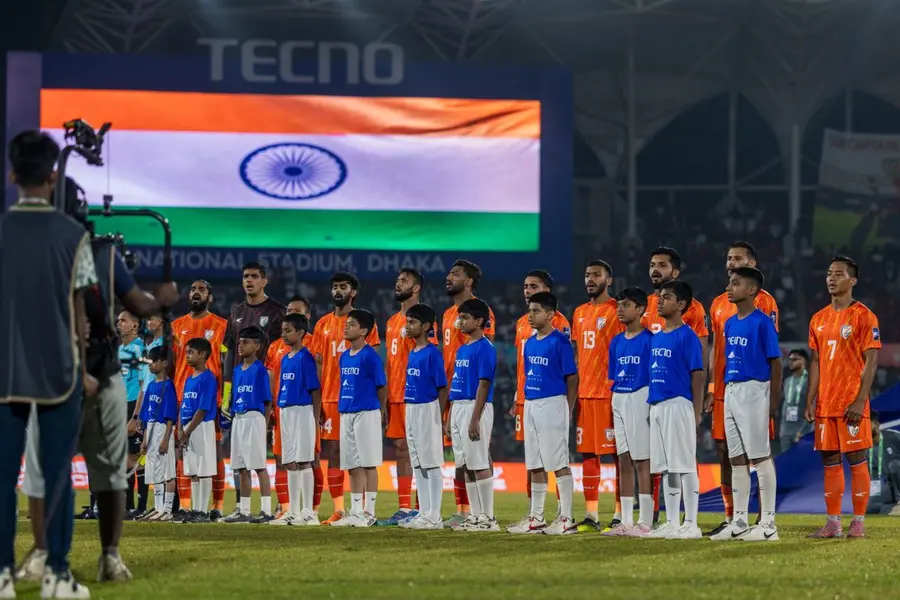
India's men's football team fell six places to 142nd in the latest FIFA rankings released Wednesday, marking their lowest position since October 2016 and capping a dramatic two-year decline for the Blue Tigers. The drop follows a painful 0-1 defeat to Bangladesh in Dhaka on November 18, India's first loss to their neighbours since 2003. The defeat, which came in the 2027 Asian Cup qualifiers, left India bottom of Group C with just two points from five matches. Bangladesh's Shekh Morsalin scored the only goal in the 11th minute after Rakib Hossain broke down India's defence on a counterattack.
India has now lost 40 places since December 2023, when they were ranked 102nd. The team lost 17.13 coefficient points in this latest update, representing the joint-biggest drop alongside El Salvador. The ranking is India's worst in nine years, with the team positioned at 148th in October 2016.
Head coach Khalid Jamil, appointed in August as India's first domestic manager in 13 years, has struggled to reverse the team's fortunes. The Bangladesh match marked India's third consecutive game without a win in the qualifiers, following their elimination from Asian Cup contention after a 1-2 home loss to Singapore in October.
Among Asian nations, India now ranks 27th out of 46 countries, with Japan leading the continent at 18th globally, followed by Iran (20th), South Korea (22nd), and Australia (26th). Bangladesh climbed three places to 180th after their victory.
What ails Indian football?
India's freefall in football standards is the result of systemic neglect, lack of investment and planning at the grassroots, underwhelming domestic competition, coaching deficiencies, poor management, and talent pipeline failures -- exacerbated in 2025 by off-field chaos.
Weak grassroots and poor infrastructure: A key structural problem is India's weak grassroots system, which lacks consistent talent scouting, quality academies, and adequate playing facilities -- especially outside major cities. The absence of a country-wide curriculum and coordinated player development pathways limits the emergence of high-quality talent.
Inconsistent and subpar coaching: Frequent changes in coaching staff, lack of continuity, and training methods that are not on par with global standards further hinder player development. Indian coaches often lag behind modern football tactics and sports science, while foreign coaches are unable to build long-term programs due to administrative instability.
Domestic league limitations: Despite the Indian Super League raising football’s profile, its short season, limited competitiveness, and an overreliance on foreign players reduce opportunities for domestic talent to gain meaningful, high-pressure match experience. The traditional I-League also suffers from poor management and low visibility, ensuring that promising local talent does not transition effectively to the national team.
Administrative mismanagement and instability: There has been widespread criticism of mismanagement by Indian football authorities, with leadership crises, factional control within the federation, and a lack of a coherent national football policy. Off-field turmoil, including uncertainty about the future of the ISL, further demoralises players and fans and disrupts long-term planning.
Lack of professionalism and competitive mentality: The financial bubble created by inflated domestic salaries incentivises mediocrity, with few players testing themselves abroad or pushing personal limits. This has produced a squad with limited hunger to excel at the international level.
Retirement of key players: The retirement of iconic striker Sunil Chhetri exposed the lack of depth in Indian football's player pool. His brief return in 2025 was a symptom of the sport’s overdependence on a single star and the failure to develop quality successors over the past decade.
Historical context
India's best-ever FIFA ranking was 94th in February 1996. The team had shown promise in recent years, reaching 96th in 2017 after qualifying for the 2019 Asian Cup and remaining unbeaten throughout that calendar year. However, a string of poor results in 2024 and 2025 has sent the team into freefall.
The Blue Tigers won just three of 11 international matches in 2025, playing under multiple coaches. The team's struggles have been compounded by the retirement of legendary striker Sunil Chhetri in June 2024, though he briefly returned to the squad in March 2025 before the current campaign.
With no matches remaining in 2025, India is set to finish the year at 142nd -- a sobering conclusion to what has been one of Indian football's most challenging periods.
Published: 21 Nov 2025, 09:00 pm IST
Related Topics
Disclaimer: Kindly avoid objectionable, derogatory, unlawful and lewd comments, while responding to reports. Such comments are punishable under cyber laws. Please keep away from personal attacks. The opinions expressed here are the personal opinions of readers and not that of Mathrubhumi.
