
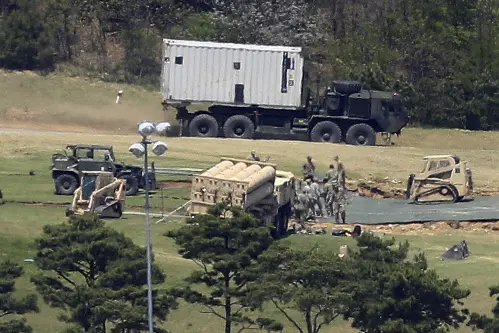
In a significant development that could escalate the crisis in the Middle East, reports indicate that the U.S. is planning to deploy its THAAD defense system in Israel.
Following this development, Iran on Sunday warned the US to keep its military forces out of Israel. Meanwhile, Israel has been escalating its campaign against Hezbollah with waves of heavy airstrikes across Lebanon and a ground invasion at the border after a year of exchanges of fire. Israel is now at war with Hamas in Gaza and Hamas' ally Hezbollah in Lebanon.
What is THAAD?
The Terminal High Altitude Area Defense (THAAD) missile system is a sophisticated weapon designed to intercept and destroy short, medium, and intermediate-range ballistic missiles during their terminal phase of flight. Developed by Lockheed Martin for the U.S. Army, THAAD is part of the United States' multi-layered missile defense strategy, aimed at protecting critical assets and populations from aerial threats.
THAAD operates using a combination of advanced radar systems and interceptors. The AN/TPY-2 radar detects incoming threats, while the THAAD interceptor engages targets at high altitudes, allowing it to neutralize missiles before they can reach their intended targets. This capability is crucial for nations facing the threat of missile attacks, particularly in regions with heightened tensions.
The system has been deployed in various locations worldwide, including South Korea, to counter threats from North Korea. Its deployment has often stirred controversy, eliciting strong reactions from neighbouring countries concerned about regional security dynamics.
U.S. offer of THAAD to Israel
In the context of Israel's ongoing military operations in Lebanon, reports emerged that the USA would deploy THAAD in Israel to counter any potential attacks from Iran. The offer comes as Israel faces significant threats from Hezbollah and other militant groups, raising concerns about missile strikes on Israeli territory.
The integration of THAAD would significantly bolster Israel's missile defence architecture, complementing existing systems like the Iron Dome and David's Sling. This enhanced capability could provide a more robust shield against potential missile strikes, particularly during escalated conflicts.
The decision to provide THAAD could evoke mixed reactions from the international community. While Israel may welcome the support, other nations could criticize the move as exacerbating regional conflicts. Diplomatic efforts might be needed to mitigate backlash and promote dialogue.
Published: 13 Oct 2024, 07:47 pm IST
Related Topics
Disclaimer: Kindly avoid objectionable, derogatory, unlawful and lewd comments, while responding to reports. Such comments are punishable under cyber laws. Please keep away from personal attacks. The opinions expressed here are the personal opinions of readers and not that of Mathrubhumi.
