
The latest round of demonstrations began on October 13, when hundreds of people assembled outside Albania's education ministry.
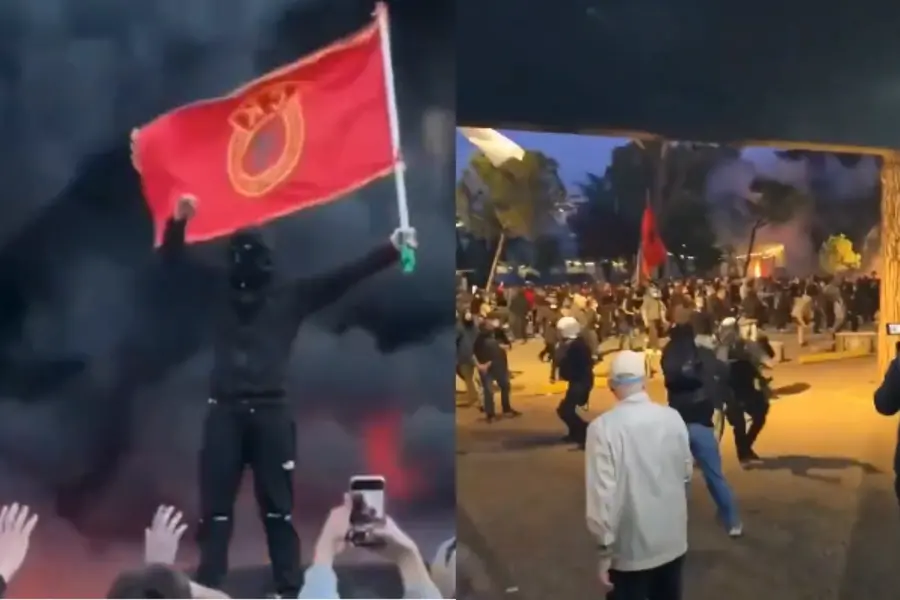
Tirana: Albania is witnessing some of its most intense anti-government demonstrations in recent months, with thousands of protesters demanding Prime Minister Edi Rama's resignation over education costs, university conditions and wider dissatisfaction with his administration. The latest unrest follows months of demonstrations that initially erupted over a controversial luxury resort development linked to US President Donald Trump's family.
The protests took a violent turn on Tuesday, October 13, triggering four consecutive days of clashes between demonstrators and security forces in the capital, Tirana.
By Friday, the violence had left 156 people injured, including 97 police officers, according to Interior Minister Ervin Demo. Police also reported taking 160 people into custody on Thursday over their alleged involvement in violent incidents.
Scenes of burning barricades, damaged government buildings and clashes with riot police have dominated the capital. Security personnel have used tear gas and water cannons to disperse crowds, while groups of protesters have thrown stones, vandalised shops and blocked roads with burning rubbish bins.
The demonstrations have also reached other parts of the Balkan country, accompanied by student boycotts of universities and renewed calls for Rama to relinquish power.
The prime minister, however, has blamed unidentified foreign interests for encouraging the unrest, alleging that the violence is intended to destabilise Albania and interfere with its efforts to secure European Union membership.
How did the protests begin?
The origins of the current political unrest can be traced to a dispute over a proposed high-end tourism development on Albania's southern coastline.
The project, associated with an investment company linked to Jared Kushner, the son-in-law of Donald Trump, attracted opposition from residents and environmental campaigners concerned about its potential impact on coastal ecosystems and disputed land ownership.
Demonstrations against the development began in May, gradually evolving into a broader campaign against Rama's government.
For many protesters, the resort controversy came to represent deeper frustrations over the government's development priorities and its handling of public resources.
Critics questioned why major tourism investments appeared to receive government attention while ordinary citizens continued to struggle with economic pressures and inadequate public services.
The dispute also brought allegations concerning land transactions into the spotlight.
Reuters previously reported that some residents alleged their land had been improperly sold in connection with the development. However, the news agency found no evidence of wrongdoing by Kushner, who was not directly involved in the villagers' dispute.
Although the resort project helped mobilise the initial demonstrations, the movement subsequently expanded to encompass concerns about education, economic opportunities and political accountability.
Why have students joined the movement?
Education has emerged as one of the central issues driving the latest phase of Albania's protests.
Students have been demanding reductions in university tuition fees, improvements to educational infrastructure and better employment prospects after completing their studies.
Their concerns extend beyond university campuses. Many young people believe that rising living expenses and limited career opportunities are making it increasingly difficult to establish a stable future in Albania.
Frustration over perceived corruption and the influence of political connections on employment opportunities has further strengthened opposition to the government.
The demonstrations have drawn participation from university students and younger protesters, many of whom say they want meaningful reforms rather than political confrontation.
"We are not criminals. We simply want a better life for our parents and ourselves. We do not want to leave Albania," 18-year-old Ledia told AFP.
The high school student, who requested that only her first name be published, accused the authorities of ignoring the concerns raised by protesters.
"The government's indifference and arrogance since the beginning of our movement have been unbearable and made the situation worse," she said.
For young demonstrators such as Ledia, the protests reflect a desire to build their futures in Albania rather than seek opportunities abroad.
As the movement gathered momentum, demands for improvements in education became increasingly linked to calls for Rama's resignation.
What led to the violent clashes in Tirana?
The latest round of demonstrations began on October 13, when hundreds of people assembled outside Albania's education ministry.
Protesters shouted "Rama resign!" as they demanded government action on tuition fees and university conditions.
The gatherings soon grew into larger demonstrations, with thousands joining protests across the capital.
Confrontations escalated as some participants began throwing stones at police and attempting to enter government premises.
Security forces responded by deploying tear gas and water cannons, while several demonstrators were detained.
The situation deteriorated further over the following days.
Masked groups were seen smashing shop windows and looting businesses, while government buildings, including the finance ministry, were attacked.
On Friday, protesters attempted to force their way into offices along Tirana's main boulevard, according to AFP journalists covering the demonstrations.
Burning rubbish bins were placed across roads, disrupting movement through parts of the city. Clashes between protesters and police continued into the night.
Authorities said the violence had resulted in 156 injuries, with police personnel accounting for 97 of those affected.
Interior Minister Ervin Demo condemned the attacks and suggested that certain groups were using the demonstrations to pursue political objectives.
"I would also like to remind you that we have far more reason to come together and work for the good of our country than to clash. This is a disguised attempt by those who seek to seize power through violence," Demo said in a statement.
The government also acknowledged concerns about police conduct during the unrest.
Demo said two instances of excessive force had been identified, resulting in the suspension of two police officers.
Reports of demonstrations and student boycotts have also emerged from other Albanian cities, indicating that the discontent is not confined to Tirana.
Why has Edi Rama accused foreign forces of fuelling the protests?
Rather than accepting that the escalating violence reflects public dissatisfaction, Rama has alleged that outside interests are attempting to exploit the demonstrations for political purposes.
The Socialist prime minister claimed that the unrest was being encouraged by forces seeking to undermine Albania's stability and derail its European integration efforts.
In a statement issued on Friday, Rama argued that the violence had "absolutely nothing to do with the hardships, problems or legitimate aspirations of anyone who desires a better life".
He suggested that the same forces responsible for earlier episodes of political instability were behind the latest disturbances.
"All of this is the work of the very same hand, the hand that has gripped the Albanian opposition by the throat, the hand that has burned and destroyed Albania more than once."
Rama subsequently reinforced his allegations in a video published on Facebook.
"These are foreign hands that do not wish for Albania to be at peace," he said.
The prime minister did not identify the countries, organisations or individuals allegedly responsible for encouraging the unrest.
Nor did he present evidence establishing foreign involvement.
His remarks follow a pattern of accusing political opponents and external interests of manipulating anti-government demonstrations.
The government has maintained that political disputes should be resolved through democratic institutions rather than violence on the streets.
However, protesters continue to insist that their concerns about education, economic conditions and government accountability deserve attention.
What is Donald Trump's family connection to the protests?
The Trump family connection arises from the controversial tourism project associated with Jared Kushner, Trump's son-in-law.
The proposed development on Albania's southern coast has attracted criticism from residents and environmental groups concerned about the potential consequences of large-scale construction in ecologically sensitive areas.
Questions have also been raised about land ownership, the approval process and the government's treatment of major foreign investment proposals.
For opponents of the project, the controversy became an example of what they considered the administration's willingness to prioritise powerful investors over local communities.
The demonstrations that emerged around the development eventually became part of a much wider movement challenging Rama's leadership.
However, the current unrest cannot be attributed solely to the Kushner-linked project.
Education expenses, university conditions, economic pressures and broader dissatisfaction with the government have become major factors behind the latest protests.
The movement has consequently brought together people with different grievances, united by demands for political accountability and changes in government policy.
Could the protests affect Albania's plans to join the European Union?
The unrest has erupted at a time when Albania is seeking to advance its long-running efforts to become a member of the European Union.
Rama has placed European integration at the centre of his government's agenda, with an ambition to secure membership as early as 2028.
However, the political turmoil has raised questions about the country's ability to maintain stability while addressing concerns over corruption, democratic accountability and the rule of law.
The European Union delegation in Albania has expressed concern about the violence and urged restraint from both protesters and security forces.
The government argues that continued unrest could damage Albania's international standing and complicate its path towards EU membership.
Those participating in the demonstrations, meanwhile, contend that stronger democratic institutions, greater transparency and improvements in public services are essential to the country's European ambitions.
The competing positions have placed Rama under growing pressure.
His Socialist Party secured a fourth consecutive electoral victory in 2025, with the next parliamentary elections expected in 2029.
For now, the prime minister has shown no indication that he intends to resign.
Published: 17 Oct 2026, 08:27 am IST
ABOUT THE AUTHOR

Related Topics
Disclaimer: Kindly avoid objectionable, derogatory, unlawful and lewd comments, while responding to reports. Such comments are punishable under cyber laws. Please keep away from personal attacks. The opinions expressed here are the personal opinions of readers and not that of Mathrubhumi.