
Many cardinals have expressed a desire to continue Pope Francis' pastoral focus on marginalised communities and opposition to war.
Vatican City: Catholic cardinals announced that the conclave to select a successor to Pope Francis will commence on May 7. The vote, initially set to start on May 5 or 6, has been delayed for two days to allow the cardinals time to engage in informal meetings and build consensus on a candidate before they enter the Sistine Chapel for the secret voting process.
The announcement came on the first day of informal discussions after Pope Francis' funeral on Saturday. The scene outside was chaotic, with journalists shouting questions about the atmosphere inside and the possibility of unity. A reporter from an Italian satirical TV programme even asked whether an Italian cardinal, convicted of finance-related charges by the Vatican criminal court, would be allowed to vote.
While the conclave could have begun earlier, the cardinals have chosen to give themselves more time to speak with one another in less formal sessions. These discussions will include cardinals over the age of 80, who will not be allowed in the Sistine Chapel once the conclave officially starts.
“There is the hope of unity,” said Cardinal Ángel Sixto Rossi, the 66-year-old archbishop of Cordoba, whom Pope Francis appointed as a cardinal in 2023.
Many cardinals have expressed a desire to continue Pope Francis' pastoral focus on marginalised communities and opposition to war. However, some conservatives are more focused on achieving unity and realigning the Church with the core doctrines emphasised by St John Paul II and Pope Benedict XVI, rather than continuing Francis' emphasis on social justice and outreach to women and the LGBTQ+ community.
British Cardinal Vincent Nichols, 79, the archbishop of Westminster, emphasised the importance of unity, downplaying any divisions.
“The role of the pope is to essentially hold us together and that’s the grace we’ve been given from God,” Nichols remarked.
Venezuelan Cardinal Baltazar Enrique Porras Cardozo expressed confidence that the conclave would come to a decision quickly once it began, estimating it would take "between two and three days”.
The College of Cardinals responsible for electing a new pope consists of members from across the globe, whom Pope Francis appointed during his 12-year papacy to bring fresh perspectives. Many of these cardinals have not spent much time in Rome or had the chance to build relationships with their colleagues, creating some uncertainty in the process. The voting requires two-thirds of the cardinals to support one candidate.
Cardinal Nichols acknowledged that the 135 cardinal electors — 108 of whom were appointed by Pope Francis — do not know each other well. The last 20 cardinals were appointed only in early December.
“We’ve got all week,” Nichols said as he arrived for the meetings.
Only cardinals under the age of 80 are eligible to vote, and it remains unclear how many of the 135 cardinals will participate. A Spanish cardinal has already stated that he will not attend due to health reasons.
A significant point of uncertainty surrounds Cardinal Angelo Becciu, once one of the Vatican's most powerful figures. Becciu was forced to resign as head of the Vatican’s saint-making office in 2020 and relinquished his rights as a cardinal after being implicated in a financial scandal. Despite denying any wrongdoing, Becciu was convicted of embezzlement and financial fraud by the Vatican's criminal court in December 2023, though he is appealing the verdict.
Becciu has participated in the pre-conclave meetings, but there is ongoing debate about whether he is allowed to vote. Official Vatican documents list him as a “non-elector.” When he was dismissed in 2020, Becciu claimed he would not vote in future conclaves, but he has since argued that he is entitled to participate. Canon lawyers are currently reviewing the Vatican’s regulations to determine if he is indeed eligible.
The matter was discussed among the cardinals on Monday, but the Vatican reported that no resolution was reached.
While Pope Francis has appointed many cardinals during his papacy, it is not guaranteed that all of them will seek to continue his vision for the church.
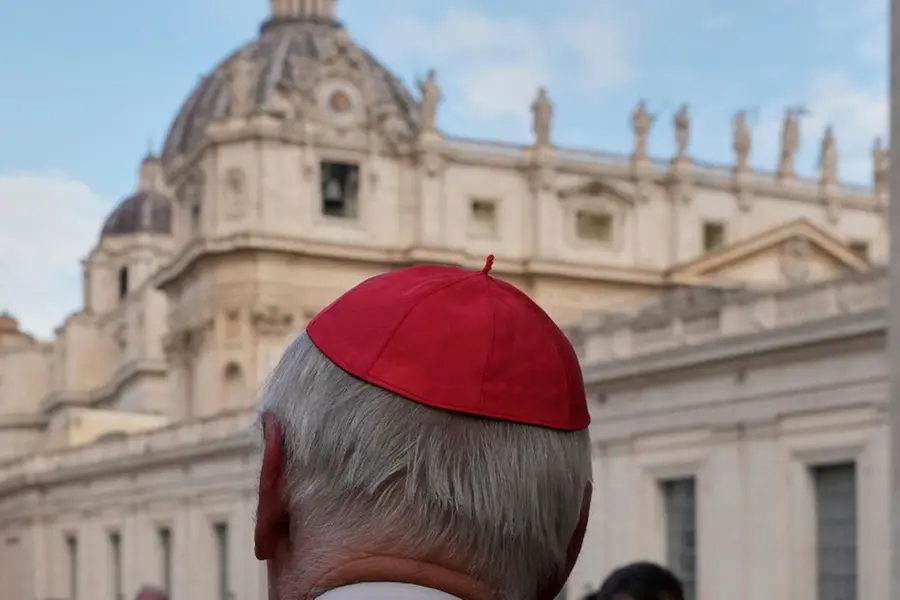
On Monday, the appearance of a red hat along St. Peter’s Square had journalists rushing with cameras and voice recorders to capture any hint of the mood inside.
Italian Cardinal Matteo Zuppi, considered a potential papal candidate, navigated through the journalists with humor, joking that he was "holding his breath" as the microphones and cameras surrounded him all the way to the Vatican gate.
When Nigerian Cardinal John Olorunfemi Onaiyekan, emeritus archbishop of Abuja, was asked about the African cardinals' potential support for a specific candidate, he downplayed any political rallies.
“We have not come here for a political rally. We have come to get a pope out,” said Onaiyekan, who, though too old to vote, may influence the younger electors.
Indian Cardinal Anthony Poola, 61, archbishop of Hyderabad, noted a sense of unity among the cardinals, although he acknowledged that "anything could happen." As a relatively young cardinal, Poola is one of four Indian electors in the conclave, three of whom were appointed by Pope Francis.
“Anyone who is coming up must be the successor of St. Peter, and we all hope that he will be a good pope,” Poola remarked.
Cardinal Rossi, from Argentina, expressed hope that Pope Francis' message of “mercy, closeness, charity, tenderness, and faith" would guide the electors in choosing a successor.
But he also admitted the process was daunting. When asked how he felt about participating in his first conclave, Rossi laughed and replied: “Afraid?”
Published: 28 Apr 2025, 07:05 pm IST
Related Topics
Disclaimer: Kindly avoid objectionable, derogatory, unlawful and lewd comments, while responding to reports. Such comments are punishable under cyber laws. Please keep away from personal attacks. The opinions expressed here are the personal opinions of readers and not that of Mathrubhumi.
