
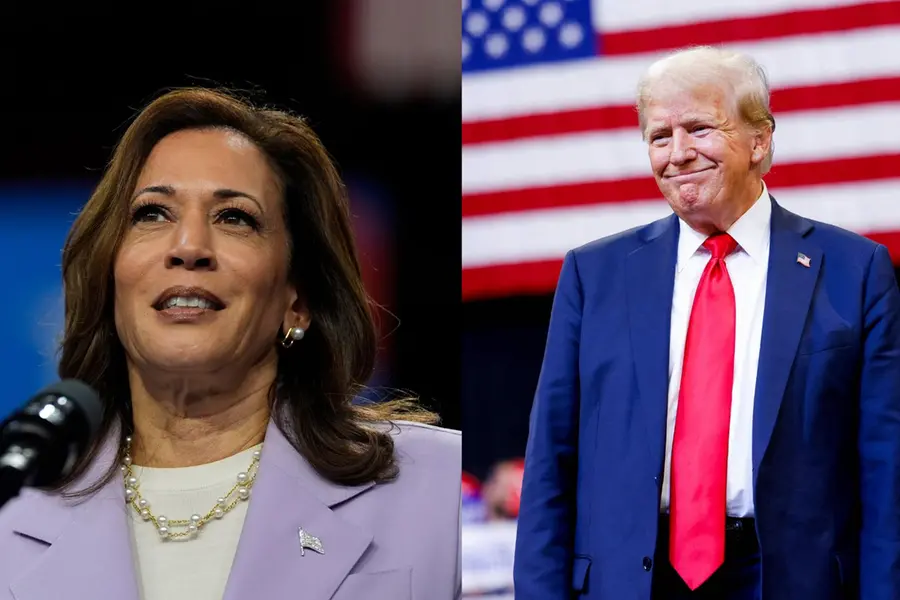
Charlotte: Vice President Kamala Harris and former President Donald Trump launched campaign blitzes Thursday, offering dramatically different approaches to attract swing-state voters who will decide the presidential contest.
In North Carolina, Harris, the Democratic nominee, held rallies in Charlotte and Greensboro where she highlighted endorsements from Republicans who have crossed the aisle to support her. She vowed to protect access to health care and abortion, and celebrated her debate performance Tuesday with partisan crowds, taking digs at Trump and promoting her vision for the country.
“We're having a good time, aren't we?” Harris asked, smiling as her boisterous crowd chanted: “USA! USA! USA!”
Meanwhile, in the border state of Arizona, Trump, the Republican contender, introduced a tax exemption on all overtime wages, adding to his earlier proposals not to tax tips or Social Security income. However, his policy pitches were overshadowed by a fiery speech filled with incendiary rhetoric on immigration, name-calling of Harris and others, and a bleak portrayal of a nation that he claimed is in freefall—a situation he insisted only he could reverse.
“I was angry at the debate,” Trump said, mocking commentators' description of his performance Tuesday. “And, yes, I am angry,” he continued, blaming Harris and President Joe Biden for “destroying our country.” His crowd in Tucson echoed his sentiments, responding with chants of “USA! USA! USA!”
The contrasting narratives underscored the starkly different choices facing voters in battleground states. Harris is appealing to Democrats' diverse coalition, aiming to draw in moderate and even conservative Republicans disenchanted with Trump. In contrast, Trump is solidifying his base with arguments targeted at his most ardent supporters, while also seeking to broaden his appeal with working-class voters through tax proposals.
This campaign dynamic could define the closing stretch after Trump ruled out participating in another debate, potentially missing another key moment in a year already marked by significant events: Trump’s criminal conviction by a New York jury, his survival of an assassination attempt, Biden ending his re-election bid amid age-related concerns, and Harris consolidating Democratic support as the first woman of colour to lead a major-party ticket.
“There will be no third debate,” Trump declared Thursday, counting his June matchup against Biden as part of the total, and claiming victory in his lone debate with Harris on Tuesday in Philadelphia.
The post-debate efforts reflect the narrow path to 270 Electoral College votes for both candidates, with the campaign now concentrated on seven key swing states: Arizona, Georgia, Michigan, North Carolina, Nevada, Pennsylvania, and Wisconsin.
Harris' itinerary on Thursday took her to North Carolina, a state Trump won twice, but only narrowly in 2020 by 1.3 percentage points. Arizona, meanwhile, was one of Trump’s closest losses four years ago, after winning it in 2016.
In North Carolina, Harris took a post-debate victory lap, with her campaign quickly cutting key moments from the debate into ads. Yet she cautioned against complacency, positioning herself as an underdog and emphasising the stakes.
“This is not 2016 or 2020,” Harris warned in Charlotte. “Just imagine Donald Trump with no guardrails.”
She also touted endorsements from Republican figures like former Vice President Dick Cheney and his daughter, former Rep. Liz Cheney, who have criticised Trump as a fundamental threat to American values and democracy.
“Democrats, Republicans, and independents are supporting our campaign,” Harris said, praising the Cheneys and other Republicans who prioritise “putting country above party and defending our Constitution.”
Harris also defended the Affordable Care Act, commonly known as “Obamacare,” mocking Trump for lacking a concrete replacement despite years of promises to repeal the law.
“He said, ‘concepts of a plan,’” Harris quipped. “Concepts. Concepts. No actual plan. Concepts. ... Forty-five million Americans are insured through the Affordable Care Act. And he’s going to end it based on a concept.”
Harris also criticised Trump over the Supreme Court’s decision to end federal abortion rights, which she linked to Trump’s influence and warned of severe restrictions imposed by Republican-led states.
“Women are being refused care during miscarriages. Some are only being treated when they develop sepsis,” Harris said, highlighting states with stringent abortion laws.
She further denounced Project 2025, a conservative policy agenda for a second Trump administration that he has distanced himself from, despite notable overlaps with his policies.
Harris’ approach in North Carolina focused on energising the Democratic base, including young people, nonwhite voters, and women, while appealing to moderate Republicans wary of Trump. This mirrors Biden’s 2020 strategy, which saw success in traditionally Republican states like Arizona and Georgia and narrowed the gap in North Carolina.
Trump, meanwhile, seems to be banking on rallying his core supporters while attracting new working- and middle-class voters with promises of tax breaks. His pledge to eliminate taxes on overtime wages drew cheers from his audience. However, the Harris campaign dismissed the proposal as a “snake oil sales pitch,” noting the Trump administration’s past decisions on overtime pay.
Addressing rising housing costs, Trump also vowed to reduce construction expenses by “30 to 50 percent,” though he provided scant details beyond pledging to cut regulations and restrict mortgages for undocumented immigrants.
“We are going to bring back the American dream bigger, better and stronger than ever before,” Trump declared.
However, Trump devoted much of his 75-minute speech to expressing anger, primarily over immigration and the debate moderators, whom he claimed were biased. He singled out Linsey Davis, calling her “nasty”—a term he famously used against his 2016 opponent, Hillary Clinton.
Trump reiterated several of his usual immigration claims, including the unfounded assertion that Haitian immigrants in Springfield, Ohio, are eating domesticated animals in public parks. He also invoked the endorsement of Hungary’s authoritarian leader, Viktor Orban, and promised the “largest deportation operation in the history of our country.”
Throughout his remarks, Trump mispronounced Harris’ first name and labelled her both a Marxist and a fascist, despite the conflicting nature of those ideologies. AP
Published: 13 Sept 2024, 06:31 am IST
Related Topics
Disclaimer: Kindly avoid objectionable, derogatory, unlawful and lewd comments, while responding to reports. Such comments are punishable under cyber laws. Please keep away from personal attacks. The opinions expressed here are the personal opinions of readers and not that of Mathrubhumi.
