
Swiss mountain forests are increasingly affected by drought at higher elevations, weakening trees that help protect valleys from natural hazards.
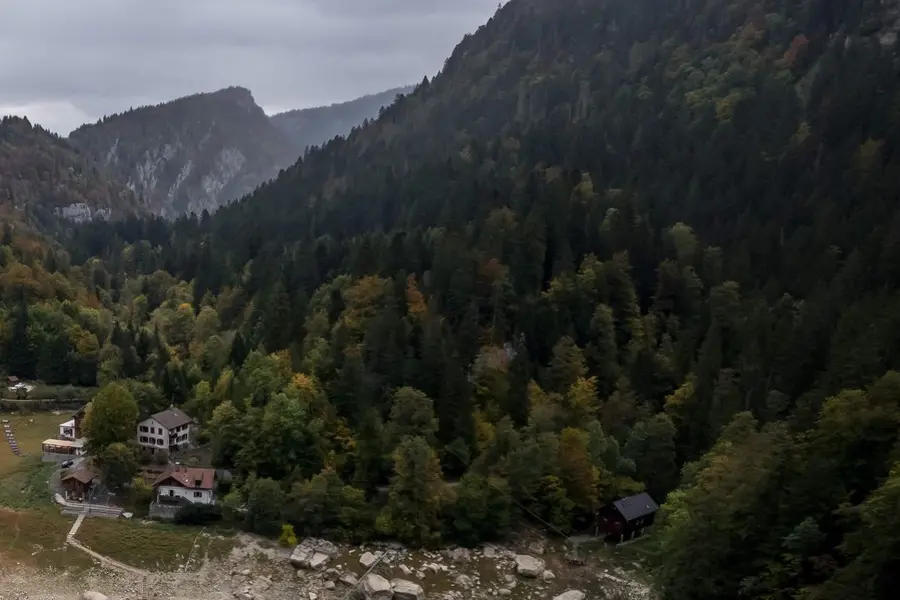
Switzerland’s mountain forests are increasingly struggling to withstand summer droughts, with the effects now reaching higher elevations once thought to be relatively protected from water stress. Scientists warn that the decline could weaken forests that act as a natural barrier against avalanches, rockfalls, landslides and floods.
A new study based on four decades of Swiss forest data found that drought-related decline is no longer confined mainly to forests at lower elevations. Trees in protective forests as high as 2,200 metres are also showing signs of increasing stress.
The findings challenge the earlier assumption that higher-altitude forests would remain relatively resilient as temperatures rise.
Drought is reaching higher into the mountains
Mountain forests have historically benefited from colder conditions and longer-lasting snow cover at higher elevations. These conditions helped keep soils moist and reduced the amount of water trees needed during summer.
That advantage is now weakening.
Researchers from Bern University of Applied Sciences examined records from the Swiss National Forest Inventory covering 1983 to 2022. They focused on protective forest stands that had not been affected by fires or forestry interventions, allowing them to track changes linked primarily to natural conditions.
The study found that the share of declining forest stands increased over the four decades across Switzerland's different vegetation belts.
The change was particularly pronounced at lower elevations. In the lowest, colline belt, the proportion of declining protective forest stands rose from 11.1% in 1983 to 30.4% in 2022.
But higher elevations are also showing a worrying shift.
In the highest forest belts, the proportion of declining stands had fallen to its lowest levels around the mid-1990s to early 2000s. It then rose sharply, reaching 18.8% in the most recent period studied.
Large trees are among those disappearing
The researchers also found that tree density declined across all the forest belts examined.
Declining stands showed stronger indicators of drought stress and a larger reduction in tree basal area, a measure linked to the amount of tree cover. Large, dominant trees were particularly vulnerable to drought-related decline and death.
That matters because these forests are not simply part of Switzerland's mountain landscape. They provide a natural defence for communities and infrastructure in valleys, helping reduce the impact of hazards such as avalanches, falling rocks, landslides and floods.
Researchers found that the previous relationship between altitude and drought stress had also weakened. After 2017, higher elevation no longer consistently meant lower drought stress.
What happens to these forests next?
The study suggests that drought may already be changing the composition of Swiss protective forests. More drought-tolerant species and tree sizes are becoming prevalent as vulnerable trees disappear.
But that does not necessarily mean the forests are becoming more secure.
If severe droughts occur repeatedly before forests have time to recover, even trees that are more resilient could come under pressure. The researchers say this creates an urgent need to adapt forest management to a warmer and drier climate.
The team is now investigating how quickly forest species composition could change and how forestry practices could encourage more diverse, multi-layered stands that may be better able to withstand future drought.
The findings have implications beyond Switzerland, with the researchers pointing to the need for adaptive forestry strategies across European mountain ranges.
Published: 03 Oct 2026, 01:27 pm IST
ABOUT THE AUTHOR

Related Topics
Disclaimer: Kindly avoid objectionable, derogatory, unlawful and lewd comments, while responding to reports. Such comments are punishable under cyber laws. Please keep away from personal attacks. The opinions expressed here are the personal opinions of readers and not that of Mathrubhumi.