
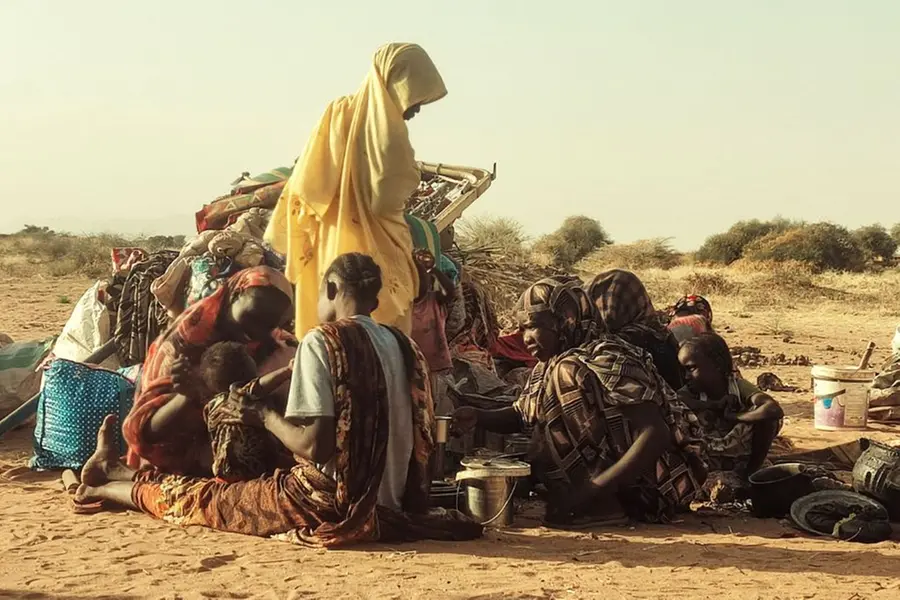
Cairo: As Sudan marks the grim two-year anniversary of its brutal civil war this Tuesday, the country is grappling with what the United Nations has declared the world’s worst humanitarian crisis. With atrocities mounting and famine spreading rapidly, millions are left in desperate need, while peace remains elusive.
In a major military development last month, Sudan’s armed forces retook the capital, Khartoum, from their rival paramilitary group, the Rapid Support Forces (RSF). While heralded as a symbolic victory, it has done little to change the war’s devastating trajectory. Instead, the conflict appears to be entering a new, potentially more entrenched phase, marked by a de facto partition of the country.
Over the weekend, the RSF and allied militias stormed two refugee camps in western Darfur—Zamzam and Abu Shouk—killing at least 300 people. These camps, which collectively shelter around 700,000 displaced Sudanese, are also among the worst-hit by famine. Fighting has made it nearly impossible for aid workers to access the areas.
“Local sources are telling us that armed groups have taken control of the Zamzam camp and are restricting the movement of those remaining, especially young people,” said U.N. spokesman Stéphane Dujarric, adding that up to 400,000 people have fled the camp in recent days.
With half of Sudan’s 50 million people facing hunger, the World Food Programme (WFP) has confirmed famine in 10 locations and warns that it could soon engulf many more, endangering millions.
“This abominable conflict has continued for two years too long,” said Kashif Shafique, country director for Relief International Sudan, the only aid group still operating in the Zamzam camp. He reported that nine of the organisation’s workers were killed in the RSF attack. “Every moment we wait, more lives hang in the balance. Humanity must prevail.”
A war with no end in sight
The war erupted on 15 April 2023, following a power struggle between Sudan’s military leader, General Abdel-Fattah Burhan, and RSF commander Mohamed Hamdan Dagalo—once allies in suppressing Sudan’s pro-democracy movement.
What began with fierce urban combat in Khartoum has spiralled into a nationwide catastrophe. The conflict has displaced nearly 13 million people—4 million of them into neighbouring countries—and left at least 20,000 dead, though actual figures are likely far higher.
Both sides stand accused of war crimes. The RSF, in particular, has gained notoriety for its attacks on villages in Darfur, where mass killings and sexual violence have been widely reported.
Though the military’s reclaiming of Khartoum in March was hailed as a breakthrough, experts caution that it merely shifts the war’s dynamics. The RSF continues to control large swathes of western and southern Sudan, including Darfur and Kordofan, while the military holds the north, east, and centre.
“The reality on the ground already resembles a de facto partition,” said Federico Donelli, an assistant professor of international relations at the University of Trieste.
Despite speculation that both sides might now seek a ceasefire, analysts believe further offensives are more likely.
“Both parties are suffering from combat fatigue,” said Suliman Baldo, director of the Sudan Transparency and Policy Tracker. The RSF, though weakened by internal rifts and lacking political legitimacy, maintains strong supply lines through regional backers such as the UAE, Chad, Uganda, Kenya, South Sudan, and Ethiopia.
A nation on the brink
Famine is tightening its grip on regions under RSF siege, particularly North Darfur’s Zamzam camp, where the RSF is advancing on El Fasher—the military’s last stronghold in the area.
“We have no choice,” said Amna Suliman, a mother of four in the camp, speaking by phone. “We live in fear, with no communication, no food, and no hope.” She described how people have resorted to eating grass and tree leaves to survive.
Since famine was first confirmed in Zamzam last August, it has spread to South Kordofan and threatens to engulf 17 more locations, according to the WFP. At present, 25 million people face acute hunger, with 638,000 on the brink of starvation. Over 3.6 million children are acutely malnourished.
Disease has compounded the crisis. Sudan has experienced multiple outbreaks of cholera, malaria and dengue since the war began. The most recent cholera outbreak in March claimed 100 lives and infected over 2,700 people in White Nile province.
The economy has been devastated, with GDP dropping 40% and full-time employment halved. Nearly 20% of urban households now report having no income at all, according to the U.N. Development Programme.
Despite this, international funding for Sudan’s humanitarian response has plummeted. Only 6.3% of the $4.2 billion needed this year has been received, U.N. humanitarian coordinator Clementine Nkweta-Salami revealed.
“The reductions come at a time when the needs in Sudan have never been greater,” she said.
Return amidst ruins
Some 400,000 people have returned to areas around Khartoum and Gezira retaken by the military. Many returned to find their homes destroyed or looted, reliant on local charities for food and aid.
Abdel-Rahman Tajel-Ser, a 46-year-old civil servant, returned to his home in Omdurman in February after nearly two years of displacement. His house, once occupied by RSF fighters, was damaged and ransacked.
“It was a dream,” he said of his return. “But even in a destroyed neighbourhood, life here is better than living as a refugee or a displaced person.”
As Sudan enters its third year of civil war, the calls for peace grow ever more urgent. Yet, without sustained international pressure and a commitment to humanitarian access, the country’s suffering is set to deepen.
Published: 16 Apr 2025, 07:56 am IST
Related Topics
Disclaimer: Kindly avoid objectionable, derogatory, unlawful and lewd comments, while responding to reports. Such comments are punishable under cyber laws. Please keep away from personal attacks. The opinions expressed here are the personal opinions of readers and not that of Mathrubhumi.
