
China's Shenzhou-24 spacecraft has successfully lifted off with Pakistani astronaut Muhammad Zeeshan Ali aboard. The mission is headed for the Tiangong space station.
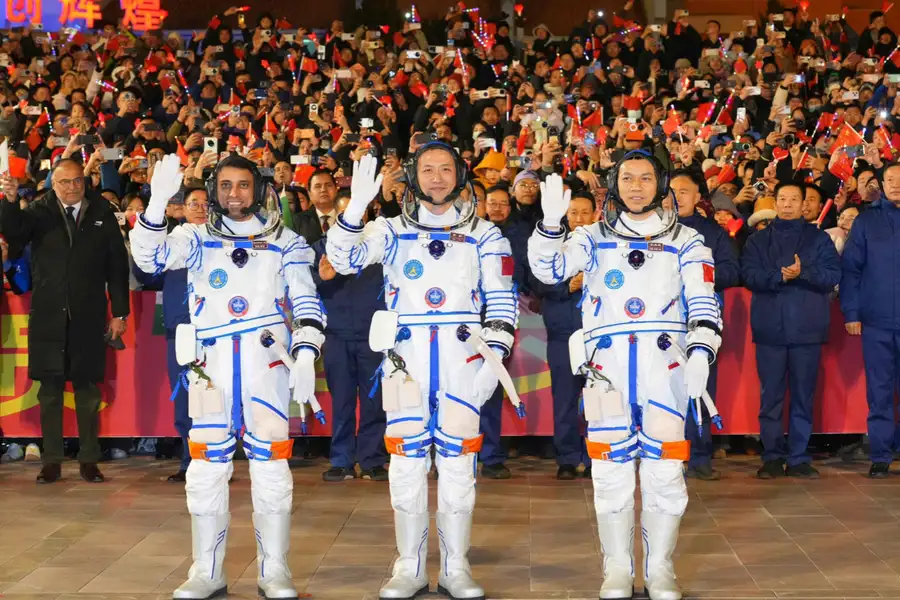
China's Shenzhou-24 spacecraft successfully lifted off on Wednesday, November 25, carrying Pakistan's first astronaut, Muhammad Zeeshan Ali, and two Chinese astronauts on a mission to the Tiangong space station.
The Long March-2F rocket carrying the spacecraft blasted off from the Jiuquan Satellite Launch Centre in northwestern China at 8:18 am Beijing time (5:48 am IST), according to reports.
The spacecraft subsequently entered its planned orbit. The three-member crew comprises Chinese astronauts Tang Hongbo and Wu Yi, along with Ali, a 40-year-old former Pakistan Air Force pilot.
Tang is the mission commander, Wu is the flight engineer, while Ali is serving as a payload specialist.
The mission marks a significant milestone for Pakistan as Ali is set to become the country's first astronaut to enter Earth's orbit.
He will also make history as the first foreign national to visit China's Tiangong space station, once the spacecraft docks with the orbital outpost.
Ali underwent seven months of intensive training in China before being selected for the mission. He was chosen alongside fellow Pakistani astronaut candidate Khurram Daud to train under a bilateral space cooperation agreement between China and Pakistan, signed in February 2025.
The crew is expected to conduct around 90 scientific experiments and technology tests during the mission.
These include research involving photosynthetic microorganisms that could potentially support food and oxygen production during future space missions, as well as experiments examining the effects of spaceflight on quinoa seeds.
Ali is expected to spend approximately five to ten days in space before returning to Earth aboard the Shenzhou-23 spacecraft. The mission is part of China's broader efforts to expand international cooperation through its Tiangong space station, operational since 2022.
The launch also represents a new chapter in China-Pakistan space cooperation.
Beijing has been seeking to position Tiangong as a platform for international scientific partnerships, while continuing preparations for its ambitious goal of sending astronauts to the Moon by 2030.
Speaking ahead of the launch, Ali described the mission as a responsibility towards his country, saying, ‘I carry the name of Pakistan on my shoulder, the hopes of 250 million Pakistanis.’
He also expressed hope that the partnership would eventually lead to joint missions beyond Earth's orbit, including journeys to the Moon and Mars.
Published: 25 Nov 2026, 07:54 am IST


ABOUT THE AUTHOR

Related Topics
Disclaimer: Kindly avoid objectionable, derogatory, unlawful and lewd comments, while responding to reports. Such comments are punishable under cyber laws. Please keep away from personal attacks. The opinions expressed here are the personal opinions of readers and not that of Mathrubhumi.