
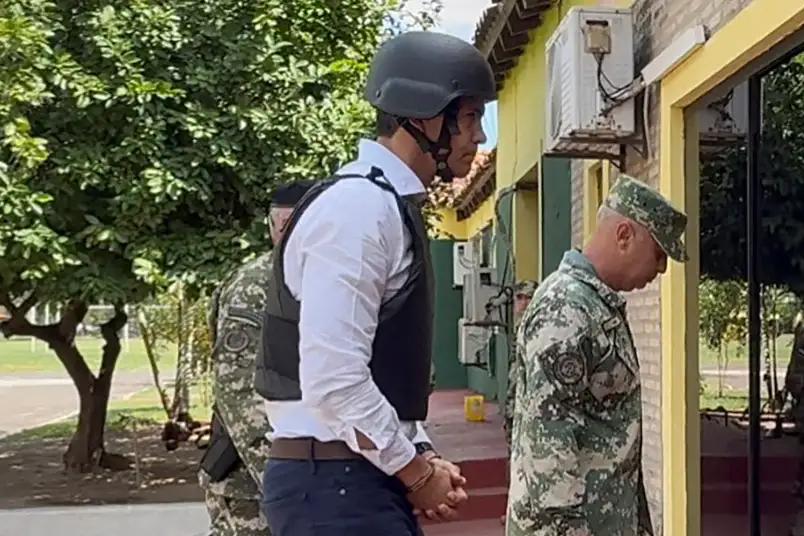
Asuncion: A Paraguayan judge on Monday ordered former president Santiago Pena moved out of a suite with a private gym and into a military prison as he awaits trial over the collapse of a major digital bank that toppled his government earlier this month.
Judge Osmar Legal ordered Pena transferred from the Presidential Escort Regiment, a military base in the capital, Asuncion, where photos published by local media showed that his quarters also included a private bathroom, well-furnished office and spacious dining area.
Under the court order, a copy of which was obtained by The Associated Press, Pena will be held at the Vinas Cue military prison, apart from other detainees. He arrived there Monday afternoon, his 48th birthday, in handcuffs, a helmet and a bulletproof vest.
President Pedro Alliana opened a news conference Monday by announcing that he had ordered the dismissal of the regiment's commander, Col Jose David Daiub, following allegations that Pena had received special treatment there.
Alliana, who served as Pena's vice president, pledged to give prosecutors whatever resources they need to investigate the bank's collapse.
"Paraguayans deserve to know the truth," he said.
Pena is in pretrial detention on charges including breach of trust, criminal association and administration for personal gain. Prosecutors allege that he used his influence to steer public money to Ueno Bank, a lender used by more than half of Paraguay's adults, as its executives made large insider loans to companies linked to the bank's owners. The criminal association charge, added Friday, alleges that he led an organisation that shielded Ueno from oversight. Pena denies wrongdoing.
Paraguay's central bank eventually seized Ueno on Nov 3 after declaring it insolvent, freezing the accounts of nearly 3 million customers and more than USD 850 million in public funds, and disrupting payments for households and small businesses. Three days later, the Senate removed Pena from office, and Alliana took over. A judge ordered Pena jailed the next day.
A bank too close to power
-----------------------------
Ueno's dizzying growth had become a symbol of Pena's effort to sell landlocked Paraguay to foreign investors as a low-tax, business-friendly hub. A former International Monetary Fund official and one of the Trump administration's closest allies in the region, Pena enjoyed prime access to Washington and Wall Street despite his country's limited economic and geopolitical weight.
The bank launched its digital brand in 2022 and by June had 2.9 million customers in a country of about 6 million. It even sponsored the national soccer team.
But Ueno was also intertwined with Pena's government. He held a stake in Ueno's parent company until last year and appointed the bank's former chairman, Carlos Carvallo, to lead the central bank. Carvallo, who also faces charges in the case, has said through his lawyer that he did not take part in regulatory decisions involving Ueno.
Since Pena's arrest, authorities have searched two of his four homes, one in Asuncion and a mansion in the resort town of San Bernardino, about 50 kilometres (30 miles) away. On Thursday, prosecutors also raided the presidential residence.
Prosecutors say the mansion was built partly with about USD 577,000 in loans that Ueno granted Pena while he was president, and investigators found a vault hidden behind a false wall there. They have also asked the United States, Luxembourg and Argentina for help tracing money that may have been diverted from the bank.
Savers left waiting
--------------------
Alliana acknowledged that the crisis had shaken Paraguayans' faith in their banks. "The closure of Ueno Bank has deeply affected numerous Paraguayan families," he said.
More than 1.8 million depositors have so far received about USD 640 million, Alliana said, from a deposit guarantee fund that Paraguay created in 2003 after a series of financial crises wiped out dozens of banks and finance companies.
Most small savers have been repaid in full. The fund has paid out up to about USD 19,600 per person, out of a guarantee of about USD 36,700, and authorities haven't said when the rest will be paid. Investors in Ueno's mutual funds aren't covered and must wait for the bank to be liquidated.
Still, more than 75 per cent of the roughly USD 2.8 billion deposited at Ueno, much of it belonging to larger savers and public institutions, has yet to be returned.
For pension funds that had money at Ueno, Alliana said that authorities have preliminarily identified about USD 600 million in viable assets at the bank, such as loans expected to be repaid, that they plan to use to reimburse the funds. It remains unclear how much of the pension money and other public deposits will be returned.
Teachers walked off the job and blocked roads across the country last week to demand the return of their retirement savings, and retirees' groups have pressed Alliana and Congress to pass an emergency law to guarantee it. That followed days of unrest in Asuncion after Ueno's collapse, when thousands of people took to the streets demanding their money back and Pena's ouster, at times clashing with police.
(This story has not been edited by Mathrubhumi and is published from a syndicated feed.)
Published: 17 Nov 2026, 08:21 am IST


Disclaimer: Kindly avoid objectionable, derogatory, unlawful and lewd comments, while responding to reports. Such comments are punishable under cyber laws. Please keep away from personal attacks. The opinions expressed here are the personal opinions of readers and not that of Mathrubhumi.
