
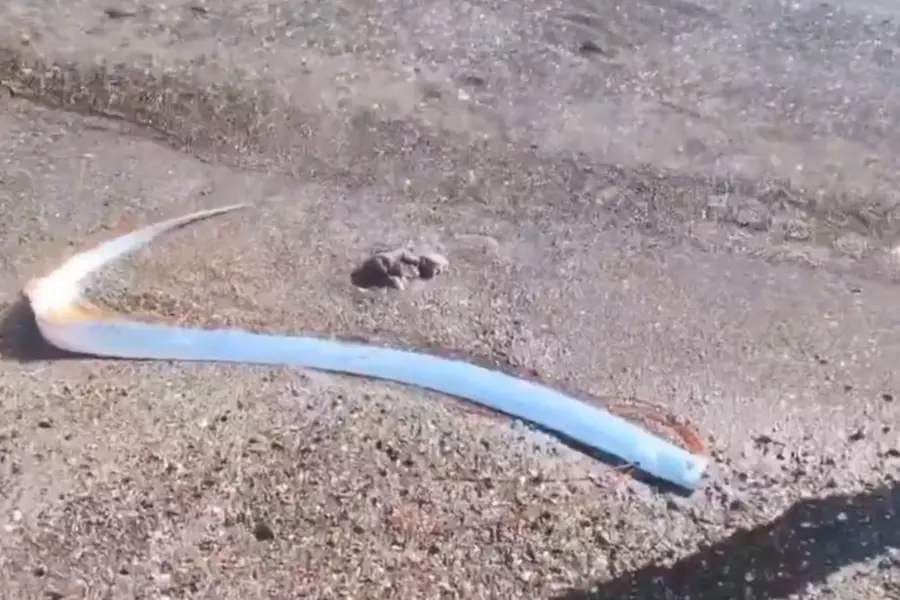
Beachgoers in Baja California Sur, Mexico, were left stunned after an extraordinary sighting of an oarfish (nicknamed the 'doomsday fish') in shallow waters—an event that is extremely rare given that these elusive creatures typically reside at depths of 200 to 1,000 metres. The long, ribbon-like fish, known for its iridescent scales and striking red fins, was caught on camera as it moved near the shore.
Oarfish, which can grow up to 11 metres in length and weigh more than 200 kilograms, are rarely observed alive. Their serpent-like bodies and deep-sea habitat have fuelled myths and superstitions for centuries. Despite their fearsome reputation, they are harmless to humans, primarily feeding on plankton and other microscopic sea life.
Just days before the sighting in Mexico, another deep-sea giant made an unexpected appearance—a deep-sea anglerfish was filmed off the coast of the Canary Islands. The rare footage, captured in broad daylight, has left marine experts baffled. Anglerfish, known for their bioluminescent lures and sharp-toothed jaws, typically inhabit the ocean’s darkest depths, as deep as 2,000 metres.
The deep-sea predator, often referred to as the “black seadevil,” was captured on film by Condrik Tenerife, a marine research group. The group described the sighting as an extremely rare occurrence, as these creatures are almost never seen alive outside their deep-sea environment.
Both sightings, occurring within a short span, have led to speculation about unusual oceanic activity. While some believe it to be a mere coincidence, others fear these deep-sea creatures surfacing may signal an impending disaster.
Why does the oarfish have this negative association?
The oarfish has long been associated with disaster, particularly in Japanese folklore, where it is called ryūgū no tsukai, or the “Messenger from the Sea God’s Palace.” Legends dating back to the 17th century claim these deep-sea dwellers rise to the surface as a warning before earthquakes, storms, or other natural calamities.
This belief was reignited in 2011 after 20 oarfish were found washed up on Japanese shores in the months leading up to the devastating Tōhoku earthquake and tsunami. The catastrophic 9.1-magnitude earthquake struck just 72 kilometres off Japan’s coast, triggering massive waves that reached speeds of 700 km/h and heights of over 40 metres, leaving over 15,000 people dead.
Although scientists have yet to establish a direct correlation between oarfish sightings and seismic activity, some theories suggest these deep-sea creatures may be sensitive to underwater disturbances. Some researchers believe seismic activity could cause shifts in ocean currents, which might disorient the fish and drive them to the surface. Another hypothesis suggests that large releases of carbon monoxide from the seabed before an earthquake could affect deep-sea marine life, forcing them into unfamiliar waters.
The phenomenon is not limited to Japan. In 2013, two oarfish washed up on California beaches, sparking concerns about seismic activity. Last year, an oarfish was seen off the coast of California just a month before a 7.0-magnitude earthquake struck the region.
What do scientists have to say?
Despite the historical association between oarfish sightings and earthquakes, scientists remain sceptical about any direct connection. While the deep-sea creatures may be more sensitive to changes in their environment, there is no definitive proof that their appearances predict natural disasters.
Experts suggest other explanations for these rare surface encounters. Sudden changes in ocean temperatures, shifts in currents, or illness and injury may cause oarfish and other deep-sea species to stray from their usual habitat. Some fish may naturally surface as they near the end of their life cycle.
While the simultaneous appearances of both deep-sea creatures have sparked speculation, scientists urge caution against jumping to conclusions. However, given the historical associations, many people continue to view these rare sightings as ominous signs of an impending catastrophe.
For now, whether the resurfacing of these so-called “doomsday fish” is merely a coincidence or a true harbinger of disaster remains a mystery lurking in the depths of the ocean.
Published: 20 Feb 2025, 08:55 am IST
Related Topics
Disclaimer: Kindly avoid objectionable, derogatory, unlawful and lewd comments, while responding to reports. Such comments are punishable under cyber laws. Please keep away from personal attacks. The opinions expressed here are the personal opinions of readers and not that of Mathrubhumi.
