
Rising river levels in Nepal trigger fresh flood warnings following a catastrophic glacial collapse that left hundreds dead.
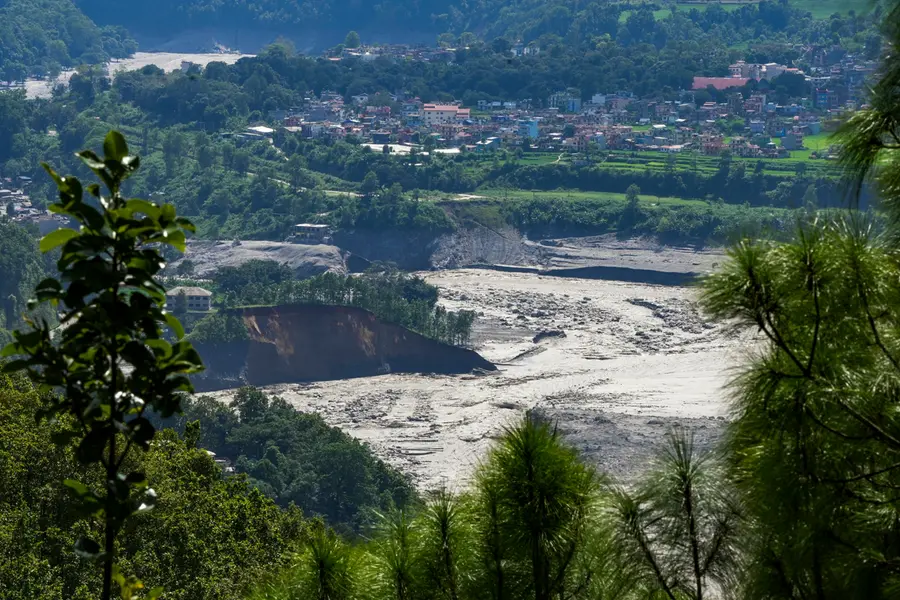
Dhading (Nepal): Authorities in Nepal urged residents in flood-impacted districts to stay on high alert Sunday following a rise in water levels along the Bhotekoshi River. Emergency notices were dispatched to mobile phones early in the day as rescue operations continued to clear access routes to areas devastated by Wednesday's catastrophic floods, which left at least 800 dead and thousands missing across Nepal and Tibet.
The renewed warnings were issued after Chinese officials alerted their Nepalese counterparts to increased water flow upstream, according to Dharam Raj Uprety, chief executive of Nepal’s National Disaster Risk Reduction and Management Authority.
Chinese state media, citing the country’s water resources ministry, reported that a newly formed high-altitude lake had largely drained. However, officials warned that a separate crater containing an estimated 1.4 million cubic meters (370 million gallons) of water located 5.6 kilometers (3.5 miles) upstream continues to present potential risks.
Nepal’s disaster management agency reported Sunday that the domestic death toll had reached 788, with 2,502 people remaining missing. Chinese authorities recorded 16 deaths and 546 missing on their side of the border. Missing person reports include hundreds of foreign nationals, with Chinese media noting 261 foreigners missing in Tibet, including over 100 Nepalis.
Devastation across river communities
In Dhading, one of the hardest-hit regions, survivors returned to damaged homes to assess losses and clear thick mud. Critical infrastructure suffered extensive damage; a primary power plant supplying electricity to over 20,000 residents across four districts was knocked offline, leaving intact homes and businesses without power.
Destruction of major concrete and suspension bridges has isolated several local communities.
“Those who are there are now stuck there. Those who are here are stuck here. It’s going to be very difficult,” said Sattan Singh Tamang, a local resident.
The initial catastrophe began Wednesday following a massive glacial collapse in the Himalayas. Satellite analysis indicated that bedrock beneath a high-altitude glacier gave way, generating a impact equivalent to a magnitude 5.2 earthquake. The resulting torrent of rock debris and meltwater surged down mountain valleys through Tibet and Nepal.
Speaking on the disaster, Nepalese Foreign Minister Shisir Khanal pointed to broader environmental factors, stating, “Despite having only 0.1% contribution to the global emissions, people of Nepal have become major victims of climate change.”
International relief efforts have begun assembling, with Malaysian Prime Minister Anwar Ibrahim announcing Sunday that Malaysia will deploy a search-and-rescue team alongside $1 million in financial assistance.
AP
Published: 31 Aug 2026, 06:50 am IST
ABOUT THE AUTHOR

Related Topics
Disclaimer: Kindly avoid objectionable, derogatory, unlawful and lewd comments, while responding to reports. Such comments are punishable under cyber laws. Please keep away from personal attacks. The opinions expressed here are the personal opinions of readers and not that of Mathrubhumi.