
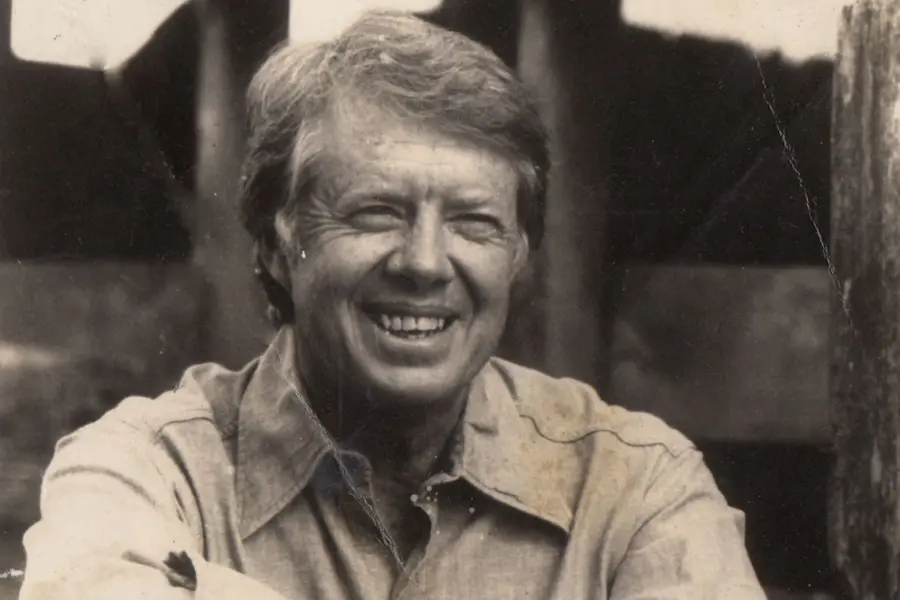
Jimmy Carter's time in office was marked by significant achievements, including the Camp David peace accords, but also by controversies that led many US voters to view him as ineffective, resulting in his loss after a single term.
However, Carter’s most enduring legacy was shaped after his presidency, as he went on to become the longest-retired president in US history. Below are some key moments in his life, as Carter passed away at the age of 100 on Sunday.
Also Read

The Panama Canal decision
In his first year as president, Carter made the controversial decision to fulfill a campaign promise by returning control of the Panama Canal, which had been under US military oversight since the early 1900s. "Fairness, and not force, should lie at the heart of our dealings with the nations of the world," Carter stated when signing the canal treaties with Panamanian leader Omar Torrijos on September 7, 1977.
While Carter faced criticism for this move, which allowed Panama to take control of the vital waterway in 1999, history has largely praised it as a diplomatic success. The agreement helped ease tensions in Latin America, ending the US's image as an imperialist power. Upon Carter's death, Panamanian President José Mulino remarked that Carter's efforts played a crucial role in Panama achieving "full sovereignty."
Shifting focus to human rights
Upon assuming office, Carter sought to move away from the realpolitik that dominated previous administrations during the Cold War. He placed human rights at the core of his policy agenda. "Our principal goal is to help shape a world which is more responsive to the desire of people everywhere for economic well-being, social justice, political self-determination and basic human rights," he declared in a 1978 speech at the U.S. Naval Academy.
This vision led to significant actions, including Carter signing the International Covenant on Civil and Political Rights in 1977, which the U.S. would ratify in 1992, after years of Senate opposition.
Camp David accords
A major diplomatic achievement came in September 1978 when Carter invited Israeli Prime Minister Menachem Begin and Egyptian President Anwar Sadat to Camp David. After 13 days of intensive negotiations, Carter successfully mediated a peace agreement between the two nations, which led to the historic peace treaty the following year. For this achievement, Carter was awarded the Nobel Peace Prize.
The "Crisis of Confidence" speech
In the summer of 1979, as inflation soared and his approval ratings plummeted, Carter made a televised address on July 15 to the American public. The half-hour speech sought to address accusations of weak leadership and shift the blame onto what he called a national "crisis of confidence."
"The erosion of our confidence in the future is threatening to destroy the social and the political fabric of America," he said. The speech was not well received, and it marked a low point in his presidency. Within days, five cabinet members resigned, highlighting the internal turmoil of his administration.
Hostage crisis and its aftermath
The Iran hostage crisis, in which more than 50 Americans were held captive at the U.S. embassy in Tehran for 444 days (from November 1979 to January 1981), proved to be the final blow to Carter’s presidency. A failed military mission to rescue the hostages in April 1980 -- Operation Eagle Claw -- ended in disaster due to mechanical failures and sandstorms, leading to the death of eight American servicemen when two aircraft collided during the retreat.
The failure of the mission and the prolonged crisis overshadowed Carter's efforts to resolve the situation, leading to the resignation of Secretary of State Cyrus Vance. The hostages were finally released on January 20, 1981, the same day Ronald Reagan took office, after defeating Carter in the 1980 election.
Post-Presidency: A legacy of service
Carter remained remarkably active well into his 90s, despite his retirement from politics. In 1982, he founded the Carter Center, a non-profit organization focused on conflict resolution, promoting democracy and human rights, and addressing global health issues.
Carter earned widespread recognition as one of the most successful former U.S. presidents, traveling the world to monitor elections in places like Haiti and East Timor and acting as a mediator in global disputes.
Elders and global peace efforts
Carter also became a member of The Elders, a group of former world leaders established by Nelson Mandela in 2007. The group’s mission was to promote peace and human rights globally. Carter worked alongside other Nobel Peace laureates such as Archbishop Desmond Tutu, former Liberian President Ellen Sirleaf Johnson, and the late UN Secretary-General Kofi Annan to further the group's humanitarian causes.
Through his tireless work after leaving office, Carter’s legacy grew beyond the challenges of his presidency, securing his place in history as a devoted advocate for peace, democracy, and human dignity.
Agency
Published: 30 Dec 2024, 07:54 am IST
Related Topics
Subscribe to our Newsletter
Disclaimer: Kindly avoid objectionable, derogatory, unlawful and lewd comments, while responding to reports. Such comments are punishable under cyber laws. Please keep away from personal attacks. The opinions expressed here are the personal opinions of readers and not that of Mathrubhumi.