
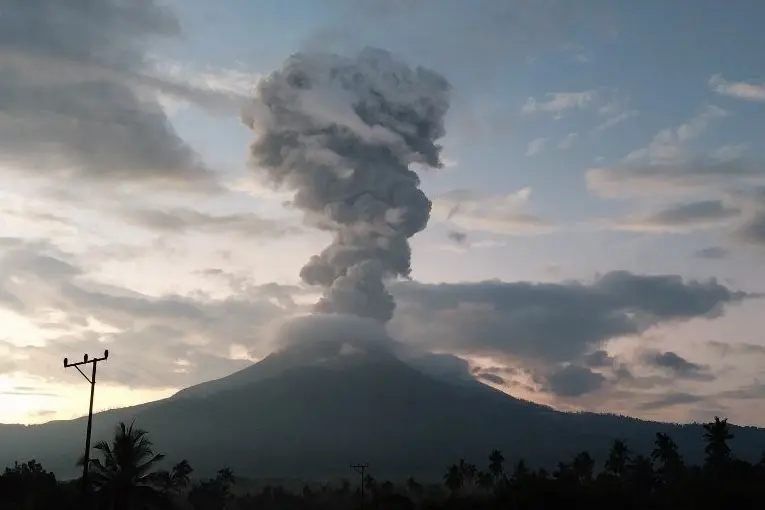
Jakarta: Mount Lewotobi, situated in Indonesia’s East Nusa Tenggara province, erupted on Wednesday, prompting an aviation warning and the issuance of safety advisories, according to the Volcanology and Geological Disaster Mitigation Centre.
The eruption sent a column of ash soaring up to 3,500 metres into the sky, with a thick grey cloud drifting towards the west and northwest of the crater.
To minimise the risks from volcanic ash, a Volcano Observatory Notice for Aviation was issued at the orange alert level, the second-highest tier. Aircraft are now prohibited from flying below 5,000 metres near Mount Lewotobi. Pilots have been urged to remain cautious due to the potential hazard volcanic ash poses to aviation safety.
The centre also released safety advisories to protect communities residing on the slopes of the volcano from dangers including hot clouds and volcanic debris, as reported by Xinhua news agency. Residents, tourists, and visitors have been advised to refrain from engaging in any activity within a six-kilometre radius of the volcano.
The communities living near the volcano should be aware of the potential for lava floods induced by rivers originating from the peak of the volcano when heavy rains occur.
Those in regions affected by the volcanic ash spread have been encouraged to wear facemasks or cover their noses and mouths to reduce the risk of respiratory issues.
Last month, the Centre for Volcanology and Geological Disaster Mitigation had raised the alert status to the highest level after eruption of Mount Lewotobi.
The eruption released a column of ash up to 8,000 metres high before midnight on March 20.
Mount Lewotobi stands at 1,584 metres and is one of Indonesia’s 127 active volcanoes. The country, home to around 270 million people, lies within the ‘Ring of Fire’—a seismic zone encircling the Pacific Ocean that is known for frequent volcanic eruptions.
Indonesia sits on the boundary of several major tectonic plates: the Eurasian, Australian, and Pacific plates and has experienced some of the world's deadliest and most powerful eruptions, such as the eruption of Mount Tambora in 1815, further highlighting the country's vulnerability to volcanic hazards.
IANS
Published: 16 Apr 2025, 06:28 pm IST
Disclaimer: Kindly avoid objectionable, derogatory, unlawful and lewd comments, while responding to reports. Such comments are punishable under cyber laws. Please keep away from personal attacks. The opinions expressed here are the personal opinions of readers and not that of Mathrubhumi.
