
As the danger became apparent, panic spread among the children. One girl suffered a panic attack and was taken uphill on a motorbike
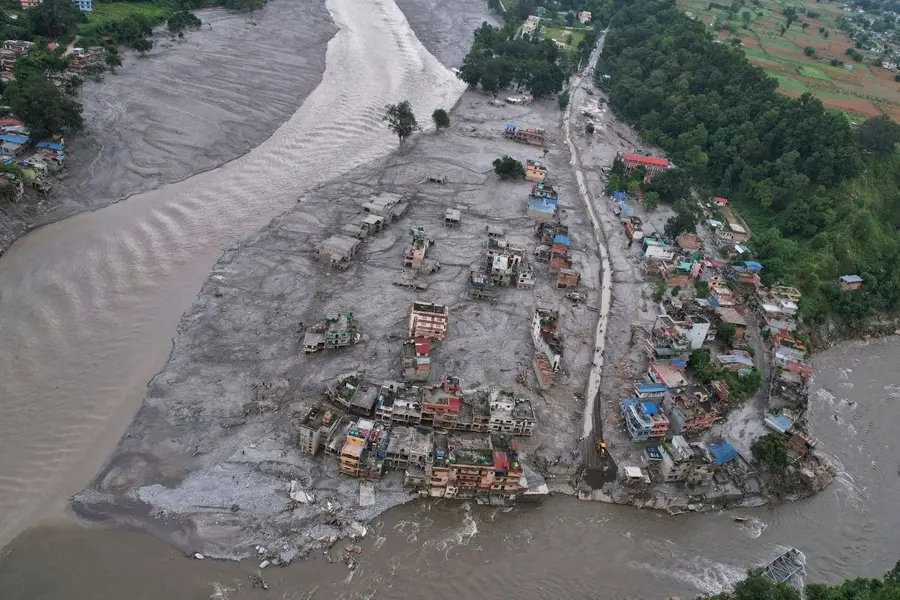
A teacher in Nepal's Trishuli Valley had only minutes to react when a friend warned him that the nearby village had been swallowed by the river. His decision to immediately evacuate the school helped save 1,643 children as a devastating flash flood tore through the region.
“He said the village was gone: taken by the river. He told me to run.” The warning came at around 9:20 am on Wednesday to Rajendra Dawadi, principal of Tribhuvan Trishuli Secondary School in flood-hit Nepal, according to The Times.
Also Read

Dawadi, a 47-year-old English teacher, was overseeing 1,643 children in and around the school's three-storey building when the floodwaters began rising rapidly.
The disaster, triggered by a glacier collapse, sent torrents of rock, ice, mud and debris through mountain river systems, sweeping away buildings, bridges and power infrastructure. The floods have killed 734 people in Nepal and 16 in Tibet, while around 2,498 people remain missing in Nepal and another 546 in Tibet's Gyirong County, according to the latest figures cited in reports.
At first, Dawadi believed the school was in a relatively safe position. The concrete building stood around 60 metres above the river and was at roughly the same level as the steel bridge connecting the village to the eastern bank.
That sense of security quickly disappeared.
A parent arrived at the school and warned Dawadi that the water was rising at an alarming speed. He immediately rang the school bell and instructed teachers to get the children out of their classrooms.
He also contacted the school bus drivers, asking all but one to turn back. Soon afterwards, he saw the bus he had been unable to contact making its way across the bridge.
As the danger became apparent, panic spread among the children. One girl suffered a panic attack and was taken uphill on a motorbike. The remaining students escaped on foot, with Dawadi following them, The Times reported.
The children eventually found shelter beneath a bodhi tree while the floodwaters surged through the area and swept away the school buildings.
Dawadi's quick response helped bring 1,643 children to safety and saved all but one member of the teaching staff.
Rescue operation enters fifth day
As the search for survivors continued, Nepali rescue teams stepped up efforts to reach hydropower workers believed to be trapped inside tunnels overwhelmed by flood debris.
Heavy machinery was deployed on Sunday after rain and rising river levels disrupted earlier rescue attempts.
"Drilling of four holes has been completed... preparations are now underway to enter the tunnel directly... and proceed with search and rescue operations," Nepal's energy ministry said in an update.
Rescue operations have now entered their fifth day, with teams facing difficult conditions at several disaster sites.
The Nepal government estimates that more than 100 workers could still be alive inside tunnels at hydropower projects. Major rescue efforts are focused on the Trishuli 3A and 3B sites in the Himalayan river valley.
A total of 933 hydropower workers have been reported missing since a wall of mud and debris swept through the area on Wednesday morning, according to Nepal's National Disaster Risk Reduction and Management Authority.
At Trishuli 3A, Army rescue teams using drilling equipment broke through into the upper section of a tunnel buried in mud on Saturday evening. They then began pumping air into the tunnel and used a camera to search for signs of survivors.
However, overnight rain and rising river levels flooded the excavation area early Sunday, forcing rescuers to contend with additional water before conditions improved.
The Nepal Army later resumed the operation, using “drilling machines, excavators, hydraulic cutters, and other equipment” to clear the area.
Images released by Nepal's disaster authorities showed rescuers moving through deep mud and negotiating huge boulders deposited by the floodwaters.
The Prime Minister's Office said rescue teams were operating under “difficult conditions” but were “making tireless efforts to search for and rescue those who may be trapped”.
The teams are also using advanced search cameras and specialised monitoring equipment as they continue looking for workers who may have survived inside the flooded tunnels.
Published: 30 Aug 2026, 03:11 pm IST
ABOUT THE AUTHOR
Related Topics
Disclaimer: Kindly avoid objectionable, derogatory, unlawful and lewd comments, while responding to reports. Such comments are punishable under cyber laws. Please keep away from personal attacks. The opinions expressed here are the personal opinions of readers and not that of Mathrubhumi.