
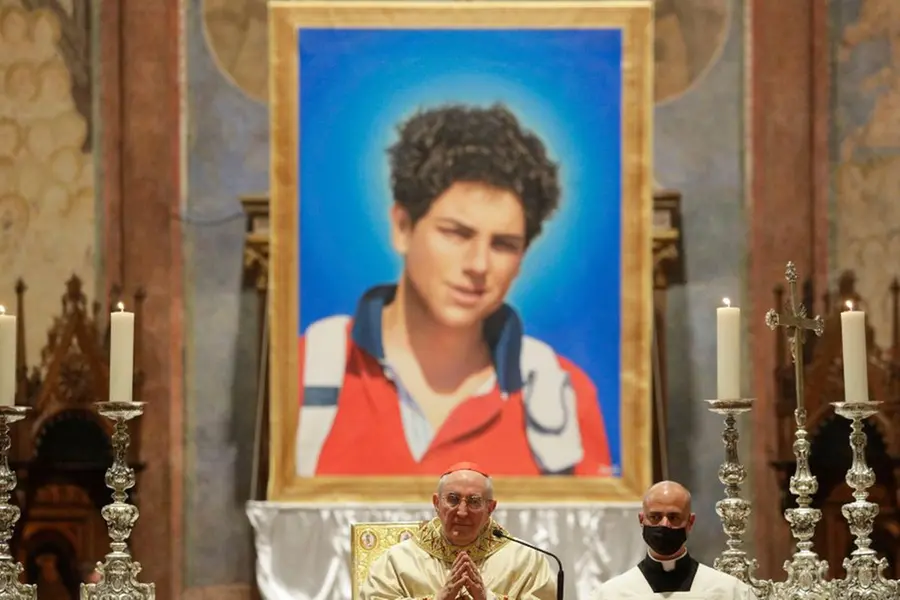
Vatican City: The Vatican has officially announced the postponement of the canonisation of Blessed Carlo Acutis, the British-born Italian teenager widely known as “God’s Influencer”, following the death of Pope Francis. The event, originally scheduled for Sunday, 27 April, would have seen Acutis become the first millennial to be formally recognised as a saint in the Catholic Church.
“Following the death of the Sovereign Pontiff Francis, we inform you that the Eucharistic Celebration and Rite of Canonization of Blessed Carlo Acutis... has been postponed,” read a brief statement from the Holy See issued on Monday.
Who Was Carlo Acutis?
Carlo Acutis was born in London on 3 May 1991 to Italian parents, though he spent most of his life in Milan. Despite coming from a wealthy but not particularly devout family, he showed remarkable religious fervour from a young age, attending daily Mass and developing a deep devotion to the Eucharist.
He died on 12 October 2006 in Monza, northern Italy, after a brief battle with leukaemia. He was only 15. Before his death, he had expressed a desire to become a priest and dedicated his teenage years to spreading Catholic teachings online.
The Making of a Millennial Saint
Carlo Acutis, often referred to as the “Cyber Apostle”, taught himself computer coding and used his skills to design websites promoting the Catholic faith. He created online content for his parish and beyond, using technology as a tool for evangelism.
In 2020, he was beatified — a major step towards sainthood — and his body was relocated to Assisi, in accordance with his final wishes. There, he was laid to rest in a clear-sided tomb, dressed in a tracksuit, jeans, and trainers. A wax model of his face was placed over his body, and pilgrims from across the globe have since gathered in Assisi to honour his memory.
His mother, Antonia Salzano Acutis, told Reuters, “There is no doubt he was special. But in many ways, he was like any other teen.”
She added, “Carlo was an ordinary child like (others). He used to play, to have friends, and to go to school. But his extraordinary quality was the fact that he opened the door of his heart to Jesus and put Jesus in the first place in his life.”
Miracles and the path to sainthood
According to the Catholic Church, sainthood is granted to individuals who have either lived a life of heroic virtue, offered their life for others, or died for their faith. Carlo’s legacy, bolstered by reports of miraculous healings attributed to his intercession, met these criteria.
Two miracles have been officially recognised. One involved the healing of a four-year-old Brazilian boy with a severe pancreatic condition. Another involved a Costa Rican university student who suffered a traumatic brain injury in a cycling accident. In both cases, family members had prayed to Carlo, and the recoveries were deemed miraculous by the Vatican.
Bishop of Assisi, Domenico Sorrentino, affirmed his canonisation, stating, “Carlo Acutis was an ordinary boy, who lived his childhood and youth between family, school, and the games children play.”
He continued, “He lived a life of faith that was nurtured until it reached a peak that now makes him stand out in the eyes of the Church and the world as a saint.”
A saint in sneakers
Carlo’s digital mission and relatable lifestyle have resonated especially with younger Catholics. Visitors to his tomb often remark on his relatability, having grown up with the internet, school challenges, and everyday teenage struggles.
“I felt great emotion at seeing a boy younger than me who lived a happy life ... despite his sickness,” said 18-year-old Emanuele Iaquaniello from Frosinone. Another teen, Lorenzo Dalia, added, “I was left dumbfounded seeing such great faith at this age.”
His mother shared how he committed himself to simplicity and charity: “He was very severe with himself ... If I wanted to buy two pairs of shoes, he said, no, one is sufficient.”
Concerns over relic sales
As Acutis’ popularity surged, purported relics — including articles of clothing and even parts of his body — have begun surfacing online, with some being listed for sale on platforms like eBay. Bishop Sorrentino called the sales “horrible” and urged police to take action against those profiting from the sacred items.
(With inputs from AFP)
Published: 21 Apr 2025, 05:26 pm IST
Related Topics
Disclaimer: Kindly avoid objectionable, derogatory, unlawful and lewd comments, while responding to reports. Such comments are punishable under cyber laws. Please keep away from personal attacks. The opinions expressed here are the personal opinions of readers and not that of Mathrubhumi.
