
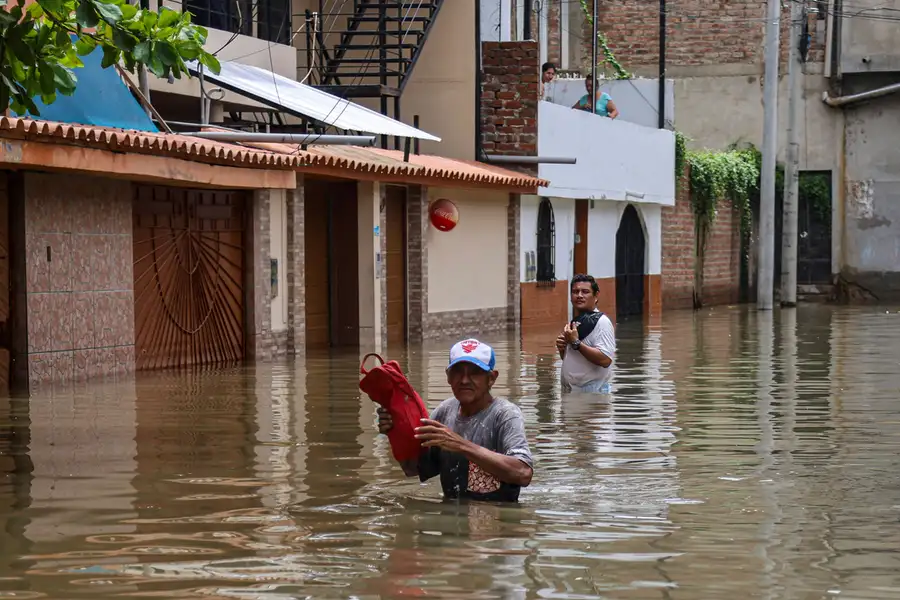
Lima (Peru): Rivers overflowed across northern Peru and coastal Ecuador on Saturday, prompting water rescues, evacuations and road closures as relentless storms dumped rain on the region.
The increased flooding, which stretched along the Pacific coast from Ecuador's border with Colombia into northern Peru, came after weeks of heavy rain fuelled by a particularly powerful El Nino. The climate phenomenon starts with a warming of the tropical Pacific and influences rainfall, temperature and storms around the globe.
Along these normally dry coasts, it has brought downpours that have killed at least 34 people in Ecuador since late August, according to the country's risk management agency. Two died Friday when a mudslide crashed into their homes.
Forecasters warned of more rain, extending a red alert for Peru's northern Piura and Tumbes regions through Monday and saying El Nino would remain at "extraordinary" strength until February.
In northwestern Ecuador's Esmeraldas province, police and firefighters evacuated families after two rivers burst their banks. Floods and landslides had damaged more than 50 road sections across the country by Saturday morning, closing at least 10, including the main highway between the capital, Quito, and the coast.
The storms also disrupted Ecuador's local elections Sunday, which officials had rescheduled from February to avoid El Nino's expected peak. The National Electoral Council said Friday it had moved polling stations in five provinces because of the rains and warned that dozens more were at risk.
Across the border, the overflowing Tumbes River flooded part of the Pan-American Highway, Peru's main north-south artery, and police this week rescued seven ranchers trapped by its waters. Pacific swells have also battered hotels in coastal resort towns.
In Peru's northwestern city of Piura, a record 143 millimetres (5.6 inches) of rain fell in 24 hours, leaving streets under waist-high water. Crews pulled 400 people from flooded homes, said Peruvian President Keiko Fujimori, who toured a submerged neighbourhood in the middle of a lightning storm on Friday. About a dozen people were still trapped inside, she said.
Fujimori has warned that Peru will face "a mega Nino," and her government is coordinating aid from the United States and China.
Even in Peru's arid capital of Lima, El Nino has brought persistent drizzle to some neighbourhoods and unusual heat to others, with temperatures reaching 90 degrees Fahrenheit (32 degrees Celsius), nearly 18 degrees Fahrenheit (10 degrees Celsius) above normal.
"My house is an oven," said Cindy Cueto, a mother of three who cooks at a community soup kitchen in one of the city's hillside neighbourhoods.
The phenomenon has also pushed up food prices by cutting crop yields and fish catches, helping drive Lima's annual inflation above 5 per cent in October, the highest in three years. Peru's central bank expects El Nino to cost the economy nearly a percentage point of growth this year and more than a point in 2027.
"It's gotten worse," said Elizabeth Espinoza, a mother of five who sells gelatin desserts on Lima's outskirts. "Things are so expensive, the money doesn't cover anything anymore."
(Except for the headline, this story has not been edited by Mathrubhumi and is published from a syndicated feed.)
Published: 29 Nov 2026, 08:01 am IST


Disclaimer: Kindly avoid objectionable, derogatory, unlawful and lewd comments, while responding to reports. Such comments are punishable under cyber laws. Please keep away from personal attacks. The opinions expressed here are the personal opinions of readers and not that of Mathrubhumi.
