
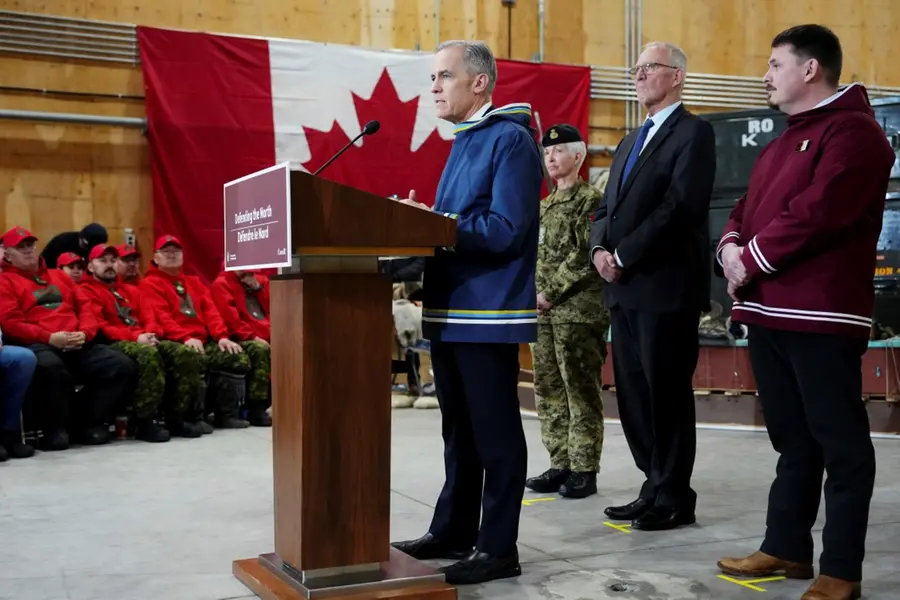
Iqaluit, Nunavut: Canadian Prime Minister Mark Carney on Tuesday announced a radar purchase from Australia and an expansion of military operations in the Arctic while visiting Canada’s far north in an effort to assert sovereignty over the increasingly contested region.
The prime minister’s office said the Canadian $6 billion ($4.2 billion) Over-the-Horizon Radar system will provide early warning radar coverage from the Canada-United States border into the Arctic.
Carney made the announcement at a military base in the capital of the Inuit-governed territory of Nunavut, following visits to Paris and London for meetings with leaders there.
“Arctic sovereignty is a strategic priority of our government,” Carney said. “Canada is, and forever will be, an Arctic nation.”
Australian radar system details
The Australian radar system will consist of a series of pillars almost a mile (1.6 kilometres) in length. Officials stated that the system would have a smaller footprint than the equivalent American system.
“This will be a significant export if this deal is finalised,” Australian Prime Minister Anthony Albanese said.
Albanese had a phone call with Carney the prior night.
“Obviously, there are issues taking place, particularly between Canada and the United States, I wouldn’t have expected to have been happening in my lifetime,” Albanese said.
US relations and military response
Senior Canadian government officials, who briefed reporters on Carney’s plane before the announcement, said the purchase has been well received by top military officials in the North American Aerospace Defense Command (NORAD), the joint US-Canadian military command that oversees threats to both countries.
However, the officials said they could not predict how the Australian purchase would be received politically in Washington. They spoke on condition of anonymity as they were not authorised to speak publicly.
Carney also announced that the government will spend Canadian $420 million ($294 million) to expand Canada’s Arctic operations and training exercises and deploy more personnel. He said Canada will have a “greater sustained year-round presence.”
Shifting US priorities and Canada’s response
The prime minister’s flight path took him over Greenland. US President Donald Trump’s interest in Greenland, northeast of Nunavut, comes as part of an aggressively “America First” foreign policy platform that has included threats to take control of the Panama Canal and suggestions that Canada should become the 51st US state.
“The United States’ priorities, once closely aligned with our own, are beginning to shift,” Carney said.
Trump has threatened economic coercion to make Canada the 51st state. His frequent remarks about annexation have angered Canadians and revitalised the governing Liberal Party, which was heading for a historic defeat but now has a chance of winning a fourth term. Carney is expected to call a general election by the end of the week.
The president has also threatened sweeping tariffs on all Canadian products and has already placed them on steel and aluminium.
Carney and Trump have not spoken since Carney became the new Liberal Party leader and prime minister more than a week ago. Carney said that at the “appropriate time” he will have a discussion with the US president, as “two sovereign nations, that is comprehensive and not targeted at one issue.”
However, Trump continues to make remarks that many in Canada view as disrespectful. On Fox News on Tuesday night, he stated twice that “Canada was meant to be the 51st state.”
Trump also claimed that he is tougher on Canada than on America's biggest adversaries for this reason. He repeated several times that he was indifferent to the outcome of the Canadian election.
“The Conservative that’s running is stupidly no friend of mine. I don’t know, but he said negative things,” Trump said. “So, when he says negative things, I couldn’t care less. I think it’s easier to deal actually with a Liberal. And maybe they’re going to win, but I don’t really care. It doesn’t matter to me at all.”
Iqaluit’s strategic importance
Carney visited Iqaluit, the largest municipality in Nunavut, a vast territory straddling the Arctic Circle. Nunavut is roughly the size of the U.S. states of Alaska and California combined, with a mostly Inuit population of about 40,000.
For much of the year, the weather in Iqaluit can be severe. In February 2010, Iqaluit hosted a meeting of finance ministers and central bank governors from the Group of Seven nations. Several of the dignitaries, including Carney when he was head of Canada’s central bank, went dogsledding in subfreezing temperatures.
It is a distinctive destination—home to about 7,500 people but without a single traffic light—and has no road or rail links to the outside world.
AP
Published: 19 Mar 2025, 09:18 am IST
Related Topics
Disclaimer: Kindly avoid objectionable, derogatory, unlawful and lewd comments, while responding to reports. Such comments are punishable under cyber laws. Please keep away from personal attacks. The opinions expressed here are the personal opinions of readers and not that of Mathrubhumi.
