
New Delhi: Amid escalating political unrest in Bangladesh, Pankaj Saran, a former Indian ambassador to Dhaka, has warned of potential border challenges for India. Pankaj Saran, who oversaw the ratification of the Land Boundary Agreement during his tenure from 2012 to 2015, expressed concerns over the uncertain situation in Bangladesh.
"We will just have to wait for different political forces to find some equilibrium inside Bangladesh," he said.
Also Read

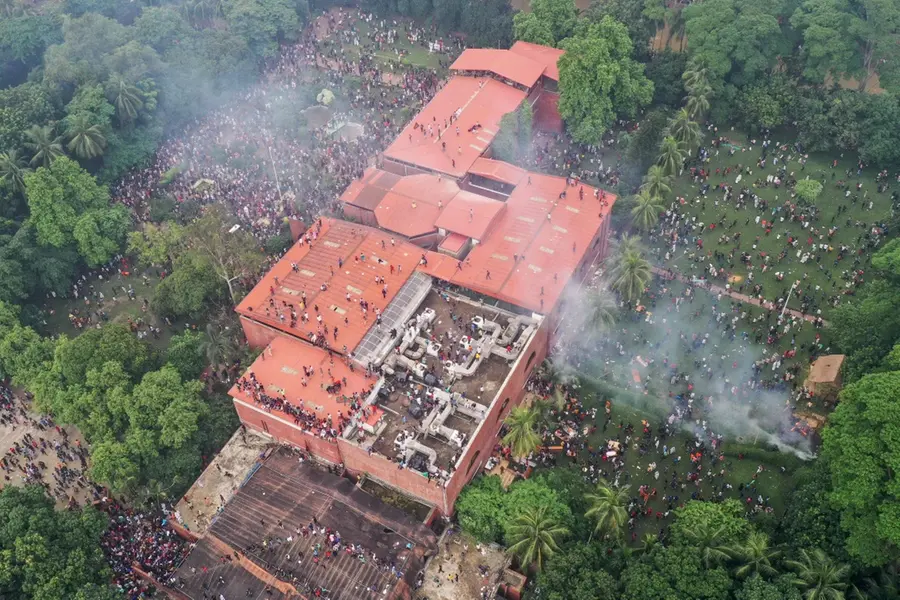
Following Prime Minister Sheikh Hasina's resignation amid widespread protests and the ransacking of her official residence in Dhaka, Saran noted that trouble had been brewing for weeks. "The last two days saw an escalation in the level of protests. Therefore, some decisions had to be taken about how to go forward in controlling the protests.”
"I think, the situation reached a point where it was clear that curfews and other restrictions were not adequate. Police and security forces' actions were not adequate and the only resort that was left was to bring in the army," he said.
The former envoy said, "Hasina was left with no choice but to step down".
"The only issue left was ensuring her safety, which the (Bangladesh) army helped in arranging. So, now we are in a situation where essentially the army has taken over.
"They have announced the establishment of an interim government. Who is going to be a part of the government, that is something they are going to discuss with the president," he added.
He emphasised the critical nature of the next few days and speculated on the impact of Hasina's departure on the country's stability. "There is a power vacuum right now which is being filled by the army. But... now we have to see... whether this situation and this development will lead to a halt in street protests and return of the students... and a reduction in street violence. That we have to see."
"We will also have to see the extent of attacks on Awami League members, members of the government and other supporters. All this will play out and (it needs to be seen) how much the army will be able to manage and control the situation. I think it is clear that there are ... political forces who are using students' grievances as an opportunity to settle political scores," he said.
Highlighting the evolving dynamics of Bangladesh's political landscape, Saran acknowledged a shift in generational mentality. He underscored the historical ties between India and Bangladesh, recalling India's support during the Liberation War of 1971 and the extensive border shared by the two nations.
Asked about the immediate repercussions of the current events on India-Bangladesh ties, he said, "Obviously, there could be an overreaction to the past. This overreaction could manifest itself in some trouble at the border, some anti-India statement."
"So, we have to be alert on the border to make sure this does not lead to movement of any people from Bangladesh to India... We will have to be very vigilant on the border. That is the immediate requirement," Saran said.
Regarding economic implications, Saran pointed out that prolonged instability could adversely affect Bangladesh's economy, closely intertwined with India's. "So, there will be a further downtrend in the situation in Bangladesh on the economic side. But, once things settle down, and it may take a few months... we will just have to wait for different political forces to kind of find some equilibrium inside Bangladesh," he said.
While the government-to-government relationship will obviously be impacted, the people-to-people relation and trade will go on, the former envoy said.
"But, we will not go back to business as usual," Saran underlined.
Asked that since the Land Boundary Agreement ratification could happen in the past, could the two countries again go the distance in the long run, he said whether it is Bangladesh or any other country, "you make the best of relations in any given time".
"There was a government in Dhaka which wanted to move and resolve issues. We did all that. It does not mean that it cannot happen again in future.
"When we had the chance, the alignment of the two leaderships was correct, we achieved a lot. Now, we just have to wait and see what is the kind of political dispensation that comes up in Bangladesh," Saran said.
Reflecting on bilateral achievements under Hasina's leadership, Saran emphasised the importance of continuing and nurturing the relationship between India and Bangladesh moving forward.
"I am sure we will be prepared for all eventualities. I think, everyone in Dhaka today is aware that that they need good relations, normal relations with India, but the question... but it's premature to think about that now, right now it is a crisis moment," Saran added.
Agencies
Published: 06 Aug 2024, 10:12 am IST
Related Topics
Disclaimer: Kindly avoid objectionable, derogatory, unlawful and lewd comments, while responding to reports. Such comments are punishable under cyber laws. Please keep away from personal attacks. The opinions expressed here are the personal opinions of readers and not that of Mathrubhumi.