
Among those waiting was 19-year-old Liza Paliy, who had not seen her father since January 2024 when she, her mother, and her sister fled occupied territory while he remained behind.
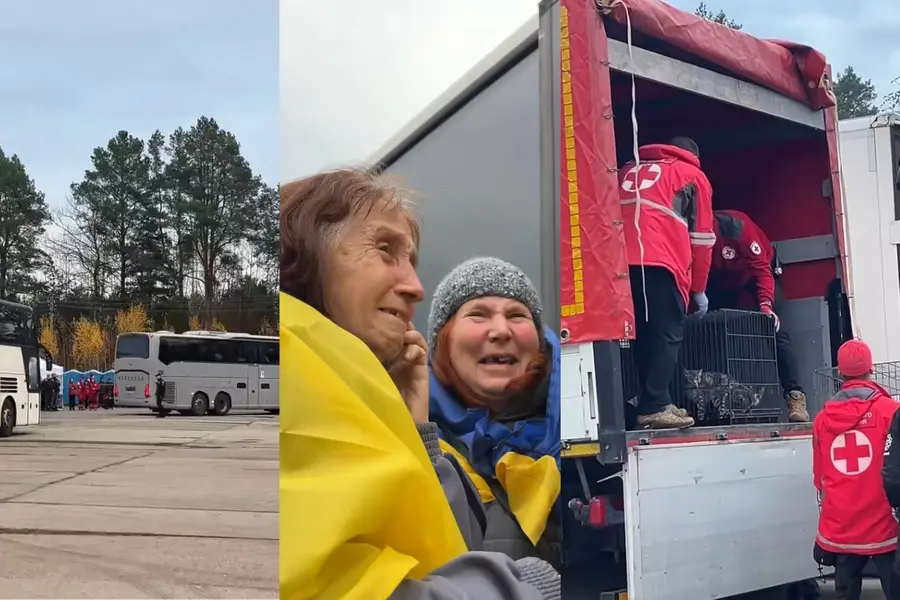
Hundreds of civilians trapped inside the Russian-occupied city of Oleshky on Saturday arrived in Ukrainian-controlled territory following a rare, localised ceasefire. The humanitarian operation allowed starving residents to escape years of heavy fighting in southern Ukraine's Kherson region. The temporary pause in fighting, which began at 3:00 am on Tuesday and is scheduled to end on Sunday evening, marks the longest break in combat anywhere along the front line since Russia launched its full-scale invasion four and a half years ago in February 2022. The deal was brokered by US First Lady Melania Trump, with Pope Leo XIV—the first American pontiff—also pressing Russian and Ukrainian leaders to permit civilian evacuations and aid deliveries.
A humanitarian lifeline for a devastated town
Oleshky was captured by the Russian military in 2022. Over the course of the five-year conflict, which has claimed hundreds of thousands of lives and displaced millions, the town was left devastated. Ukrainian military drone footage revealed rows of empty apartment blocks, charred by fire or partially destroyed by bombardments. Ahead of the rescue operation, Kyiv estimated that only about 2,000 residents remained in Oleshky, down from a pre-war population of 24,000.
First Lady Melania Trump, who announced the ceasefire on 23 October, described Oleshky as being "on the brink of disaster" and noted that delivering assistance would have been "impossible" without direct intervention. Ukrainian President Volodymyr Zelensky expressed gratitude on social media platform X, stating that the residents would "receive the assistance they need" and thanking the American side and Melania Trump for their mediation.
On Friday, Ukrainian and Russian officials visited Oleshky together in a rare display of bilateral cooperation to deliver aid and marshal those wishing to depart. Under the terms of the truce, the remaining 2,000 residents were offered three choices: evacuate to Ukrainian-held territory, relocate to Russian-controlled areas, or remain in Oleshky with replenished food and medical supplies. While neither Kyiv nor Moscow disclosed exact evacuation numbers, Melania Trump posted on social media that the humanitarian convoy could safely evacuate more than 750 people. Ukrainian authorities restricted public disclosure of evacuee numbers and exact border crossing locations to safeguard residents staying behind and protect future missions.
Surviving on grass and pets under siege
For months, trapped locals endured severe shortages of food, water, and medicine. Some residents were forced to eat grass, while others hunted dogs and pigeons to survive as shops closed and supplies ran out.
Valera, a 29-year-old evacuee, described the desperate conditions upon reaching northern Ukraine. "There was no bread. Nothing. The shops weren't open," he said. "Lots of people planted vegetable gardens. We ate whatever was available. Well, thank God, we're here now".
Intricate transit routes and tearful border reunions
The journey out of the occupied town required complex international coordination. Evacuees travelling to Ukrainian-controlled areas were transported by bus and aircraft through Russia and Belarus. They were driven to the Russian city of Anapa, flown to Homel in Belarus, and then moved across the border into Ukraine's northern Chernigiv region. Meanwhile, buses also transported residents who chose to move to Russia. Russian media showed civilians arriving at a temporary accommodation facility in Simferopol, located on the Crimean peninsula which Moscow annexed in 2014.
At the Ukrainian-Belarusian border, volunteers from organisations including the Red Cross, Doctors Without Borders, and World Central Kitchen set up aid tents, coffee stalls, and pet food supplies for animals brought along by fleeing families. Relatives gathered in emotional scenes, watching evacuees disembark from buses—some draped in Ukrainian flags—and tearfully embracing after years apart.
Among those waiting was 19-year-old Liza Paliy, who had not seen her father since January 2024 when she, her mother, and her sister fled occupied territory while he remained behind. "We thought at that time that it would be a month, two maximum, and we would return, but unfortunately, two years have already passed," she recalled. Upon reuniting, her smiling father remarked, "This is a blessing. I've been waiting a long time," adding that "there's no life there anymore" in Oleshky.
Another relative, Daria Pavlyn, waited to see if her father Mykhailo had escaped. He had stayed behind to look after their home and animals after a strike killed two neighbours. He had also feared making the journey without Russian documents. "We realised that, well, there was no [other] way, and he walked us to the road and that was it - that was the last time," she said.
Relentless drone strikes resume across the broader front line
While the localised truce brought temporary relief to Kherson, heavy fighting and infrastructure strikes escalated elsewhere across Ukraine and Russia. Overnight into Saturday, Moscow launched drone strikes against Ukrainian energy and railway infrastructure, leaving 280,000 households without electricity across the Dnipro and Kyiv regions. The attacks hit combined heat and power plants in Kyiv and Sumy, four electrical substations and a gas facility in Dnipro, and railway networks in Dnipro and Kharkiv. Capital city Kyiv also faced power shortages on Saturday following Russian strikes on energy targets the previous day.
Concurrently, a Ukrainian drone attack in Russia's western Bryansk region killed a 30-year-old woman and a 41-year-old man, and injured five others, according to local Governor Yegor Kovalchuk. Ukrainian drones also struck the Russian republic of Bashkortostan, causing a fire in the capital, Ufa, which houses several oil refineries. Russia's Defence Ministry reported that its air defence forces shot down 433 Ukrainian drones overnight.
Air defence debates and diplomatic outlook
Amid ongoing grid damage, President Zelensky welcomed the US government's approval of a proposed $2.1 billion deal allowing Ukraine to purchase 500 PAC-3 Patriot air defence interceptors. The State Department confirmed the missiles would be funded by Canada, Germany, and Norway through a US programme, with no American public funds used. However, Zelensky urged Western allies to supply interceptors immediately from existing stocks, warning that newly manufactured systems could take years to arrive.
"Right now, the Russians are attacking our energy infrastructure every single day. In just these past two weeks of October, there have already been more than 30 Russian strikes on critical parts of our power grid," Zelensky posted on X. He added, "The world sees Russia targeting civilian infrastructure every day. Everyone who does not want to see this Russian escalation spread further into Europe must help Ukraine".
The Kherson truce remains restricted to the local area, while Russia continues to occupy roughly one-fifth of Ukraine—including Crimea, most of Donetsk and Lugansk in the Donbas, and parts of Zaporizhzhia and Kherson. US-mediated peace talks between Moscow and Kyiv are scheduled to resume in November, having been stalled since joint US-Israel strikes on Iran in February.
Published: 31 Oct 2026, 09:08 pm IST


Disclaimer: Kindly avoid objectionable, derogatory, unlawful and lewd comments, while responding to reports. Such comments are punishable under cyber laws. Please keep away from personal attacks. The opinions expressed here are the personal opinions of readers and not that of Mathrubhumi.
