
The Supreme Court flagged inconsistencies in the Kerala High Court order directing an FIR in the CMRL case and cautioned the ED against exceeding its jurisdiction.
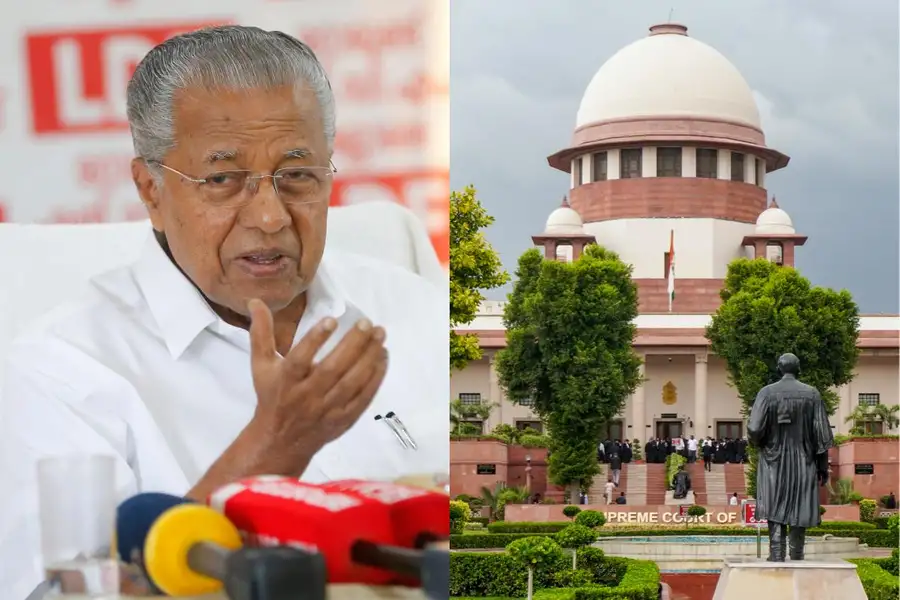
New Delhi: The Supreme Court on Wednesday stayed for seven days the vigilance investigation against Pinarayi Vijayan, his daughter Veena T and son-in-law P A Mohammed Riyas in the alleged Cochin Minerals and Rutile Limited (CMRL)-Exalogic bribery case, while allowing them to approach the Kerala High Court's division bench for relief.
A vacation bench comprising Justices Joymalya Bagchi and V Mohana set aside the Kerala High Court division bench's order refusing the petitioners permission to appeal against a single judge's direction to register an FIR in the case.
The Supreme Court clarified that the FIR would remain in place, but the investigation would be suspended for a week to enable the petitioners to seek interim relief from the appellate court.
The bench also questioned whether an Enforcement Directorate (ED) communication under Section 66(2) of the Prevention of Money Laundering Act (PMLA) automatically requires a state agency to register an FIR. It cautioned the ED against interfering with the statutory jurisdiction of other investigative agencies.
The court clarified that its observations were confined to the petitioners' right to pursue an appeal and did not express any opinion on the merits of the case. The High Court's division bench is free to decide the appeal and any application for interim relief independently.
Also read | CMRL case: Congress divided over govt's stand on Vijayan as some insiders seek payback for Chandy
Supreme Court questions Kerala High Court order in CMRL case
During the hearing, Justice Bagchi questioned the urgency and legal basis of the single judge's October 9 direction to register an FIR based on an ED communication.
The bench examined whether the material forwarded by the ED was sufficient to warrant an investigation under the Prevention of Corruption Act and whether the state was legally bound to register an FIR on the basis of the agency's communication.
The court also noted that Pinarayi Vijayan had not been heard before the single judge issued the direction. The bench questioned whether a public servant should have an opportunity to present arguments on the merits before an order directing the registration of an FIR is passed.
The Supreme Court rejected the argument that the apex court's judgment in the Vijay Madanlal Choudhary case made registration of an FIR mandatory in every such instance.
Justice Bagchi observed that the PMLA could not be treated as a superior authority that dictates every action by other agencies. The bench cautioned the ED against using its statutory powers to interfere with the statutory domain of other investigative bodies.
The hearing also brought out differing positions on the ED's communication. Senior advocate Sidharth Luthra, appearing for the petitioners, questioned whether the state was legally required to act on the ED's recommendation. Complainant K M Shajahan maintained that the communication imposed an obligation on the state to register an FIR, while ED counsel Zoheb Hossain argued that the material disclosed cognisable offences.
The bench's interim order suspends the vigilance investigation for seven days without cancelling the FIR. The petitioners can approach the Kerala High Court's division bench during this period to seek further relief.
Why Pinarayi Vijayan approached the Supreme Court
The petitions followed the Kerala High Court division bench's October 15 decision rejecting applications by Vijayan, Veena and Riyas seeking permission to appeal against a single judge's October 9 order.
The single judge had directed the Vigilance and Anti-Corruption Bureau (VACB) to register a case based on information submitted by the ED to the state police in connection with alleged payments by CMRL to Exalogic Solutions, Veena's now-defunct company.
The petitioners argued that they had not been heard before the single judge issued the direction. They also contended that the original petition was in the nature of a public interest litigation and should have been considered by a division bench.
The High Court had observed that an accused in a corruption case has no legal right to be heard before the registration of an FIR, while clarifying that the petitioners could pursue other constitutional and statutory remedies.
Before the Supreme Court, the petitioners sought protection from arrest and other coercive action in connection with the vigilance case. The apex court has now allowed them to pursue their challenge before the High Court's division bench.
Also read | CMRL case: VD Satheesan says Kerala govt acted according to law, not in haste
What is the CMRL-Exalogic case?
The case concerns alleged payments of Rs 2.78 crore by CMRL to Exalogic Solutions under the guise of IT consultancy services. The ED has alleged that the payments were linked to benefits extended to the company by the state government when the CPI(M) was in power.
The ED sought the registration of a case based on material gathered during its investigation under the PMLA and searches conducted as part of the probe.
On October 9, the Kerala High Court directed the VACB to register a case based on the ED's report. The vigilance agency's Special Investigation Unit-1 subsequently registered two FIRs in connection with the allegations.
The ED's communication was based on material gathered during its probe, including searches conducted under the PMLA. The allegations concern payments by CMRL and an associate concern to Exalogic and Veena.
The Supreme Court's order provides temporary relief by suspending the vigilance investigation for seven days, but the FIR remains in place. The Kerala High Court's division bench will consider the petitioners' challenge and any request for further interim protection.
Published: 21 Oct 2026, 12:25 pm IST


ABOUT THE AUTHOR

Disclaimer: Kindly avoid objectionable, derogatory, unlawful and lewd comments, while responding to reports. Such comments are punishable under cyber laws. Please keep away from personal attacks. The opinions expressed here are the personal opinions of readers and not that of Mathrubhumi.