
Efforts are ongoing to prevent the fire from spreading to other parts of the ship
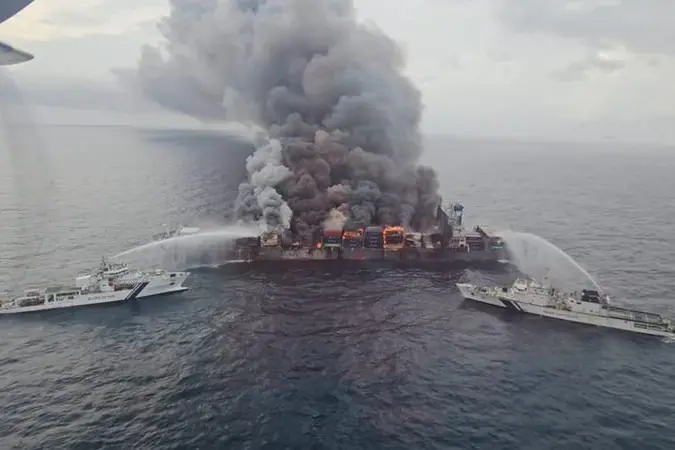
Kochi: Coast Guard ships stood guard without sleep throughout the night, working to cool down the blazing Wan Hai vessel that burned like a furnace. The mission to extinguish the fire, which stretched through day and night, was carried out by Coast Guard ships Sachet and Samudra Prahari.
Although the vessels approached Wan Hai on Monday night, the containers that had fallen into the sea posed a major obstacle. In addition, the unbearable heat and lack of visibility made it impossible to get close to the ship. Throughout the night, water was sprayed using high-pressure jet pumps from a safe distance.
By Tuesday morning, they managed to get closer to the ship and bring the fire at the front under control. However, explosions and flames continued in the midsection. Efforts are ongoing to prevent the fire from spreading to other parts of the ship.
As soon as the information was received that MV Wan Hai 503 had caught fire, five Coast Guard ships rushed to the accident site. While ICGS Sachet and Samudra Prahari began firefighting operations, the ships Rajdoot, Arnavesh, and Abhinav were engaged in the search for four missing crew members. Interceptor Boat C-144 was also deployed for the search.
To monitor the vessel, Dornier aircraft from the Kochi Naval Base were dispatched on Tuesday. Meanwhile, another Coast Guard ship, Samarth, reached the accident spot along with a salvage team appointed by the Wan Hai shipping company. Based on the report submitted by this team, a decision will be made on whether the vessel should be abandoned or steered towards a nearby coast.
Survey Operations by Sutluj and ELSA
The Indian Navy ship INS Sutluj, which was involved in the rescue operations of the Wan Hai ship fire incident, is now headed to Alappuzha. The ship will conduct a survey at the site where the Liberian vessel MSC ELSA sank.
Possibility of a Major Explosion
Alappuzha: Experts have warned that some of the chemicals leaked during the ship accident could cause a major explosion. According to Dr. R. Venugopal, retired Joint Chief Controller of Explosives from the Petroleum and Explosives Safety Organisation (PESO), nitrocellulose, resin solution, and lithium batteries are substances with explosive potential.
There are examples from Kerala itself of nitrocellulose causing explosions. One such instance was the 1998 explosion at the explosives manufacturing factory in Kanjikode, Palakkad. Lithium batteries also fall under the same category. The explosions caused by these materials are highly unpredictable.
In addition to this, there are problems caused by gas leaks—styrene being the most concerning. On May 7, 2020, 13 people died after a styrene gas leak at the LG Polymers plant in Visakhapatnam. The gas spread across a three-kilometre radius. Styrene must be stored at refrigerated temperatures.
Phosphoric acid, maleic anhydride, and pesticides affect marine biodiversity. These substances are easily absorbed by aquatic life but very difficult to expel. Hydrobromic acid and pentamethylheptene alter the pH levels of water, which also harms marine organisms. Zinc oxide and benzophenone, which contain heavy metals, settle on the sea bed, posing long-term threats to marine resources.
Firefighting in such cases is not easy.
The presence of hazardous materials, including explosives and chemicals, in 157 containers aboard the Wan Hai 503 is what makes firefighting and rescue operations particularly difficult. This is also what poses a serious environmental threat.
The two persons who suffered severe burns and are in critical condition were inside the engine room of the ship. The missing crew members are:
• Yu Bo Fong (32), Second Engineer from Thailand
• Sa Wing (53), Carpenter from Myanmar
• Zainal Abidin (36), Able Seaman from Indonesia
• Heshe Chia Wen (41), Motorman from Thailand
As per information from the central authorities, the chances of containers drifting to Kerala’s coast from the fire-hit ship are currently very low. Therefore, legal actions or compensation claims have not been discussed at this stage, according to state government sources.
Published: 11 Jun 2025, 10:05 am IST
Disclaimer: Kindly avoid objectionable, derogatory, unlawful and lewd comments, while responding to reports. Such comments are punishable under cyber laws. Please keep away from personal attacks. The opinions expressed here are the personal opinions of readers and not that of Mathrubhumi.
