

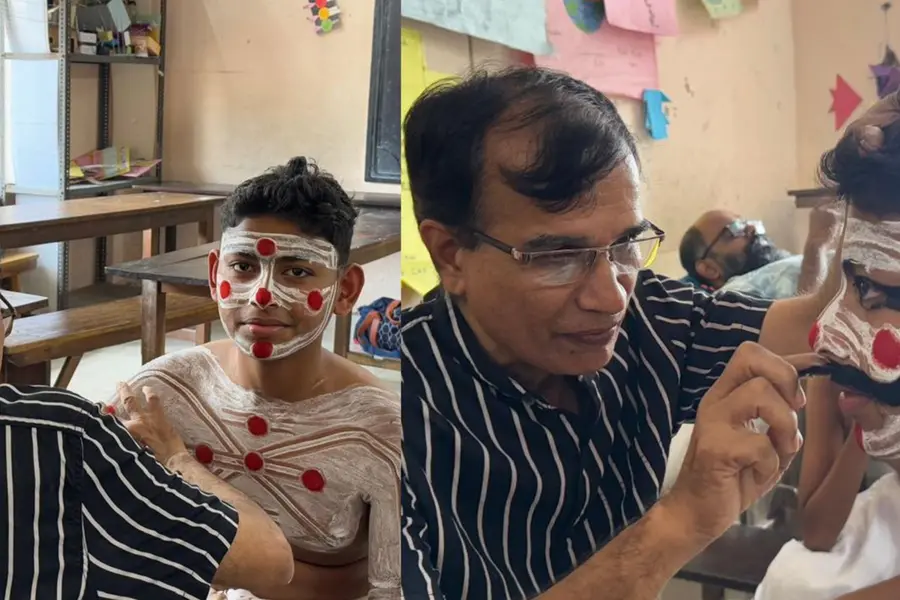
In the vibrant, bustling green room of Government HSS School in Palayam, an air of quiet creativity fills the space, where every corner seems to hum with the energy of artistry taking shape. Children are busy getting ready for their item Chakyar Koothu and Koodiyattam for Kalolsavam 2025 unfolding in the city of Thiruvananthapuram.
There, amidst the hustle of an impending performance, a figure works diligently on the makeup of a young participant preparing for Chakyar Koothu, a traditional Kerala art form. The artist, whose poised hands expertly blend rice flour, ink, and kumkumam, is none other than the renowned Chakyar—Painkulam Narayana Chakyar. At 66, his charisma and timeless presence reflect the rich legacy he carries. It takes him 15 minutes to perfect the makeup of a single performer, an intricate ritual that has been part of his life for decades.
But this moment is far from an isolated occurrence. Narayana Chakyar, a name synonymous with Koodiyattam, has dedicated his life to preserving and popularizing this ancient art form. His small school in Shoranur has grown into a vibrant hub, with students traveling from 12 districts across Kerala to learn from him. For 37 years, Chakyar has been both a teacher and a performer, tirelessly working to ensure that Koodiyattam, Chakyarkoothu, and Nangyarkoothu not only survive but flourish in the modern age.
Chakyar's legacy
Koodiyattam is a traditional performing art form, which is a combination of ancient Sanskrit theatre with elements of Koothu, an ancient performing art from the Sangam era. Though officially recognized by UNESCO as an Intangible Cultural Heritage, it has often remained obscure to the masses.
Yet, for Chakyar, this is an art form that runs in his blood. “Teaching this art has been hereditary in my family for generations,” he shares. His personal journey into the world of Koodiyattam was shaped by his mother’s uncle, the pioneering Painkulam Rama Chakyar, who is credited with taking this sacred performance beyond temple walls and into public spaces, making it accessible to a wider audience.
“If he hadn’t done that then, this art form wouldn’t have been popularised and we wouldn’t even be talking today,” said Chakyar.
Can girls perform ‘Koothu’?
For Chakyar, the devotion to Koodiyattam was not without its challenges. “Many of the people I knew drifted away from this art form, as it doesn’t promise a guaranteed income,” he recalls. But Chakyar remained determined to follow his passion. After initially attending Kalamandalam and then returning to complete his schooling, he ultimately embraced his destiny as a Chakyar. "It was not an easy decision, but it was my calling," he says with pride.
His journey as a teacher was equally profound. “I’ve always taught students from all backgrounds. At first, it wasn’t well received by society, especially when I began teaching girls and students from other religions," he admits. Back then, the notion of a girl dressing up as a male character was met with resistance. But times have changed, and now, a majority of Chakyar's students are girls, many of whom outperform their male counterparts due to their dedication.
My students keep it alive
“Now, there are children who approach me to learn before even completing their 10th standard. Many even come to me after getting married, wanting to perform on stage in full costume,” he shares with a warm smile. There are students who tell him, “Mashe, I want my husband to see me on stage in costume.”
For him, each student represents a small victory in his larger mission of popularizing Koodiyattam and ensuring its survival. Chakyar’s students are diverse in their pursuits. While many go on to build careers in various fields, they remain passionate about Koodiyattam. He has managed to create an ecosystem where this art form is no longer seen as a burden or an unattainable dream. "When students have their own careers, the pressure of making a living through art is lifted. They pursue it because they purely love it," he explains.
There are even children of his students who has come as participants of the Kalolsavam. One such parent/student is GK Sreehari who has now come to accompany his son to the festival. "My first performance was in 1991, now my son is performing at Kalolsavam. I still perform professionally too," says Sreehari proudly.
Chakyar's commitment to his students is unwavering. "I don’t charge my students for the lessons; they only need to bear the costs for food, travel, and accommodation when we attend competitions," he explains. He even provides makeup for students who are not part of his school. For Chakyar, it's not about financial gain, but about preserving and sharing the art he holds so dear.
“There is a whole economy that benefits from this art every time we perform. The makeup artists, event organisers, caterers and other supporting roles, are all compensated for their efforts. In this sense, the art form has created livelihoods for many,” the Chakyar explains.
We don't get the audience we deserve
While there has been a surge in interest from younger generations, the audience for such intricate performances remains limited. “The audience is decreasing. People are more drawn to quick, humorous acts like Mono act. But with Koodiyattam, you need patience to understand and appreciate its depth,” he laments.
Despite the dwindling audience numbers, Chakyar remains steadfast in his belief that the art form will continue to thrive. “Kalolsavam (the state school youth festival) has been a crucial medium to introduce this art to the masses,” he notes. Through these competitions, students not only gain recognition but also help spread awareness about Koodiyattam, making it more relatable to modern audiences. “If a student from a particular place performs, it is an awareness about this art form for the people around him. That is what I am hoping for.”
What do people mean when they say 'Art is my life'?
At the heart of Painkulam Narayana Chakyar’s work is his deep love for Koodiyattam, and his belief that it is more than just a performance. “But there are people who say, ‘Art is my life’ or ‘I live in the character on stage,’ I find that ridiculous. If you are playing the character of Ravana, who kills people, can you really live as that character?” he laughs. For Chakyar, the art is not about living in the character but about sharing the soul of the performance with the audience, even if only a few truly understand it.
Today, as more and more students approach him with an eager desire to learn, Chakyar’s mission continues to gain momentum. The steady increase in young learners, coupled with the growing appreciation for this ancient art, gives him hope for the future of Koodiyattam.
As the world becomes increasingly fast-paced, Painkulam Narayana Chakyar stands as a guardian of tradition, ensuring that this sacred art form is not only preserved but also revered by future generations.
Through his tireless efforts, the art of Koodiyattam may just find a place in the hearts of many more, reviving the quiet magic of ancient Kerala for generations to come.
Published: 05 Jan 2025, 03:15 pm IST
ABOUT THE AUTHOR
Disclaimer: Kindly avoid objectionable, derogatory, unlawful and lewd comments, while responding to reports. Such comments are punishable under cyber laws. Please keep away from personal attacks. The opinions expressed here are the personal opinions of readers and not that of Mathrubhumi.