
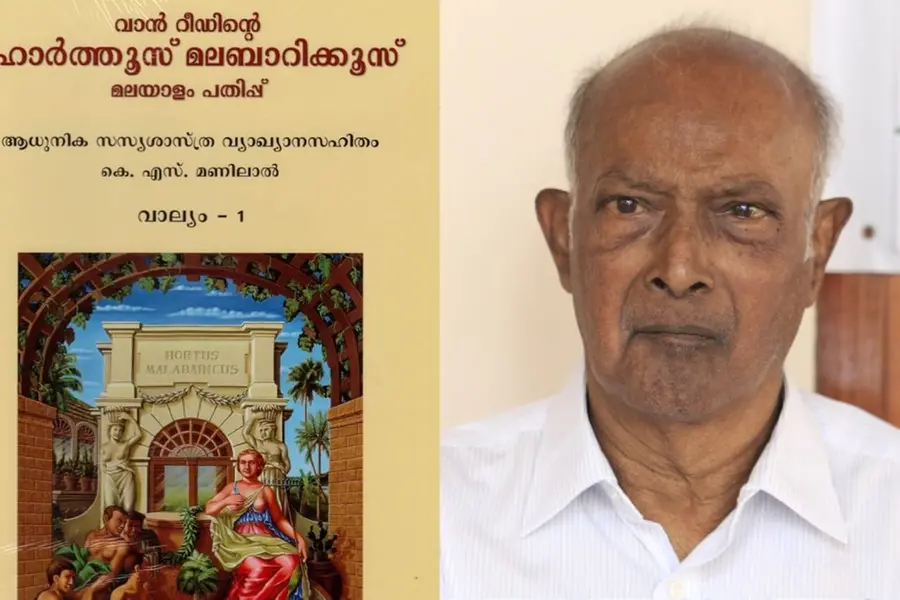
The 333rd anniversary of the publication of Hortus Malabaricus, an ancient Latin text on the plant wealth of Kerala, was celebrated in February 2012 at the University of Calicut. As part of the celebrations, a national seminar was held, where the keynote address was delivered by Dr Annama Spudich, a scholar of medical history in South Asia. Dr Spudich shared her experience of attempting to understand Hortus Malabaricus after retiring from Stanford University in the USA and taking up the study of history.
Spudich revealed that she initially approached Dan Nicholson, a renowned expert on Hortus and a curator at the Smithsonian Institution in Washington. He advised her, "You must go to Kerala and meet Dr K S Manilal. He is the greatest living expert on this subject." Dr Spudich, who had family roots in Kottayam, was taken aback by these words. When she arrived in Kozhikode and met Dr Manilal, she was struck by his scholarship and knowledge, which turned her into a devoted admirer of his work.
While Dr K S Manilal, also known as Kattungal Subrahmanyan Manilal, might not be widely known among Keralites, the respect for his work worldwide is evident in Dr Spudich's account.
Hortus Malabaricus was compiled by Hendrik Adrian van Rheede, the Dutch Governor of Kochi, with the help of the scholar Etti Achuthan from Cherthala and several others. Published in Latin in Amsterdam between 1678 and 1693 in twelve volumes, it took over 300 years for experts to fully understand the text. Dr Manilal was the one who ultimately deciphered the work.
Of the 679 plant species mentioned in Hortus Malabaricus, Dr Manilal was able to rediscover all but one, spending 27 years explaining them in modern botanical terms. Over 50 years, he dedicated his life to translating Hortus Malabaricus from Latin into languages that the common people could read and understand. In 2003, the English edition and in 2008, the Malayalam edition were published by the University of Kerala, bringing back a valuable chapter of Kerala's cultural heritage.
Dr Manilal also spent years understanding the plant biodiversity of Kozhikode and Silent Valley in a scientific manner. In doing so, he revitalised the field of plant taxonomy in India, which had been neglected for a long time.

Dr Manilal authored over a dozen books, including the English and Malayalam editions of Hortus Malabaricus. Some of his notable works include Flora of Calicut (1982), Flora of Silent Valley (1988), Botany and History of Hortus Malabaricus (1980), An Interpretation of Van Rheede's Hortus Malabaricus (1988) and Hortus Malabaricus and the Socio-Cultural Heritage of India (2012). He published more than 200 research papers and introduced 19 new plant species to the scientific world. Four plant species are named after him.
After retiring from the University of Calicut in 1999, Dr Manilal founded the Centre for Research in Indigenous Knowledge, Science, and Culture in Kozhikode. The centre publishes the research journal Samagra. He also actively collaborated with the activities of the Chavara Cultural Centre in Kozhikode.
(This article is a republication of a piece originally published in Mathrubhumi Nagaram page in 2013)
Published: 01 Jan 2025, 03:48 pm IST
ABOUT THE AUTHOR
Related Topics
Disclaimer: Kindly avoid objectionable, derogatory, unlawful and lewd comments, while responding to reports. Such comments are punishable under cyber laws. Please keep away from personal attacks. The opinions expressed here are the personal opinions of readers and not that of Mathrubhumi.