
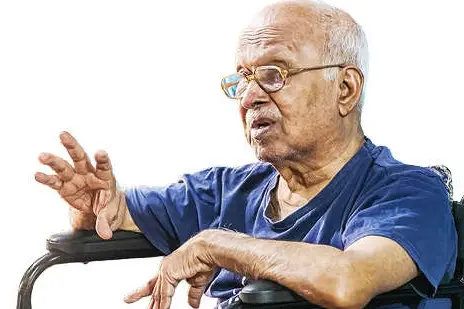
Born in the remote village of Kiralur in Thrissur in 1935, MP Parameswaran earned his PhD in Nuclear Engineering from Moscow Power Institute. From 1957 to 1975, he worked as a nuclear scientist at the Bhabha Atomic Research Centre. Later, he left his job and became a full-time science propagator. Along with his contributions in this field, he has authored many books on science, which are highly rated among intellectuals. He played a key role in shaping scientific awareness in Kerala, being at the forefront of Kerala Sasthra Sahitya Parishath. He has written nearly a hundred books in both Malayalam and English. Once a staunch left-wing supporter, he became disillusioned with the CPM after the Fourth World Theory controversy.
As of now, he is working on six books, five of which are ready for publication. These include The Rurban, Gragara Republic (to be published by Global University), and the Malayalam translation of Narendra Dabholkar's Plenty for All, titled Samruddhi Ellavarkkum. Dr. M.P. Parameswaran, who has contributed significantly to the development of ideas in Kerala, including literacy and people’s planning, celebrates his 90th birthday. Even now, he continues to write and engage in spreading development ideas rooted in science, dreaming of a future full of progressive ideas. In an interview to Mathrubhumi, he discusses the stages of idea dissemination, contemporary issues and future hopes.
You have traveled along with Kerala’s century-long historical transformation, contributing to the ideas that shaped the state's growth, from the literacy movement to people's planning. When looking back at Kerala’s development, what do you think of the past? How far have your dreams come true?
People’s planning is a concept that is never fully realised but is continuously evolving. It remains relevant at any point in time. However, the reality is that people’s decisions and actions are not given the opportunity to be implemented. The government decides, and the people are expected to carry it out. For instance, the development of a village should be decided by its own people, not by party leadership or the government. It is the collective action of the people that paves the way for real development.
A move is on to set up a nuclear power plant in Kerala. What is your take?
The idea of a nuclear power plant in Kerala is misguided. It’s a meaningless concept. As a nuclear scientist, I know that a 1000-megawatt power station produces as much waste as an atomic bomb in one day. It should not become a burden for future generations. We can fulfill our energy needs with solar power and biomass. In fact, the idea of a nuclear plant in Kerala is as idiotic as the K-Rail project. There is a common Marxist belief that the larger the project, the better, while the smaller is seen as bad. They have no interest in promoting traditional industries, such as the coir industry, which has been neglected.
What according to you are the achievements and disadvantages of Kerala?
Despite the progress Kerala has made, the old mindset still prevails. That remains the biggest obstacle the state faces. Here, progress is often equated with production. A consumerist culture is prevalent, leading to dissatisfaction among the people. This dissatisfaction contributes to higher rates of drug abuse and more crimes. Hence, when discussing Kerala's achievements, one must also address these issues. While many hold these views, there are others around us who think differently. That in itself is a positive sign.
The number of scientists is increasing, but is there an increase in scientific awareness?
The first thing to consider when talking about scientific awareness is: what do we mean by scientific awareness? It’s the idea that science can be used for the good of society. Going to temples does not diminish one's scientific awareness. I do not feel that scientific awareness is decreasing in society.
What are your expectations and hopes for the future?
When thinking about the future, my mind is filled with more desires than hopes for the new generation. Children today are beginning to realize that the way their parents have taught them is wrong. The society we live in now promotes an insatiable yearning for material goods. I hope that this longing will transform into a new generation based on wisdom. These are the thoughts I have about how society might change. There are still many dreams and ideas in my mind.
Translated by M A Rajeev
Published: 21 Jan 2025, 09:33 am IST
Related Topics
Disclaimer: Kindly avoid objectionable, derogatory, unlawful and lewd comments, while responding to reports. Such comments are punishable under cyber laws. Please keep away from personal attacks. The opinions expressed here are the personal opinions of readers and not that of Mathrubhumi.
