
A massive maritime drug corridor linking Iran and Pakistan to Sri Lanka and Australia has emerged as a major national security threat, with Pakistan-based Haji Salim cartel using the Kerala coast as a key transit hub for multi-crore contraband shipments.
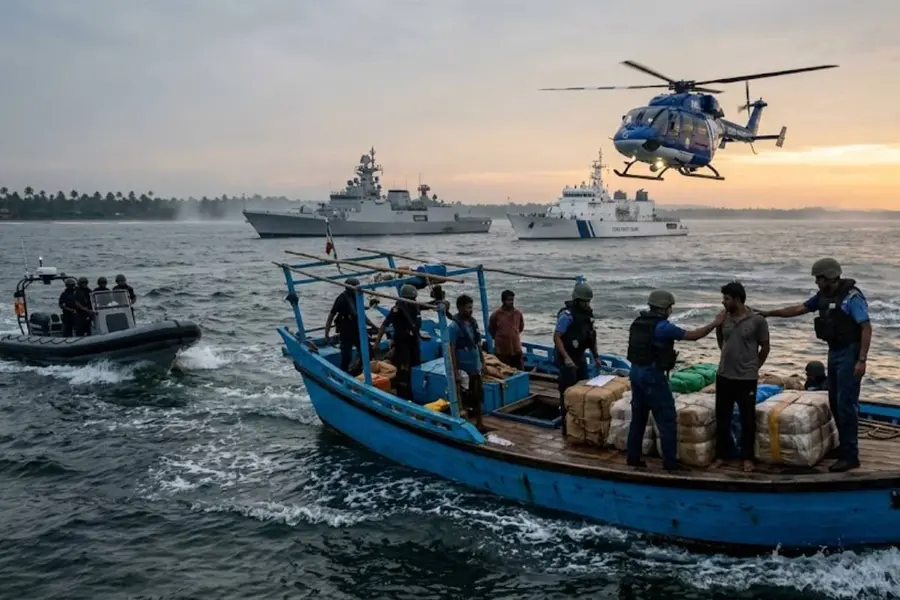
Kochi: An expansive deep-sea maritime drug corridor originating from Iranian and Pakistani ports is posing an escalating threat to India's national security, with the Kerala coastline increasingly serving as a critical transit point for international syndicates.
Passing through the Indian Ocean and Arabian Sea, the route extends past India's western coast toward Sri Lanka, the Maldives, and as far as Australia. Recent high-value seizures by the Indian Navy, the Narcotics Control Bureau (NCB), and allied agencies off the Kerala coast have exposed the scale of smuggling operations along these international sea lanes.
The 'Death Crescent' maritime pipeline
The drug corridor originates in the Golden Crescent, the golden triangle region straddling the borders of Afghanistan, Pakistan and Iran. As opium and synthetic drugs produced in Afghanistan are funneled through Pakistan’s Makran port and Iran’s Chabahar port into the Arabian Sea, security agencies have dubbed this maritime pipeline the “Death Crescent”.
From these transit hubs, contraband vessels navigate international shipping lanes to deliver consignments to Indian coastal states, primarily Gujarat, Maharashtra, Kerala and Tamil Nadu, before cargo is routed toward secondary destinations in Sri Lanka, the Maldives, Australia, Europe and Africa.
Haji Salim network controls 70% of maritime smuggling
Security agencies confirm that the Pakistan-based Haji Salim network, a notorious syndicate with documented links to fugitive underworld don Dawood Ibrahim and Pakistan's Inter-Services Intelligence (ISI), directs up to 70 per cent of maritime drug trafficking into India.
The network first drew severe scrutiny from Indian intelligence following a major drug seizure off Kerala in 2015. Consignments linked to Haji Salim's syndicate are systematically marked with specific identification numbers and distinct logos, including scorpion and horse emblems.
In response to the growing threat, joint operations involving the NCB, Indian Navy, Indian Coast Guard, and Anti-Terrorism Squads (ATS) across multiple states have seized over 3,500 kg of narcotics while arresting several Iranian and Pakistani operatives.
How the ‘mother ship’ modus operandi functions near Kerala
Traffickers deploy large commercial vessels known as “mother ships”, which remain stationed in international waters outside Indian territorial boundaries to evade jurisdiction.
Mid-sea offloading occurs via satellite phones and encrypted communications. Narcotics are transferred from mother ships onto small fishing trawlers or speedboats. Cargo is concealed within custom-built secret compartments. If intercepted, crews dump weighted drug consignments directly into the sea to destroy evidence.
Kerala’s extensive coastline, coupled with numerous fishing harbours and proximity to international maritime routes, makes the Kochi coast an ideal staging ground for moving contraband into domestic Indian markets and neighbouring states.
Major seizures off the Kerala coast
Joint maritime operations off the coast of Kerala have intercepted several massive shipments in recent years.
| Date | Interception details | Seizure volume and value |
| May 2023 | Indian Navy and NCB joint operation on a mother ship off Kerala | 2,500 kg Methamphetamine (Valued at ₹12,000 Crore — largest in Indian history) |
| October 2022 | NCB and Navy raid on an Iranian vessel off Kochi | 200 kg Heroin; 6 individuals arrested (including 4 Iranian nationals) |
Published: 01 Oct 2026, 12:59 pm IST
Related Topics
Disclaimer: Kindly avoid objectionable, derogatory, unlawful and lewd comments, while responding to reports. Such comments are punishable under cyber laws. Please keep away from personal attacks. The opinions expressed here are the personal opinions of readers and not that of Mathrubhumi.
