
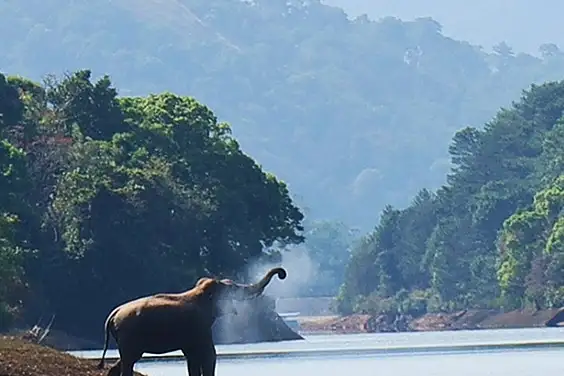
Idukki (Keralam): Keralam Forest Minister Shibu Baby John on Sunday said the wild elephant Chakkakomban, which has been straying into human habitations in Chinnakanal here, would be radio-collared and monitored, while its translocation would be considered only if necessary and with the permission of the Kerala High Court.
There have been protests in the 301 colony in Chinnakanal recently over repeated incidents of Chakkakomban entering residential areas in search of jackfruits, attacking people and damaging property.
Chakkakomban got its name because of its frequent visits to houses in search of jackfruits.
It was from the same locality that another wild elephant, Arikomban, was relocated.
The animal is currently reported to be in the Kalakkad forest range near the Upper Kodayar dam in Tamil Nadu.
Speaking to reporters, John said 34 human lives had been lost in incidents involving wild elephants in the region and that the situation required urgent attention.
He said around 17 to 18 elephants were living in the densely populated area, where only a small stretch of about three acres was classified as forest land. The area, however, was traditionally frequented by elephants for drinking water, he said.
The government was taking steps to remove encroachments to create conditions for elephants to move through their natural corridors, overcoming various pressures, he said.
The minister said the government was currently authorised to radio-collar Chakkakomban and monitor its movements, while any decision on translocation would have to comply with directions of the High Court and its monitoring committee.
"At present, the normal procedure available to the government is to radio-collar the elephant and monitor it. If we can monitor its movements accurately, we can prevent further accidents. We are moving ahead with that for now," he said.
He said the government was planning a comprehensive monitoring programme for elephants in the region.
The minister noted that elephants often moved towards Mathikettan Shola but returned as the kurinji plants there were not part of their regular diet. Chakkakomban, who had stayed there for more than a month, had also returned recently, he said.
Asked about the possibility of bringing in kumki elephants, John said their assistance would be required even for radio-collaring Chakkakomban.
He said the government would assess the situation after monitoring the elephant and approach the High Court for further directions if any additional action, including translocation, was required.
The minister said two elephants in the region had been identified as frequent troublemakers and were being monitored.
The government would ensure close monitoring and deploy personnel to prevent further human casualties, he added.
He also appealed to people to support the government's efforts within the existing legal framework, noting opposing demands: some groups protested radio-collaring.
In contrast, others insisted that the elephant be relocated.
Regarding residents' concerns that elephants could not be allowed to remain in a populated area, John said that around 10,000 to 30,000 people and 18 elephants had been living in the region for a long time.
"If it were possible to capture and relocate the elephants easily, as we wished, we would have done so. However, several directions from the High Court have to be followed," he said.
He also referred to earlier reports recommending measures such as constructing an overpass for elephants or allowing them to cross beneath the road while vehicles used an elevated route, particularly along the highway towards Bodimettu.
He said failures to implement such measures in the past had contributed to the present situation.
(This story has not been edited by Mathrubhumi and is published from a syndicated feed.)
Published: 22 Nov 2026, 12:28 pm IST


Disclaimer: Kindly avoid objectionable, derogatory, unlawful and lewd comments, while responding to reports. Such comments are punishable under cyber laws. Please keep away from personal attacks. The opinions expressed here are the personal opinions of readers and not that of Mathrubhumi.
