
His most viral work turned out to be an unplanned phone video recorded in a matter of minutes.
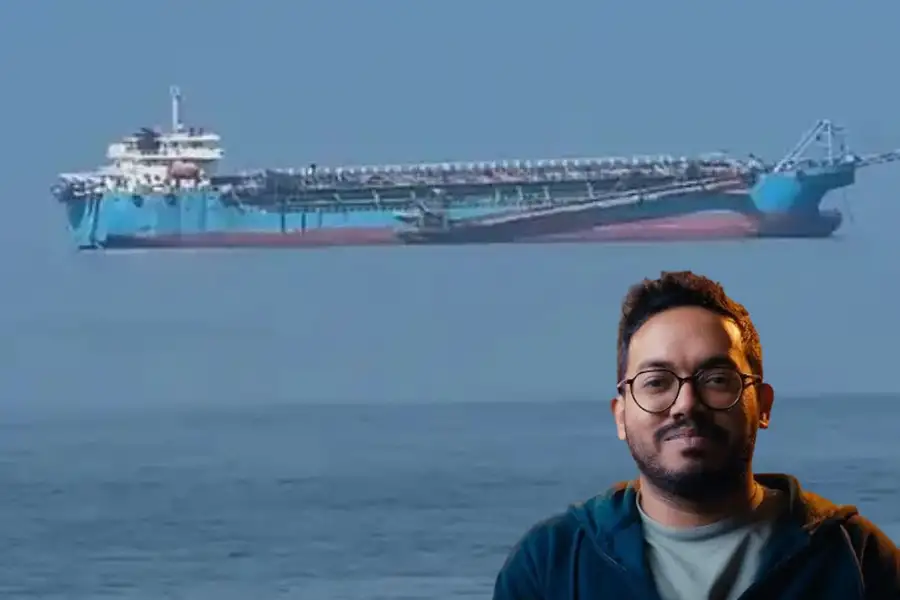
A bizarre video showing a massive cargo ship floating in mid-air off the coast of Ajman in the United Arab Emirates (UAE) has taken social media by storm. While millions of viewers online speculated whether the footage was generated by artificial intelligence, edited with Photoshop, or proof of a glitch in the simulation, the illusion is a completely natural atmospheric phenomenon. The creative mind behind this spectacular recording is Jaseel Azeez (also known as Jaseel Peralasseri), a 29-year-old self-taught photographer hailing from Kerala, India, who is currently based in Dubai.
A chance moment on the beach
On November 25, following a work assignment with colleagues, Jaseel made a brief 15-minute stop at Ajman Beach. Looking out across the sea, he spotted something bewildering: distant vessels appeared to be hovering high above the ocean surface with a distinct gap of blue water underneath. Surprised by the scene, he quickly pulled out his mobile phone to capture the moment. After a friend suggested sharing it as an Instagram reel, the clip blew up globally, amassing over 32 million views and 1.5 million likes.
Jaseel, who relocated to the UAE a year ago for better career opportunities and taught himself photography through YouTube tutorials, is no stranger to visual arts. In September 2026, he won 15,000 Dirhams in a prestigious competition organised by Dubai Culture and HIPA for his photograph of a hijabi freestyle footballer suspended mid-air at Al Jaddaf Walk. Ironically, his most viral work turned out to be an unplanned phone video recorded in a matter of minutes.
The superior mirages
Despite wild internet theories claiming digital trickery, experts explain that the video showcases a superior mirage. This optical illusion occurs during a temperature inversion, when a layer of cold, dense air sits right above the sea surface while warmer, lighter air rests above it.
As light rays from the vessel travel through the dense cold air into the warm layer, they bend downwards towards the beach. Because the human eye assumes light travels in a straight line, the brain places the ship's image higher than its actual physical location, making it look as though it is hovering in mid-air. The vessel remains safely on the water, but the bent light tricks our vision. Unlike inferior mirages that make hot UAE roads look wet by reflecting the sky, superior mirages can project ships located hundreds of kilometres beyond the normal horizon.
Published: 29 Nov 2026, 09:39 pm IST


Related Topics
Disclaimer: Kindly avoid objectionable, derogatory, unlawful and lewd comments, while responding to reports. Such comments are punishable under cyber laws. Please keep away from personal attacks. The opinions expressed here are the personal opinions of readers and not that of Mathrubhumi.
