
Rahul Gandhi attacked the 'Manusmriti mindset' and patriarchy in Pune, while highlighting women's safety, rights, harassment and social control.
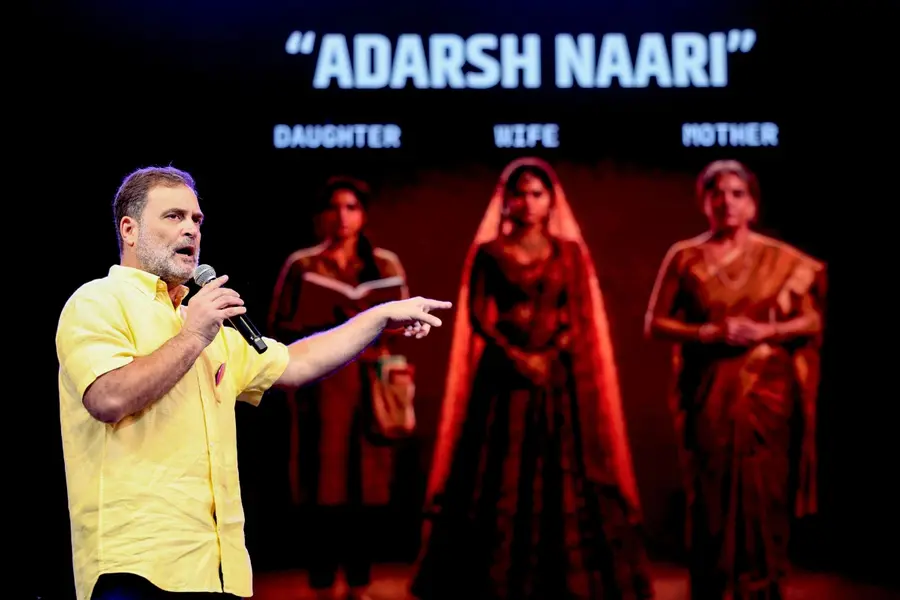
'Women belong to themselves.' With that message, Congress MP Rahul Gandhi launched a sharp attack on what he described as the 'Manusmriti mindset' and the social structures that continue to control women, while addressing the Pune leg of the 'Chhatron Ki Goonj' campaign on Saturday.
Speaking to students at the outreach programme, Gandhi said women should not be defined by their relationship with their fathers, husbands or sons.
He criticised the Manusmriti's prescription that a woman must remain under the authority of male relatives at different stages of her life, calling the words a shame.
Gandhi also turned his criticism towards Prime Minister Narendra Modi, playing a video in which Modi had referred to abusive language used by girls during the agitation at Jantar Mantar over paper leaks and described it as a 'cultural shock'.
Gandhi argued that both boys and girls had used abusive language during the protest, but questioned why girls' use of such language was singled out.
'If boys abuse, there is no problem and it is allowed, but if a girl abuses, it is a cultural shock,' he said.
The Congress leader also referred to an old statement by RSS chief Mohan Bhagwat that rape happens in 'India' and not in 'Bharat', along with former Haryana chief minister ML Khattar's alleged comment that 80% of rapes happen because of women.
'So this is a mindset, and this fight is against this mindset,' Gandhi said.
He described the mindset as one that confines women, prevents them from working, and gives men greater freedom.
Gandhi said women and girls were India's strength, foundation, and future, while patriarchy suppresses, scares, threatens, and controls them.
'Together we have to finish this patriarchy, smash the patriarchy!' he said, urging women to 'be loud, be proud, and fight for your space in society.'
Gandhi lists three forms of violence against women
Gandhi also spoke about violence against women beyond physical attacks, identifying three forms: physical violence, denial of opportunities and economic violence.
He claimed that 400,500 female foeticides take place every year, 80% of women encounter harassment, 29% endure physical violence and 6% face rape.
He further claimed that 99% of incidents of sexual violence go unreported because of social stigma.
The Congress leader said women were among the country's biggest assets and urged them to stand up for themselves and believe in their own strength. 'You belong to nobody, except yourself,' Gandhi said.
MPSC aspirant raises paper leak concerns
The programme also saw students raise concerns over examination-related issues. Sharayu Chopde, a Maharashtra Public Service Commission aspirant, told Gandhi that women candidates were particularly vulnerable to the consequences of exam-related malpractices because they faced pressures linked to marriage and family.
She sought Gandhi's support for MPSC candidates in Pune demanding a re-examination following a recent paper leak. Gandhi said he would discuss the matter.
Another woman raised the concerns of tribal students who had been observing a hunger strike at Manjari in Pune for 10 days over several demands, including an extension of the age limit for staying in government tribal hostels.
Gandhi responded by offering to join the protesters. 'Call me there, I will come and sit with you,' he said.
The Pune outreach thus became a platform for Gandhi to connect women's safety and rights with wider questions of social control, opportunity and institutional accountability, while calling for what he described as a decisive break from patriarchal thinking.
Published: 23 Aug 2026, 11:20 am IST
ABOUT THE AUTHOR

Related Topics
Disclaimer: Kindly avoid objectionable, derogatory, unlawful and lewd comments, while responding to reports. Such comments are punishable under cyber laws. Please keep away from personal attacks. The opinions expressed here are the personal opinions of readers and not that of Mathrubhumi.