
A video claiming Vande Bharat ran at 100 kmph on Chenab Bridge went viral. Northern Railway says no train has operated at that speed yet.
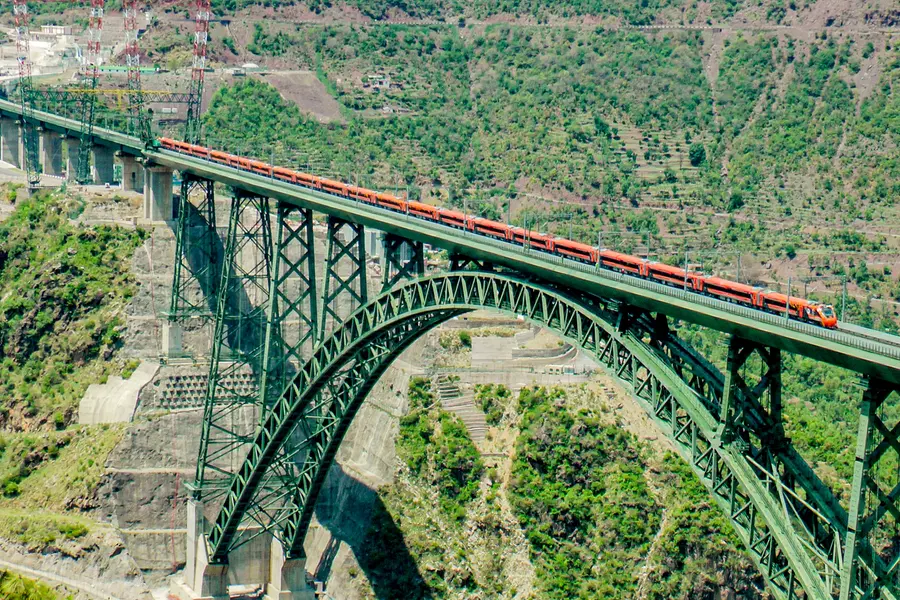
A video showing a Vande Bharat train reportedly travelling at 100 kmph over the Chenab Railway Bridge has gone viral, but there is a crucial clarification from Northern Railway: no train has actually operated at 100 kmph on the bridge so far.
Northern Railway on Thursday clarified that while permission has been granted to increase the permissible speed to 100 kmph on the Banihal–Shri Mata Vaishno Devi Katra rail section, the higher speed has not yet been used by any train on the Chenab or Anji bridges.
“Approval has been given to increase the speed of trains to 100 kmph on the Banihal to Shri Mata Vaishno Devi Katra rail section. No train has been operated at a speed of 100 kmph as of now,” Northern Railway said in a communication to the media.
The clarification follows earlier statements from some Northern Railway officials that the Vande Bharat train had operated at 100 kmph over the Chenab Railway Bridge.
When contacted later by IANS, officials said there had been a communication gap. Reporters were told that approval had been received for operating the Vande Bharat train at the higher speed, but this was understood as confirmation that the train had already operated at 100 kmph.
Northern Railway has now made it clear that approval to operate at 100 kmph is not the same as the train having actually run at that speed.
100 kmph speed approved on Katra-Banihal route
The Railway Ministry has approved speeds of up to 100 kmph on the 111-kilometre new Broad Gauge section between Shri Mata Vaishno Devi Katra and Banihal under Northern Railway's Jammu Division.
The permissible speed was earlier 85 kmph on the Katra-Sangaldan section and 75 kmph on the Sangaldan-Banihal section.
Northern Railway said the speed enhancement was approved after ensuring compliance with the prescribed safety conditions.
Senior Divisional Commercial Manager, Jammu, Uchit Singhal said the increase in speed would reduce travel time and further strengthen connectivity between Jammu and Kashmir.
He said the move would provide passengers with faster, safer and more comfortable travel while also supporting tourism, trade and economic activity in the region.
With IANS inputs
Published: 20 Aug 2026, 02:55 pm IST
ABOUT THE AUTHOR

Related Topics
Disclaimer: Kindly avoid objectionable, derogatory, unlawful and lewd comments, while responding to reports. Such comments are punishable under cyber laws. Please keep away from personal attacks. The opinions expressed here are the personal opinions of readers and not that of Mathrubhumi.