
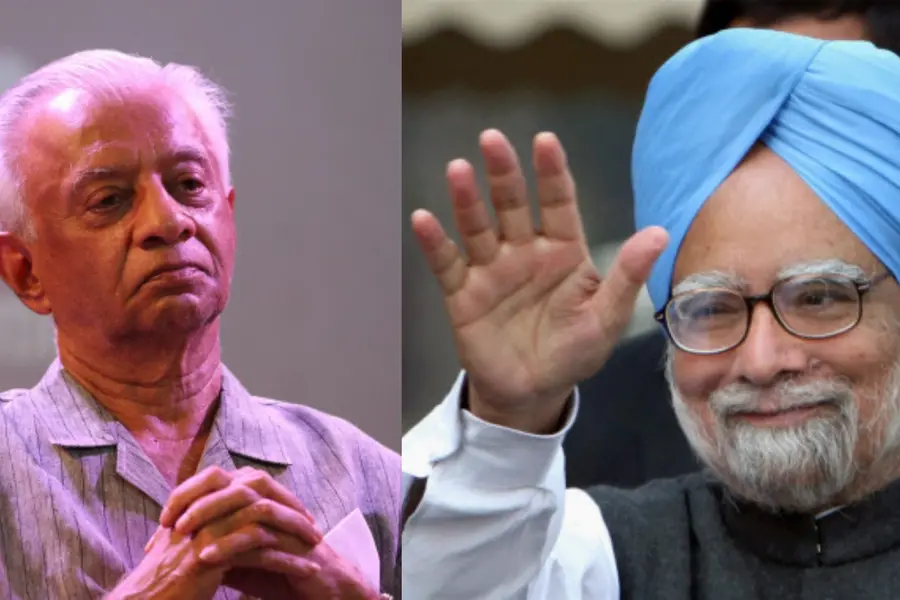
Dr. Manmohan Singh, India’s former Prime Minister, embodied humility and selflessness in leadership. His approach was clear: “Nothing the government does should be known in the name of the Prime Minister. No name or fame. Everything should be known in the name of the government of the country.” These words reflected his deep conviction and set the tone for his tenure. He lived by this principle, shunning personal glory and fame. In today’s world, such a leader is rare.
My association with Dr. Singh began decades ago and remains a cherished journey. It was during my tenure as Chairman of the Public Enterprises Selection Board that I received a call from his office. The call actually came to my colleague’s phone. The message was simple: “The Prime Minister is looking for T.K.A. Nair. Please contact us as soon as possible.” I assured them I would meet him in Delhi the next day.
With the same warmth of our earlier meetings, dating back to his days as the RBI Governor, he greeted me when I met him as Prime Minister. His words were, “Can you help me?” Without hesitation, I agreed, not knowing what the task entailed. This marked the beginning of my tenure as his Principal Secretary, a role that allowed me to witness his leadership up close.
Years before this, on the instructions of Punjab Chief Minister Darbara Singh when I was the Secretary of the Industries Department there, I went to meet Singh, then the RBI Governor, for the first time. Punjabis abroad had expressed their desire to start industries in the country, and the visit was to discuss this. The Chief Minister fixed the time for the discussion. The reception was cordial. Everything was asked, and help was provided. It was a time when even getting a telephone connection was difficult.
I met Singh in meetings when he became the chairman of the research institute founded by Dr. PN Haksar, who was Indira Gandhi's principal secretary. Later, I became the Chief Secretary. After he became the Finance Minister, I had no contact with him.

“I don't want anything in my name.”
When I took charge of the Prime Minister's Office, he reminded me of one thing right from the start: "If anyone calls, even if it's from home, you should inform me at that moment. Don't do anything as anyone tells you." Singh told everyone: "Nothing the government does should be known in the name of the Prime Minister. No name or fame. Don't do anything that exalts the Prime Minister. Tell the media about this too. Anything in the name of the government of the country is enough." He did not give any space to name and fame in his life. Can such a ruler and man be found today? In fact, even the media section was shocked. When I look at the current leaders, I feel that such a decision was not necessary and that I should have argued with him on it.
Dr. Singh’s emphasis on collective responsibility was unparalleled. He ensured every decision was discussed with his ministers. Even when he was certain of a course of action, he sought the understanding and agreement of his colleagues. This respect for others’ opinions set him apart. His presence in Parliament during Question Hour was a testament to his dedication and accountability.
He valued relationships deeply. Figures like Harkishan Singh Surjeet and Pranab Mukherjee were not just colleagues but close friends. His personal touch and respect for others made him a unique leader.
The Nuclear Deal and the Left
Dr. Singh’s vision for India as a global power was evident in his push for the nuclear deal with the United States. He believed nuclear energy was essential for the country’s progress. Despite efforts to address the concerns of the Left parties, they ultimately withdrew their support. It is not known whether the Prime Minister later felt that, if they had continued without withdrawing their support, many things that happened during the second UPA government would not have occurred. At the same time, Manmohan Singh maintained good relations with countries like Russia, China, and the US and tried to change the negative perception of the Pokhran nuclear test. Singh believed that each Prime Minister had played their part in making India what it is today and that he was just its continuation.
I believe that his reforms in the economic sector have yielded good results. I have never seen anyone else with such a great understanding of the economy. He has always shown sympathy for Kerala. Examples include the space sector, the GAIL project, and the LNG terminal. He has expressed a good opinion about Kerala's health sector. The Mahatma Gandhi National Employment Guarantee Scheme was his idea. I was the one who called the first meeting for this. (It is true that some officials were not initially interested in the scheme.
A Man of Few Words
I was with him for about ten years as an advisor and Principal Secretary. I understood one thing during that journey—he had no political aspirations as he was not a politician. That is why he did not try to enter the history of fame. Dr. Singh was not a politician in the traditional sense. He had no personal political ambitions, and this was evident in his actions. He believed in letting others speak and trusted their judgment. His brevity in words was not a sign of weakness but a reflection of his strength and clarity. He acted decisively, letting his work speak for itself.
A Textbook of Virtues
Humility, patience, love, and the feeling that nothing is mine were his forte. Even if you examine each of his qualities, Singh is a textbook. He did not indulge in bragging or glorifying himself like other rulers do. "It is not me who should say it; it is you, the people. History will tell everything," he reminded. He never got angry and took me along with him. We respected each other and maintained a personal relationship. Never misused the office, nor did he allow anyone else to do so.
Even after my tenure, our relationship endures. Whenever I go to Delhi, I see him. I called him. Even recently I called him to inquire about his health. Our closeness and friendship, the bond built over a decade, was strong and deep. To this day, I wonder: Can I ever find someone to love and respect as much as I do him?
-(Prepared by MK Suresh)
Published: 27 Dec 2024, 09:32 am IST
Related Topics
Disclaimer: Kindly avoid objectionable, derogatory, unlawful and lewd comments, while responding to reports. Such comments are punishable under cyber laws. Please keep away from personal attacks. The opinions expressed here are the personal opinions of readers and not that of Mathrubhumi.