
BJP vs TMC rebels: The Bengal BJP says NDA equations in Delhi will not automatically translate into an electoral tie-up in the state.
In politics, an alliance on paper does not always translate into an alliance on the ground.
Bengal’s BJP appears to be drawing that distinction precisely ahead of the state’s next big urban electoral test.
Despite the Nationalist Citizens Party of India (NCPI) positioning itself as part of the BJP-led NDA in Delhi and seeking a possible understanding, the Bengal BJP has decided to contest the upcoming civic polls on its own.
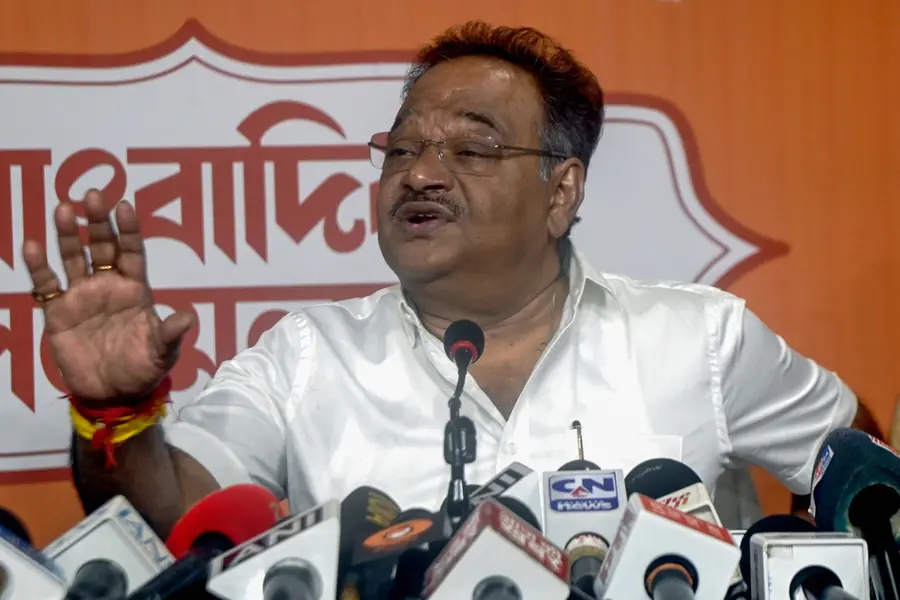
The message from the state unit is unequivocal. ‘There is no alliance partner for the BJP in West Bengal. We will fight the Kolkata and Howrah municipal elections on our own strength and win,’ state BJP president Samik Bhattacharya told reporters.
Bhattacharya also made it clear that arrangements in national politics would not automatically determine electoral equations in Bengal.
‘There may be an understanding with NCPI in Delhi, but Delhi and Kolkata are about 1,500 kilometres apart,’ he said.
The decision assumes significance because the Kolkata Municipal Corporation (KMC) and Howrah Municipal Corporation (HMC) polls will be the BJP’s first major civic electoral test after its comfortable victory in the Assembly elections earlier this year.
The elections are expected after the Durga Puja festivities, with both corporations set for a substantial redraw following delimitation.
For the BJP, Kolkata is no longer being viewed as an impregnable TMC bastion.
Ritesh Tiwari, convener of the party committee overseeing the KMC elections, pointed to the Assembly results as evidence of a shift in the city’s political landscape.
‘The BJP had almost nothing in KMC. But in the Assembly poll results, people have voted for BJP in most seats in Kolkata,’
Tiwari said, adding that the party intends to contest all 209 seats and aims for a ‘thumping majority’.
Why BJP is resisting the TMC rebels
The decision to stay away from an alliance with the NCPI is not merely an electoral calculation. For the Bengal BJP, it is also about political messaging to its own cadre.
The NCPI is led by 20 former TMC MPs, headed by MP Kakoli Ghosh Dastidar, who quit the Trinamool Congress following the party’s rout in the Assembly polls.
The MPs subsequently joined the NCPI and have attended NDA meetings in Delhi.
The NCPI, consequently, believes an electoral understanding with the BJP remains possible.
Ghosh Dastidar has said the party is the ‘largest coalition member’ of the BJP-led NDA and intends to contest the civic elections as part of the alliance.
‘We are the largest coalition member of the BJP-led NDA and will contest the civic polls as members of the alliance,’ she said, adding that a final decision would be taken closer to the election and that a coalition remained a possibility.
The Bengal BJP, however, appears unwilling to carry the Delhi arrangement into the state.
A senior Bengal BJP leader argued that the party first wants to test the strength of its own organisation, leaders and workers. More importantly, the NCPI’s leaders are former TMC figures who were political opponents of BJP workers for years.
The leader said joining hands with them could send ‘a wrong message’ to BJP leaders and workers, many of whom had fought against the TMC and, according to the party, lost their lives in political clashes.
The BJP also sees a reputational problem in partnering with former TMC leaders while simultaneously making corruption a central plank of its civic campaign.
The party plans to attack the TMC over alleged corruption in the municipal administration and promise cleaner, corruption-free civic systems.
Delimitation reshapes Kolkata, Howrah battle
The BJP’s confidence is also being fuelled by the scale of the electoral reorganisation.
The number of KMC wards is proposed to rise from 144 to 209, while Howrah’s wards are set to increase from 50 to 68. The exercise will alter voter distribution, polling stations, booth-level calculations and the social and political composition of several wards.
In Kolkata, the administration is looking at bringing the electorate in individual wards closer to the 15,000-16,000 range, amid an effort to address disparities in voter numbers between wards.
For political parties, however, delimitation means much more than redrawing boundaries.
Sitting councillors could find themselves in substantially altered electoral territories, while the creation of new wards opens the door for a large number of fresh political faces.
The BJP sees this as both a test and an opportunity to expand its organisation.
Union Minister Sukanta Majumdar has been assigned responsibility for the Kolkata civic elections, while Rajya Sabha MP Rahul Sinha has been given charge of Howrah.
The party’s campaign is expected to focus heavily on everyday civic concerns: Roads, drainage, waste management, drinking water, street lighting and broader urban infrastructure.
At the same time, the polls will allow the BJP to measure its booth-level machinery across the two corporations.
TMC attacks delimitation exercise
The Mamata Banerjee-led TMC, meanwhile, has signalled that it is ready for the civic battle but has questioned the manner in which the wards are being redrawn.
TMC leader Kunal Ghosh said the party expected good results but alleged that the delimitation was being conducted based on voters rather than population and was intended to benefit the BJP.
The political contest could also become more fragmented than a straightforward BJP-TMC fight.
The BJP believes that a multi-cornered contest involving the TMC, NCPI, rebel TMC MLAs, the Left and Congress could work in its favour if it maintains an independent campaign.
Howrah carries additional political significance. The corporation has not had an elected civic board for years, making its eventual contest particularly consequential.
The State Election Commission has asked the administrations to complete the final delimitation proposals by the second week of September, with draft reservation orders expected around the middle of the month.
The commission has indicated that the civic elections, including those in Kolkata and Howrah, are to be completed by December 7.
The municipal contests will come after the October 6 bypolls in Nandigram and Rejinagar, with counting scheduled for October 9.
For the BJP, then, the civic polls are about more than capturing municipal bodies.
They are an opportunity to test whether its Assembly-election momentum can be converted into an enduring urban organisation, and whether it can do so without making room for the very TMC rebels now asking to join its electoral camp.
Published: 12 Sept 2026, 09:28 pm IST
ABOUT THE AUTHOR

Related Topics
Disclaimer: Kindly avoid objectionable, derogatory, unlawful and lewd comments, while responding to reports. Such comments are punishable under cyber laws. Please keep away from personal attacks. The opinions expressed here are the personal opinions of readers and not that of Mathrubhumi.