
Sonia Gandhi’s journey from Italy to India, marriage to Rajiv Gandhi and eventual rise as a leading Congress figure has spanned love, loss and decades of public life. In her upcoming memoir, Belonging: A Journey of Love, she revisits the experiences that shaped her identity, family and decision to enter politics.
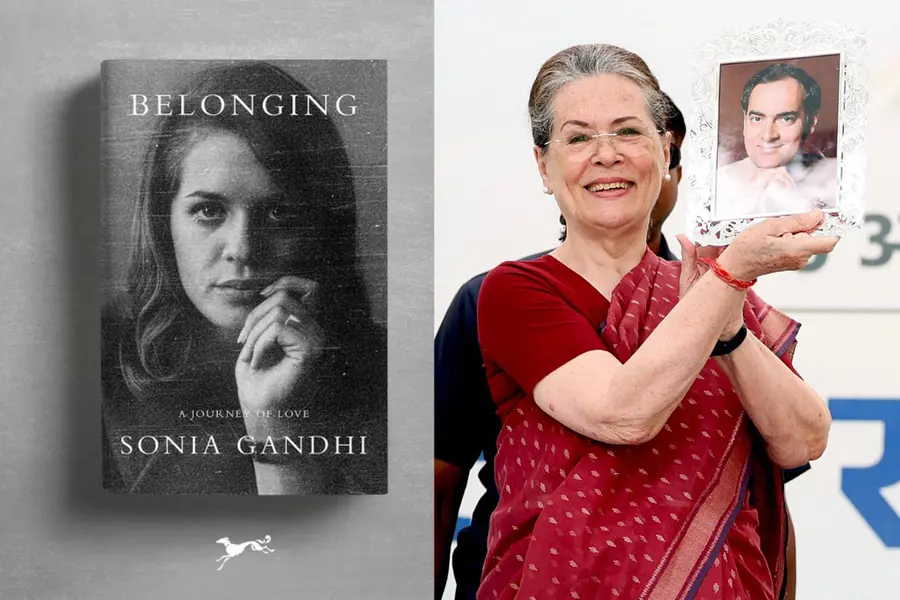
From a young woman who grew up in post-war Italy to one of the most recognisable faces of the Congress, Sonia Gandhi’s life in India has been closely linked to the Gandhi family, personal tragedies and her eventual entry into politics.
Her 544-page memoir, Belonging: A Journey of Love, is set to revisit that journey.
Sonia Gandhi’s 544-page memoir to release in November
Congress leader Sonia Gandhi is set to publish her memoir Belonging: A Journey of Love on November 10. The 544-page book will be released in hardcover and ebook formats, with an audio edition also planned.
Gandhi has described the book as an intensely personal account of her life and said that “heartbreak and loss” eventually pushed her into the public world of politics.
The memoir is expected to cover her childhood in Italy, her meeting with Rajiv Gandhi, her move to India, her years as part of the Gandhi family, the deaths of Sanjay Gandhi, Indira Gandhi and Rajiv Gandhi, and her eventual political career.
How Sonia Gandhi came to India
Sonia Gandhi was born Sonia Maino in Italy and grew up in a small town in the post-war period. Her journey to India began in the 1960s when she was studying in Cambridge, England.
In 1965, at the age of 19, she met Rajiv Gandhi in Cambridge. Rajiv was studying there at the time. The two developed a relationship and married in 1968.
Her marriage brought Sonia into the Nehru-Gandhi family, one of India's most prominent political families. She moved to India and became part of a family whose public life was already closely connected with the country's politics.
After moving to India, Sonia gradually adapted to a new country and culture. Her memoir is expected to recount her efforts to learn Hindi, wear Indian clothes and adjust to Indian food and customs.
She also became close to Rajiv's mother, then Prime Minister Indira Gandhi.
For years, however, Sonia remained outside active politics. Despite being part of a politically powerful family, she largely maintained a private life and focused on her family.
The Gandhi family's political prominence was accompanied by a series of devastating personal losses.
Sanjay Gandhi, Indira Gandhi's younger son, died in a plane crash in 1980. Indira Gandhi was assassinated in 1984.
Rajiv Gandhi subsequently became prime minister and led the Congress government from 1984 to 1989. He was assassinated in 1991 while campaigning for the Lok Sabha election.
Rajiv's death marked a major turning point in Sonia Gandhi's life. She remained reluctant to enter politics for several years, despite repeated demands from Congress leaders and supporters.
How Sonia Gandhi entered politics
Sonia Gandhi eventually joined the Congress in 1997 and became the party's president in 1998.
Her entry came at a time when the Congress was facing organisational and electoral challenges. She gradually emerged as the party's central political figure and became one of the principal leaders of the opposition to the BJP-led government.
Under her leadership, the Congress played a key role in building the United Progressive Alliance (UPA).
The alliance won the 2004 Lok Sabha election, paving the way for a Congress-led government under Prime Minister Manmohan Singh.
Why Sonia Gandhi became the face of Congress
Although Sonia Gandhi did not become prime minister, she became the most influential political figure in the Congress-led alliance.
She served as Congress president for much of the period between 1998 and 2017 and again from 2019 to 2022. During the UPA years, she chaired the United Progressive Alliance and remained central to the coalition's political strategy.
Her decision in 2004 to decline the prime minister's post became one of the defining moments of her political career. Manmohan Singh subsequently became prime minister.
Over the years, Sonia Gandhi became closely identified with the Congress and the wider Nehru-Gandhi political legacy, while Rahul Gandhi and Priyanka Gandhi Vadra also became prominent figures in the party.
A political career shaped by personal loss
Sonia Gandhi's political journey was not a straightforward progression from the Gandhi family into electoral politics. For years, she resisted entering public life.
Her memoir is expected to offer her own account of how personal tragedies, family responsibilities and political circumstances eventually changed that decision.
In her statement about the book, Gandhi said writing about her life meant revisiting experiences she had kept private for decades.
She described the memoir as a journey from her childhood in Italy to her life in India, which she called the country of her “belonging”.
What the memoir could reveal
Belonging: A Journey of Love is expected to provide Sonia Gandhi's perspective on several defining periods of modern Indian political history.
These include her relationship with Rajiv Gandhi, her years with Indira Gandhi, the assassinations that transformed the Gandhi family, her reluctance to enter politics, the Congress's electoral struggles, the UPA years and her decision not to become prime minister in 2004.
The book is also expected to explore questions of identity, family, duty and belonging, while reflecting on India's political and social changes over several decades.
For Sonia Gandhi, the memoir marks a rare departure from the privacy she maintained for much of her life.
Rahul Gandhi reacts to his mother’s memoir
Rahul Gandhi welcomed the announcement of the memoir and recalled the loss of his father more than three decades ago.
In a social media post, Rahul said that he had watched his mother face the difficulties of her life with courage and dignity. He also said he was proud that her story would finally be read by a wider audience.
He described the book as his mother's “beautiful story” and said he knew how difficult it had been for someone as private as Sonia Gandhi to share her life publicly.
Why Sonia Gandhi’s story matters to Congress
Sonia Gandhi's political career is significant because she became the central figure of the Congress during a period when the party was rebuilding itself after years of electoral setbacks.
Her leadership helped the Congress return to power at the Centre in 2004 and remain in government for two consecutive terms through the UPA coalition. Her decision to nominate Manmohan Singh as prime minister also became a defining feature of the Congress's coalition-era politics.
Her memoir could therefore offer a first-person account of the transition from a private individual married into a political family to a party president who became one of India's most powerful political leaders.
It may also provide her perspective on the Gandhi family's place in India's post-Independence political history and on the personal experiences that influenced her decision to enter public life.
Published: 20 Aug 2026, 02:01 pm IST
ABOUT THE AUTHOR

Disclaimer: Kindly avoid objectionable, derogatory, unlawful and lewd comments, while responding to reports. Such comments are punishable under cyber laws. Please keep away from personal attacks. The opinions expressed here are the personal opinions of readers and not that of Mathrubhumi.