
The disputed passages appear on pages 201 and 443 of Sonia Gandhi's memoir, Belonging: A Journey of Love.
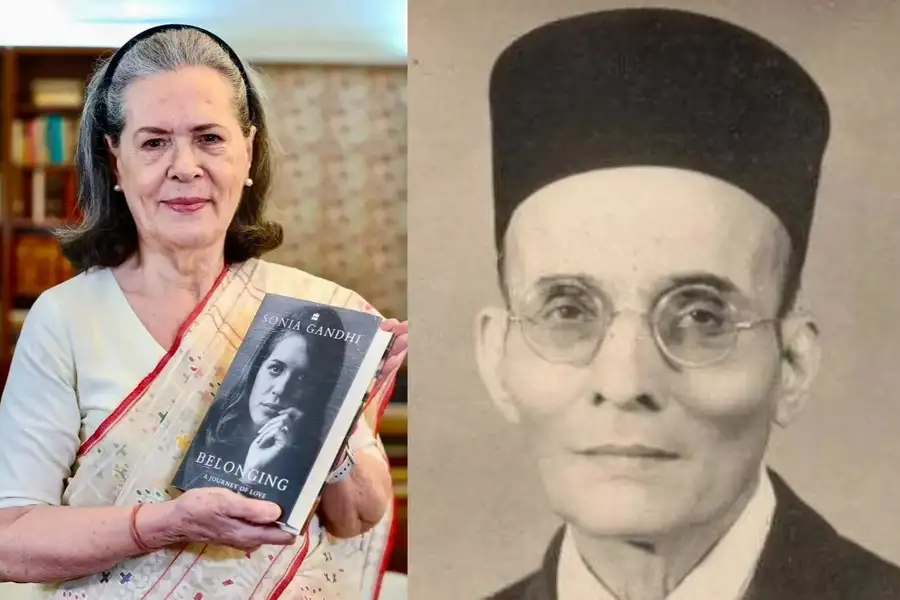
Congress leader Sonia Gandhi has received a legal notice from Vinayak Damodar Savarkar's grandnephew, Satyaki Savarkar, demanding an unconditional apology and corrections to references to the Hindutva ideologue in her recently published memoir, Belonging: A Journey of Love.
The notice, issued through advocate Sangram Kolhatkar, alleges that two passages in the book contain factually inaccurate and historically misleading statements that damage Savarkar's reputation and legacy. It gives Sonia Gandhi 15 days from the receipt of the notice to issue an apology, provide a clarification and correct the disputed references.
Satyaki has warned that he may initiate legal proceedings before a competent court or authority if the demands are not met.
What are the objections to Sonia Gandhi's book?
The objections concern passages on pages 201 and 443 of the memoir, published by HarperCollins Publishers India on November 10.
The first passage, on page 201, refers to senior RSS ideologues, including Savarkar, writing mercy petitions to British colonial rulers while Congress leaders faced imprisonment and assaults. It also alleges that RSS members collaborated with British authorities as informers.
According to the legal notice, the passage creates an impression that Savarkar was involved in informing on Indian freedom fighters or collaborating with the British against them.
Satyaki has disputed this implication, arguing that it ignores the historical circumstances surrounding Savarkar's imprisonment, petitions and political activities. The notice points out that Savarkar endured prolonged imprisonment and severe hardships under British rule, including incarceration in the Cellular Jail in the Andaman Islands.
It argues that references to his mercy petitions, without examining the circumstances in which they were submitted, present an incomplete and distorted account of his life.
The second objection concerns a passage on page 443, which describes Savarkar's vision of India as one in which Hindus are supreme. The memoir also links this ideological outlook to the Rashtriya Swayamsevak Sangh (RSS), the Bharatiya Janata Party (BJP) and organisations collectively known as the Sangh Parivar.
The notice argues that this characterisation misrepresents Savarkar's political philosophy by reducing it to religious supremacy without adequately considering the historical and intellectual context of his writings and speeches.
What has Sonia Gandhi been asked to do?
Apart from an unconditional written apology and a public clarification, Satyaki has demanded that Sonia Gandhi substantiate the disputed claims with authentic historical material or acknowledge and correct the alleged inaccuracies.
The notice also calls for the intervention of HarperCollins Publishers India, seeking corrections, suitable qualifications or withdrawal of the disputed passages from subsequent editions, reprints and electronic versions of the memoir.
Why has Savarkar's grandnephew cited Indira Gandhi?
The notice also refers to actions taken during the tenure of former prime minister Indira Gandhi to highlight what it describes as the Congress leadership's earlier recognition of Savarkar.
It cites the issuance of a commemorative postage stamp honouring Savarkar during Indira Gandhi's tenure, her personal contribution of Rs 11,000 towards the Swatantryaveer Savarkar Rashtriya Smarak and the commissioning of a biographical documentary on him by the Films Division in 1983 to mark his birth centenary.
It also refers to the recognition of activists imprisoned during the Bhaganagar (Hyderabad) Unarmed Resistance Movement led by Savarkar as freedom fighters.
Earlier, the Shiv Sena led by Maharashtra Deputy Chief Minister Eknath Shinde had also protested against the references to Savarkar in Sonia Gandhi's memoir. Its leaders publicly tore pages from the book and demanded the removal of the disputed content.
The legal notice marks a fresh escalation of the row over the references to Savarkar in the Congress leader's memoir.
Published: 24 Nov 2026, 12:36 pm IST


ABOUT THE AUTHOR

Related Topics
Disclaimer: Kindly avoid objectionable, derogatory, unlawful and lewd comments, while responding to reports. Such comments are punishable under cyber laws. Please keep away from personal attacks. The opinions expressed here are the personal opinions of readers and not that of Mathrubhumi.