
Sharmila Tagore has backed the first two stanzas of Vande Mataram, saying the full song may conflict with the beliefs of monotheistic communities.
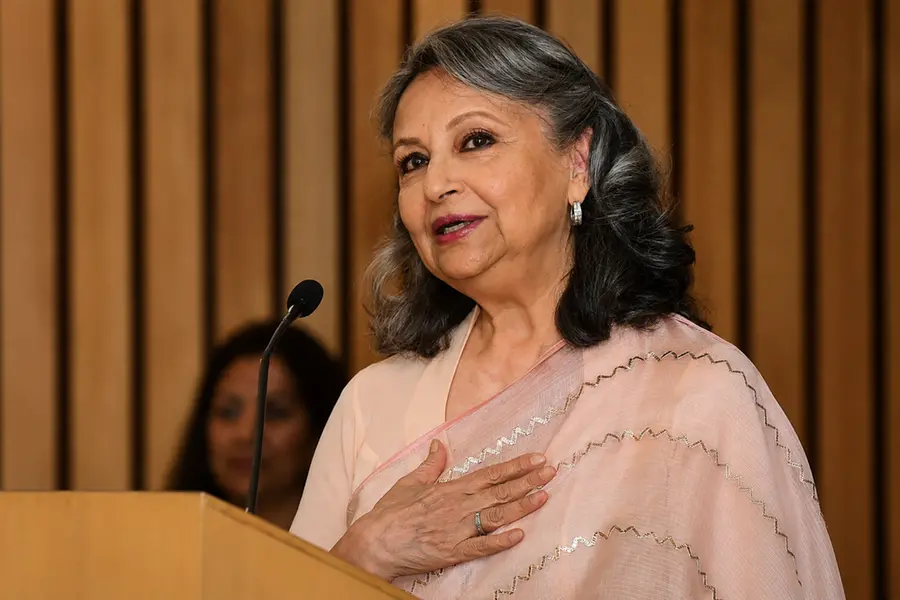
‘It is difficult for those who believe in one religion to say, Vande Kali, Vande Durga.’
Veteran actress Sharmila Tagore has entered the raging debate over the rendition of Vande Mataram, saying India should consider sticking to the national song’s first two stanzas to accommodate the country’s diverse religious beliefs.
Speaking to IANS on Thursday, Tagore said the complete version of the song could pose a difficulty for people who follow monotheistic faiths, given the references to multiple Hindu deities in its later stanzas.
‘My point of view is that there are many religious people who believe in one single God, not many Gods,’ she said, explaining her position on the ongoing debate.
Tagore added that the first two stanzas of Vande Mataram could be a more inclusive choice when viewed against the religious diversity of India.
‘Therefore, if we take all the religious people in India together, the first two stanzas are very good,’ she said.
Her remarks come at a time when Vande Mataram has become the centre of a fresh political and cultural dispute, with the BJP and Congress sparring over how the national song should be performed and interpreted.
The controversy intensified after India’s 80th Independence Day celebrations, when Vande Mataram was rendered in its entirety at the Red Fort on August 15, marking the first time the full song was used during the Independence Day celebrations.
The Congress Working Committee subsequently reaffirmed the party’s longstanding practice of singing only the first two stanzas at its events, a position dating back to 1937. BJP leaders criticised the Congress over the issue and accused the party of disrespecting the national song.
Congress president Mallikarjun Kharge, however, defended the party’s position, arguing that the version featuring the first two stanzas had historically been sung by national leaders.
The debate has also drawn comments from actor Mukesh Khanna, who has taken an even stronger position by calling for Vande Mataram to replace Jana Gana Mana as India’s national anthem.
Khanna had earlier told IANS that he had raised the issue three years ago and claimed that Jana Gana Mana was written as a tribute to Queen Elizabeth.
He argued that Vande Mataram, rather than Jana Gana Mana, should hold the position of national anthem.
Khanna also recalled the rendition of Vande Mataram by legendary singer Lata Mangeshkar and said he had recorded a seven-minute version of the song that he believed could become iconic.
The latest exchange has placed the two songs at the heart of a wider conversation about India's national symbols, their history and how they should be represented in a country marked by deep religious and cultural diversity.
Tagore's intervention, however, brings a different dimension to the debate. Rather than questioning the significance of Vande Mataram, she has focused on the question of inclusivity, arguing that limiting the rendition to its opening two stanzas could make it easier for people of different faiths to participate without conflict with their religious beliefs.
The comments are likely to add another layer to an already charged debate that has moved beyond politics into questions of history, faith, identity and the meaning attached to India's national symbols.
Published: 21 Aug 2026, 03:51 pm IST
ABOUT THE AUTHOR

Related Topics
Disclaimer: Kindly avoid objectionable, derogatory, unlawful and lewd comments, while responding to reports. Such comments are punishable under cyber laws. Please keep away from personal attacks. The opinions expressed here are the personal opinions of readers and not that of Mathrubhumi.