
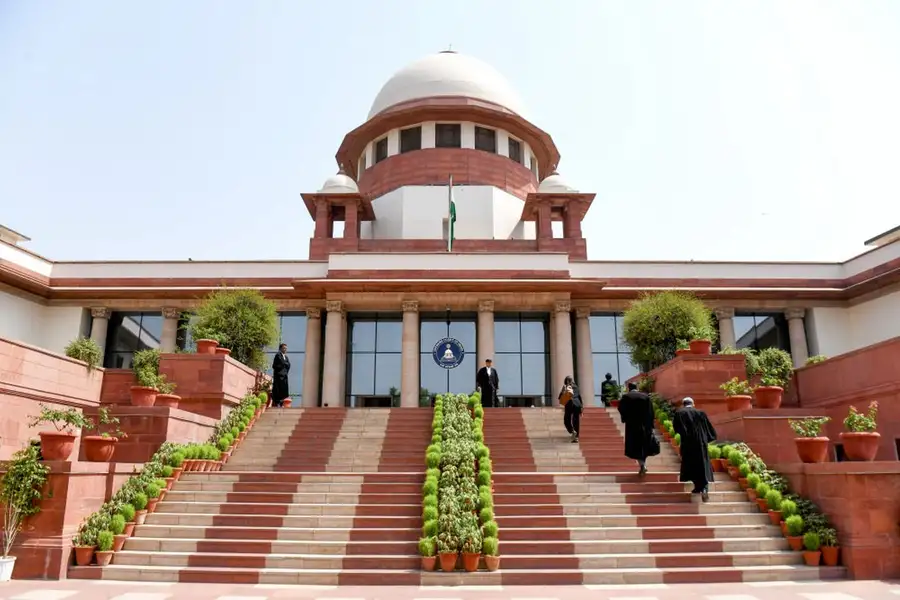
New Delhi: If a public servant is arrested and kept in judicial custody for more than 48 hours, there is a deemed suspension, the Supreme Court has said.
A bench comprising Justices J B Pardiwala and Manmohan made the observation while restoring the bail granted to Vishwajeet Singh, the administrator of Sadar Hospital at Samastipur in Bihar.
Singh was accused of demanding a bribe of Rs 4,000 for clearing a contractual worker's pending wages of Rs 36,421.
The top court set aside a Patna High Court order cancelling his bail nearly a year after it was granted.
The bench said that although the amount of bribe demanded was not a relevant consideration for deciding a bail plea, the high court could have made that observation without cancelling the bail.
While restoring the bail, the apex court also flagged a "disturbing feature" concerning the accused's service status and subsequent posting.
"However, there is one disturbing feature which we should not ignore. It appears that upon arrest, the appellant accused was in judicial custody for almost a period of 15 days.
"Once a public servant is arrested and remains in judicial custody for more than 48 hours, there is a deemed suspension. Being a public servant, he could be said to have been placed under deemed suspension. No specific order is required to be passed in this regard," Justice Pardiwala said in the order dated November 6.
The bench noted the information that Singh was placed under suspension but later, the suspension order came to be revoked.
"And, shockingly, he has been once again posted in the very same hospital and that too on the very same post. This aspect shall be looked into by the state at the earliest… We expect the state to do the needful in the matter in accordance with law," the bench said.
Singh challenged a July 1, 2026, order of the Patna High Court, which allowed a plea filed by the complainant and directed that the accused be taken into custody after cancelling the regular bail granted to him by the sessions court.
According to the case records, an FIR was registered at the Vigilance police station in 2025 under Section 7(b) of the Prevention of Corruption Act, 1988.
The accused was serving as the administrator at the government-run Sadar Hospital in Samastipur when he allegedly demanded Rs 4,000 as illegal gratification for clearing the complainant's outstanding wages amounting to Rs 36,421.
Following his arrest, the accused was granted bail by the sessions court.
The complainant subsequently challenged the bail order before the high court, which set it aside.
The top court took note of the fact that the high court had interfered with the bail order almost a year after the accused was released.
It observed that the tenor of the high court's order indicated that the sessions court's reference to the bribe amount being paltry had weighed with it while deciding to cancel the bail.
"Ordinarily, in cases of this type, having regard to the maximum punishment that the trial court would impose, ultimately, if the accused is held to be guilty, bail is to be granted," the bench said.
It added that bail may be declined in cases involving criminal antecedents or where the facts are particularly grave, it added.
(Except for the headline, this story has not been edited by Mathrubhumi and is published from a syndicated feed.)
Published: 09 Nov 2026, 06:34 pm IST


Related Topics
Disclaimer: Kindly avoid objectionable, derogatory, unlawful and lewd comments, while responding to reports. Such comments are punishable under cyber laws. Please keep away from personal attacks. The opinions expressed here are the personal opinions of readers and not that of Mathrubhumi.
