
S Jaishankar hit back at Pakistan at the UNGA, warning that terrorism cannot be justified or insulated from consequences.
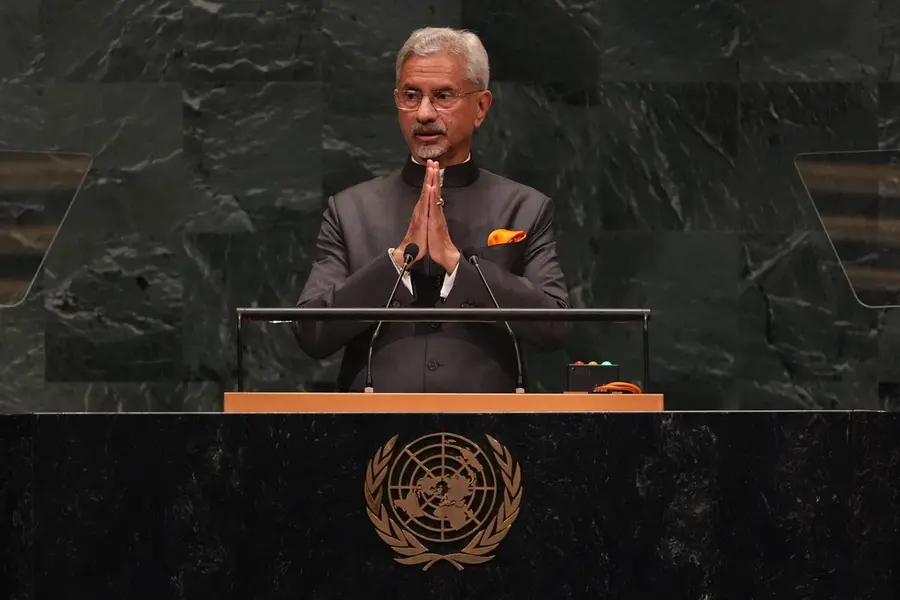
India’s External Affairs Minister S Jaishankar delivered a pointed response to Pakistan at the United Nations General Assembly, warning that attempts to justify or normalise terrorism cannot shield those responsible from its consequences.
Speaking at the 81st session of the UNGA, Jaishankar referred to the previous day’s address by Pakistan Prime Minister Shehbaz Sharif, who had raised Kashmir and criticised India over issues including New Delhi’s decision to suspend the Indus Waters Treaty.
Jaishankar did not name Sharif or Pakistan in the passage, but his remarks were clearly directed at what he described as a country with a repeated record of terrorism.
Jaishankar said the previous day’s intervention at the world body had sought to present a version of events that, in his view, attempted to make terrorism appear legitimate while also seeking protection from the consequences associated with it.
India, he made clear, would not accept such an approach.
The External Affairs Minister also linked the issue of terrorism directly to India’s right to protect itself.
He said New Delhi would continue to exercise that right when faced with terrorist threats, signalling that counter-terrorism would remain a central component of India’s security and foreign policy.
Jaishankar further argued that diplomatic relations cannot be separated from a country’s conduct on terrorism.
His message was that calls for friendship, goodwill or better ties cannot sit comfortably alongside support for, or tolerance of, terrorist activity.
He said any diplomatic understandings based on such contradictions would consequently come under scrutiny.
The remarks marked a sharp Indian response following Sharif’s UNGA speech.
Pakistan’s Prime Minister had used his address to speak about Kashmir and the 2025 India-Pakistan conflict, while also crediting US President Donald Trump for his intervention during the confrontation.
Jaishankar’s response shifted the focus back to terrorism and accountability.
Rather than allowing the debate to remain centred on competing political narratives, he emphasized what India considers the fundamental issue: that terrorism cannot be separated from responsibility for its consequences.
The External Affairs Minister also called for India’s established zero-tolerance approach to terrorism to remain intact.
He has previously used international forums to argue that countries involved in cross-border terrorism must be held accountable and that the financing and infrastructure supporting terrorist networks need to be addressed.
His latest comments came against the backdrop of heightened tensions between India and Pakistan, with terrorism continuing to be one of the most contentious issues in bilateral relations.
Jaishankar ended his message with a direct call for the perpetrator of terrorism to change course.
The broader thrust of his remarks was that diplomatic engagement cannot come at the cost of overlooking terrorism, and that India would retain the right to respond to threats against its security.
The statement also fits into India’s wider argument at international forums that terrorism should not be justified through political narratives or treated differently depending on its circumstances or perpetrators.
Published: 27 Sept 2026, 06:51 am IST
ABOUT THE AUTHOR

Related Topics
Disclaimer: Kindly avoid objectionable, derogatory, unlawful and lewd comments, while responding to reports. Such comments are punishable under cyber laws. Please keep away from personal attacks. The opinions expressed here are the personal opinions of readers and not that of Mathrubhumi.