
The RAF has begun verifying allegations of excessive force and pellet gun use during the CJP-led Chalo Sansad march in Delhi, following claims by protesters and Rahul Gandhi over student injuries.
New Delhi: The Rapid Action Force (RAF), a specialised anti-riot unit of the Central Reserve Police Force (CRPF), has begun examining allegations of excessive force during the CJP-led student protests in Delhi, including claims that personnel used pellet guns while handling demonstrators.
Officials said the CRPF has asked the RAF inspector general to verify the sequence of events during the July 20 ‘Chalo Sansad’ march and examine incidents involving both protesters and security personnel.
A formal Court of Inquiry (CoI) has not yet been initiated. Officials said further action would be taken after the verification process establishes the facts.
Social media videos under review
The RAF is reviewing multiple videos and photographs circulating on social media that show its personnel deployed during the protests.
The footage reportedly includes visuals of personnel using batons, carrying riot-control weapons and conducting lathi-charge operations, along with videos showing RAF personnel surrounded by protesters.
Officials said all procedures related to reviewing the conduct of personnel during operational duties would be followed.
Allegations over pellet gun use
The controversy began after protesters alleged that pellet guns were used during clashes on July 20, leaving some students injured.
The RAF has 12-bore pump-action guns, commonly referred to as pellet guns, as part of its riot-control equipment.
According to officials, the standard operating procedure (SOP) allows the use of such weapons only in extreme situations where personnel face serious threats to their lives.
The SOP reportedly requires the use of deflectors to reduce injuries and instructs personnel to aim at the lower part of the body.
At least two students have reportedly been admitted to hospitals with pellet injuries following the protests.
What is a pellet gun and why is it in the CJP protest row?
A pellet gun is a crowd-control weapon that fires multiple small pellets, usually metal or rubber, from a single cartridge. Unlike regular firearms, it spreads pellets over a wider area and is used by security forces during riot-control situations. However, pellet guns can cause serious injuries, especially to sensitive areas like the eyes and face.
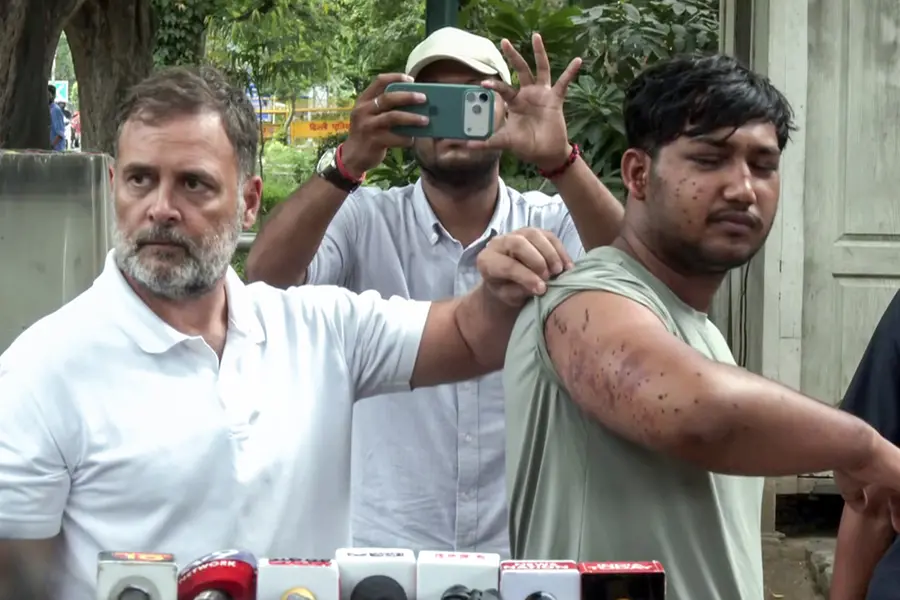
The issue came into focus during the CJP’s ‘Chalo Sansad’ march after protesters alleged that students were injured by pellet firing during clashes with security personnel. Rahul Gandhi also highlighted the case of an injured student, while the RAF has begun verifying claims of alleged pellet gun use.
Rahul Gandhi accuses government of denying injuries
The issue gained political attention after Leader of Opposition Rahul Gandhi raised the allegations and presented an injured protester, Sahil, before the media.
Gandhi claimed the student was injured by pellet fire during the protest while holding the national flag. “This is the future of our country. This has happened to thousands of youth; they have been shot at with pellet guns and have been beaten up in lathi-charge,” Gandhi said.
He accused the government of denying the use of pellet guns and demanded action against those responsible for alleged injuries to protesters.
Gandhi also repeated the Opposition’s demand that Union Education Minister Dharmendra Pradhan resign over the paper leak controversy. “Stop assaulting and threatening our students,” Gandhi said.
Delhi Police denies pellet gun use
The Delhi Police has denied using pellet guns during the protests and said reports claiming their use by the force were misleading.
However, the CRPF and RAF have not issued a final statement on whether their personnel used pellet ammunition during the demonstrations.
The RAF verification process is expected to examine available footage, operational records and statements related to the incidents.
CJP protest and ‘Chalo Sansad’ march background
The July 20 ‘Chalo Sansad’ march was organised by the Cockroach Janta Party (CJP) as part of its ongoing protest against alleged irregularities in national-level examinations.
The protesters have been demanding the resignation of Union Education Minister Dharmendra Pradhan, alleging that the government failed to prevent examination paper leaks and protect students’ interests.
The protest intensified after activist Sonam Wangchuk began a hunger strike, which he later ended after receiving written assurances from the Centre regarding examination reforms.
Wider political confrontation continues
The alleged use of force during the protests has become another point of conflict between the government and Opposition parties.
While protesters and Opposition leaders have accused authorities of using excessive force, security agencies have maintained that their actions were taken while managing a tense law-and-order situation.
The RAF’s verification exercise will now determine whether the allegations require further disciplinary action or a formal inquiry into the conduct of personnel during the protest.
Published: 24 Jul 2026, 05:44 pm IST
Disclaimer: Kindly avoid objectionable, derogatory, unlawful and lewd comments, while responding to reports. Such comments are punishable under cyber laws. Please keep away from personal attacks. The opinions expressed here are the personal opinions of readers and not that of Mathrubhumi.
