
Mathrubhumi's Instagram video showing Delhi Police detaining a young woman during the October 11 protest has been blocked in India after crossing 11 million views.
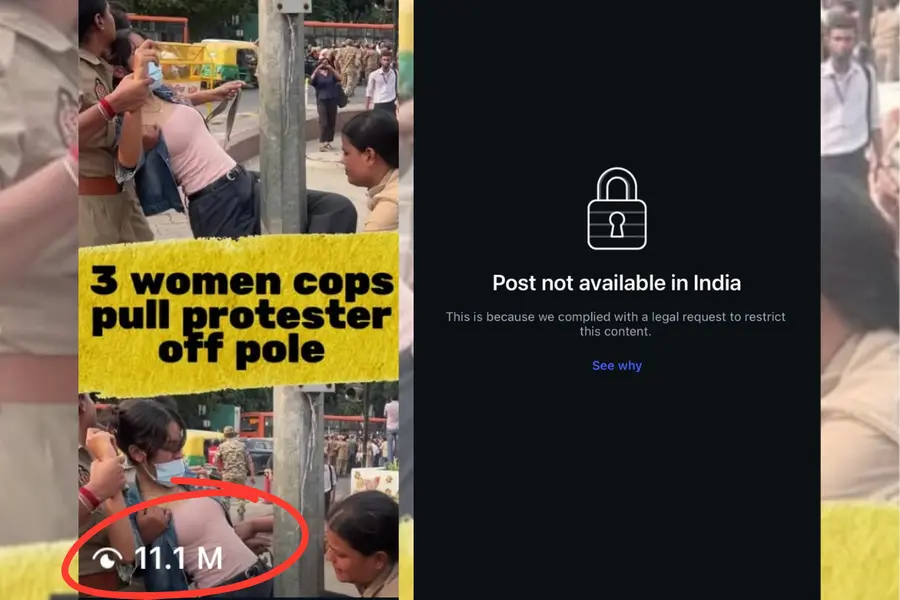
Press freedom in India has just hit yet another rock bottom. A video posted on Instagram by Mathrubhumi has been blocked in India. Access to the video -- shot by Mathrubhumi's crew covering the student protests in Delhi against Chief Election Commissioner Gyanesh Kumar on 11 October 2026 -- has been restricted in the country. Instagram is yet to confirm whether it was the Delhi Police or the Narendra Modi government that directed it to restrict our video.
The video in question shows a moment during the Cockroach Janata Party-led protests in the national capital where a young woman is seen clinging on to a pole while three -- not one or two -- women police personnel are trying to detain her.
The 50-second shows the teenager first trying to shield her friend from being dragged into detention by the police. After her attempt went in vain, she became the Delhi Police's next detainee. To resist this, she clings to a lighting pole before three cops overpower her.
This was not an isolated incident. There have been a number of reports of police excesses that have emerged since the day protests started near the Jantar Mantar.
To cherry-pick one video that went massively viral in order to suppress the sentiments on ground zero reeks of an orchestrated attempt to bolster the official narrative that has blindsided the national media. What we are facing today has been happening to credible media outlets and independent content creators who have been braving adversities to report the truth.
Clearly, the government seems to be arm-twisting social media platforms to toe its line, and expects to media to do so too. Nothing else explains why the government slapped Section 79(3)(b) of the Information Technology Act to restrict access to the video, which at last count had been viewed by over 11 million people.
Section 79(3)(b) is the provision that can strip a social-media platform of its safe-harbour protection if it fails to act on legally valid notice of "unlawful third-party content". It is not, by itself, a general power for private complainants to force takedowns.
Under Section 79(1), an intermediary is generally not liable for third-party information, data or communication links hosted or made available through its platform. But Section 79(3)(b) withdraws that immunity where the intermediary, after receiving actual knowledge or a notification from the appropriate government or its agency that content on its computer resource is being used to "commit an unlawful act", fails to expeditiously remove or disable access to it.
The government's own reading of the law states that the content must fall within categories, which include matters affecting India's sovereignty and integrity, state security, friendly relations with foreign states, public order, decency or morality, contempt of court, defamation, or incitement to such offences. It is beyond comprehension how a video showing police action against the teenager resisting detention during a peaceful protest is seems as an unlawful act by any agency aka Delhi Police or the government.
Nevertheless, we will keep on reporting facts -- however uncomfortable it makes those sitting in the corridors of power.
Published: 12 Oct 2026, 05:34 pm IST
ABOUT THE AUTHOR

Related Topics
Disclaimer: Kindly avoid objectionable, derogatory, unlawful and lewd comments, while responding to reports. Such comments are punishable under cyber laws. Please keep away from personal attacks. The opinions expressed here are the personal opinions of readers and not that of Mathrubhumi.