
Union minister Kiren Rijiju criticised veteran actor Naseeruddin Shah after the actor described himself as a “dimagi naxal” in a video supporting student protests at Jamia Millia Islamia.
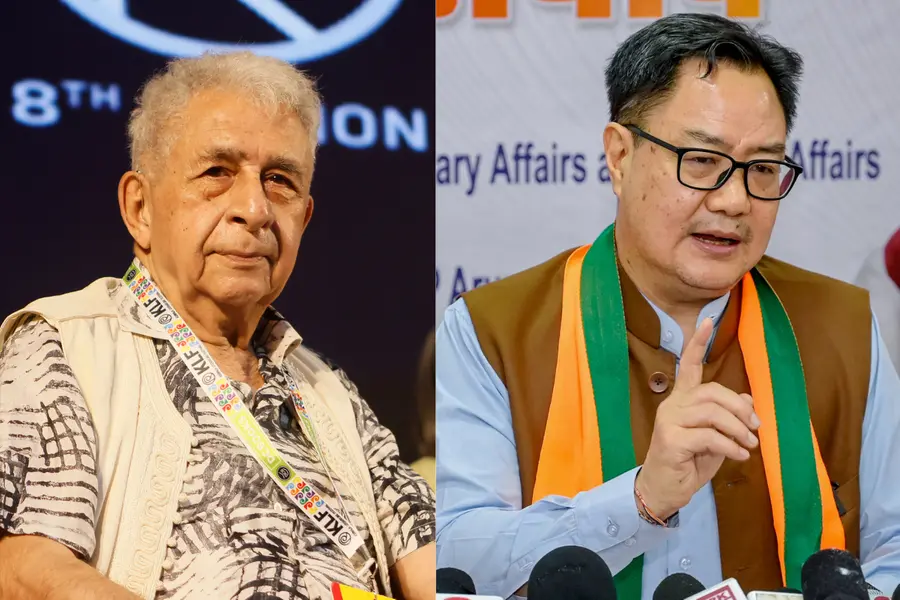
New Delhi: Union minister Kiren Rijiju has criticised veteran actor Naseeruddin Shah after the actor called himself a “dimagi naxal” in a social media video and accused the central government of undermining the education system and threatening democracy.
In a post on X on Wednesday, Rijiju said he had previously respected Shah but described the actor as a “dangerous urban Dimagi Naxal”. He also said Shah’s views were “extremely harmful” to Indian democracy.
The controversy followed a video Shah posted on Facebook on Tuesday in support of students at Jamia Millia Islamia in New Delhi. The students have been protesting for the restoration of their students’ union.
In the video, Shah showed a pin bearing the words “dimagi naxal” and said he proudly identified with the label. He also referred to labels such as “anti-national” and “tukde-tukde gang”, which he said had been used to describe people critical of the government.
Shah accused the BJP-led central government of trying to destroy the education system and weaken young people’s ability to challenge authority. He questioned how far the government would go in what he described as efforts to undermine educational institutions and put democracy at risk.
Rijiju responded by saying he had learnt about Shah’s “real character” late. His remarks intensified the public exchange between the minister and the actor over the meaning of Shah’s statements and his criticism of the government.
Shiv Sena leader Shaina NC also questioned Shah’s remarks in comments to PTI Videos on Thursday. Referring to his role in the 1999 film Sarfarosh, she asked whether he supported what she described as pro-India or anti-India slogans.
Shah, 76, has recently spoken out on student-related issues and protests. He has also expressed support for students at the Satyajit Ray Film and Television Institute, who have been staging an indefinite sit-in following incidents of violence on campus.
What does ‘dimagi naxal’ mean?
The phrase “dimagi naxal”, which translates roughly as “intellectual Naxal”, is used in Indian political discourse to describe people accused of advancing Naxalite or Maoist ideas through institutions, public debate or intellectual activity rather than armed action. The term is politically charged, and its use can be disputed.
Prime Minister Narendra Modi previously used the term in an Independence Day address, referring to people he alleged had entrenched themselves within the system and posed a threat to society by influencing policies.
Shah’s use of the label was a statement of political defiance in the context of his criticism of the government. It does not, by itself, establish that he is associated with an armed organisation.
The exchange highlights continuing tensions between public figures who criticise government policies and political leaders who challenge their characterisation of those policies. Shah’s comments focused on student activism, education and democratic freedoms, while Rijiju and Shaina NC questioned the actor’s choice of language and political position.
The dispute also reflects how terms such as “anti-national”, “urban Naxal” and “tukde-tukde gang” have become part of wider political arguments in India. Understanding the controversy requires distinguishing Shah’s own statements from the allegations made against him by political figures.
Published: 29 Oct 2026, 11:28 am IST
ABOUT THE AUTHOR

Disclaimer: Kindly avoid objectionable, derogatory, unlawful and lewd comments, while responding to reports. Such comments are punishable under cyber laws. Please keep away from personal attacks. The opinions expressed here are the personal opinions of readers and not that of Mathrubhumi.