
Karthigai Deepam celebrations across Tamil Nadu coincided with heightened tensions in Madurai, where BJP leaders were detained over the disputed Deepathoon ritual. The Madras High Court directed authorities to allow devotees to witness the lamp lighting from permitted locations, while keeping restrictions on climbing the hill in place.
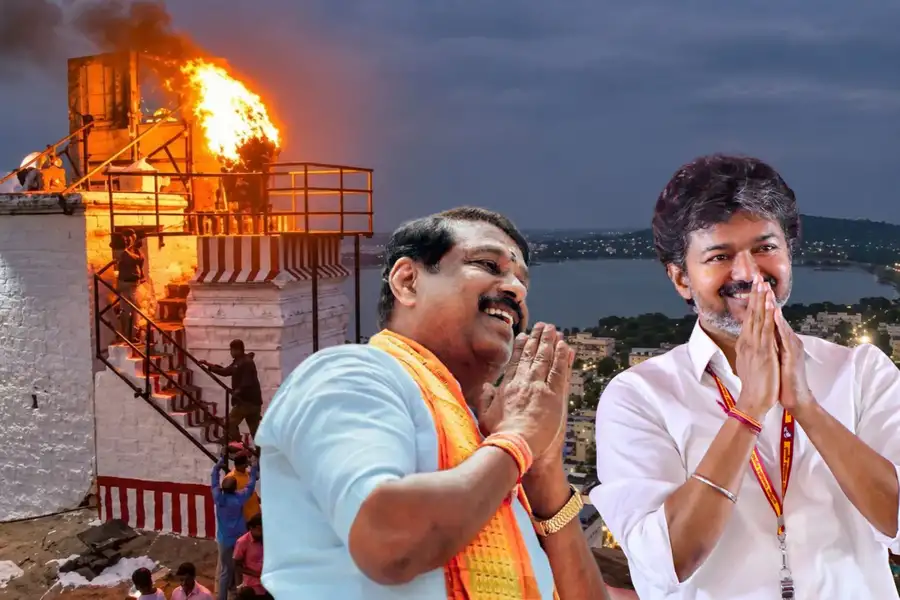
Madurai: Several BJP leaders, including Tamil Nadu party president Nainar Nagenthran and former Telangana Governor Tamilisai Soundararajan, were detained by police on Tuesday while attempting to reach Thiruparankundram hill in Madurai for the Karthigai Deepam festival.
The detentions came amid heightened security arrangements and prohibitory orders imposed across Madurai district ahead of the proposed lighting of the ceremonial lamp at the disputed stone pillar, known as the Deepathoon, on the hill.
Nagenthran was initially placed under detention at his residence in Tirunelveli, according to investigating officers. He later travelled towards Madurai, accompanied by BJP supporters carrying party flags. His vehicle was intercepted near Madurai at around 4 pm, and police personnel took him away in a police vehicle.
Soundararajan was also detained at Madurai airport while attempting to proceed to Thiruparankundram to offer prayers. She questioned the police restrictions, maintaining that she was visiting as a devotee and had no intention of organising a protest.
"Do I not have the right as a devotee to peacefully offer prayers at Thirupparankundram in Tamil Nadu?" she asked police officials.
She alleged that BJP leaders and Hindu organisations were being selectively targeted and questioned the restrictions imposed on devotees.
Other leaders of Hindu organisations, including members of Hindu Munnani, were also stopped from proceeding towards the hill.
BJP leaders criticise Tamil Nadu government
Nagenthran criticised Chief Minister C Joseph Vijay, alleging that the state government was not respecting the Supreme Court's order permitting the lamp to be lit at the Deepathoon as a one-time measure.
He said he had informed the police that he was travelling to the Arulmigu Meenakshi Sundareswarar Temple in Madurai and not to the Arulmigu Subramanya Swamy Temple at Thiruparankundram.
The BJP leader alleged that several party district leaders had been placed under house arrest and accused the government of creating unnecessary tension around the festival.
In a post on X, he questioned the detention of people seeking to exercise what he described as their lawful rights in a democracy.
Soundararajan also accused the TVK government of following the approach of the previous DMK administration. She described the restrictions as anti-Sanatana and warned that the government would face political consequences if the lamp was not lit as directed.
These were allegations made by the BJP leaders; the state government and police cited law-and-order concerns behind the restrictions.
Madras High Court protects devotees' right to witness the lamp lighting
On Tuesday, the Madras High Court's Madurai Bench directed the district administration to ensure that prohibitory orders did not prevent devotees from undertaking Girivalam, or circumambulation of the hill, or gathering at suitable locations to witness the Karthigai Deepam being lit at the Deepathoon.
The court was hearing petitions filed by Manoj Kumar and others seeking implementation of the Supreme Court's directions concerning the ritual.
It observed that preventing devotees from witnessing the event would affect their fundamental rights under Article 25 of the Constitution, which guarantees freedom of conscience and the right to freely profess, practise and propagate religion, subject to constitutional limitations.
The court clarified that devotees could not be allowed to climb the hill, in keeping with the Supreme Court's directions.
It directed the authorities not to apply the prohibitory order in a manner that prevented devotees from undertaking Girivalam or assembling at vantage points to witness the lamp.
Why were prohibitory orders imposed?
Madurai District Collector Nishant Krishna imposed restrictions under Section 163 of the Bharatiya Nagarik Suraksha Sanhita (BNSS) on November 23.
The order prohibited public gatherings, processions, demonstrations and protests across the district.
The district administration said the restrictions were necessary to maintain public order and prevent possible clashes between groups supporting and opposing the lighting of the lamp at the Deepathoon.
Police inputs had indicated the possibility of confrontations in Madurai city and other parts of the district.
Security was significantly increased around Thiruparankundram hill, with barricades placed near the entrance and along the Palani Andavar temple route. Bomb detection and disposal teams also installed screening equipment.
Reports cited different deployment figures, with one account putting the force at more than 1,700 personnel at the hill and another reporting around 5,000 personnel across the wider security arrangement.
What did the Supreme Court order say?
On November 20, the Supreme Court permitted the lighting of Karthigai Deepam at the disputed Deepathoon on November 24 as a one-time arrangement, subject to safeguards and restrictions on access.
The court stayed the operative portions of the Madras High Court's January 6 judgment while making it clear that its permission would not establish any customary, religious or proprietary right to conduct the ritual at the site in subsequent years.
It also left the broader questions concerning the site and the dispute open for further adjudication.
The Tamil Nadu government subsequently approached the Supreme Court seeking a review of the decision.
What is the Thiruparankundram Deepathoon dispute?
The dispute concerns the location where the Karthigai Deepam should be lit on Thiruparankundram hill.
Petitioners sought permission to light the ceremonial lamp at the Deepathoon, a stone pillar located around 50 metres from the Sikandar Badusha Dargah. The temple administration has opposed the demand, maintaining that there is no established tradition of lighting the lamp at that pillar.
It has argued that the ceremony has traditionally been conducted at the Deepa Mandapam near the Uchi Pillaiyar Temple for more than 150 years.
In December 2025, a single-judge Bench of the Madras High Court permitted devotees to light the lamp at the Deepathoon. The court held that the ritual would not infringe upon the dargah's rights and that denying permission would violate the petitioners' rights.
A report by the Tamil Nadu Department of Archaeology identified the Deepathoon as a Global Positioning Survey pillar dating to the colonial period.
A religious observance caught between court orders and law-and-order restrictions
The Thiruparankundram dispute has developed beyond a disagreement over the location of a religious ritual. It now involves questions about religious freedom, the implementation of judicial directions, public order and the authority of the state administration.
The Supreme Court's November 20 order allowed the lamp to be lit at the Deepathoon for one occasion, but deliberately stopped short of recognising a permanent customary right. This distinction is important because the immediate permission does not settle the larger dispute over the history, status or future use of the site.
The Madras High Court's directions on Tuesday addressed another aspect of the controversy: the rights of devotees who wish to witness the ceremony. While the court maintained the restriction on climbing the hill, it said the prohibitory orders should not prevent people from undertaking Girivalam or gathering at vantage points.
The detentions of BJP leaders have added a political dimension to the dispute. The BJP has accused the TVK government of restricting devotees' rights, while the district administration has cited the possibility of clashes between opposing groups.
The central question for the authorities is whether they can enforce security restrictions while also complying with the courts' directions. The Supreme Court's one-time permission and the Madras High Court's clarification make the distinction between preventing disorder and restricting peaceful religious participation particularly significant.
The wider dispute remains unresolved, and the Supreme Court's one-time arrangement does not determine where the ceremony can be conducted in future years.
Published: 24 Nov 2026, 06:28 pm IST


ABOUT THE AUTHOR

Related Topics
Disclaimer: Kindly avoid objectionable, derogatory, unlawful and lewd comments, while responding to reports. Such comments are punishable under cyber laws. Please keep away from personal attacks. The opinions expressed here are the personal opinions of readers and not that of Mathrubhumi.