
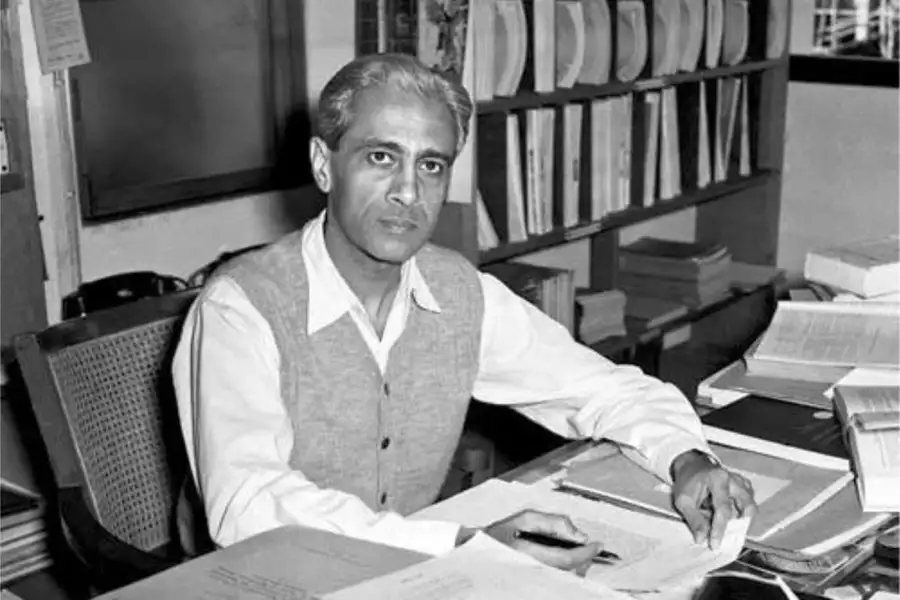
New Delhi: Congress leader Jairam Ramesh on Wednesday hailed Satish Dhawan's contributions to India's successful space programme, saying he was truly a phenomenon as an institution-builder, administrator, manager and mentor, and his 12-year tenure at ISRO had become legendary.
Ramesh, Congress general secretary in-charge of communications, said India's hugely successful space programme was first given shape in February 1962 with the creation of the Indian National Committee for Space Research (INCOSPAR).
The initiative was the brainchild of Vikram Sarabhai, with the encouragement of Homi Bhabha and then Prime Minister Jawaharlal Nehru. ISRO was subsequently established in August 1969, with Sarabhai continuing to provide inspirational leadership until his sudden demise in December 1971, Ramesh said on X.
"In February 1972, P N Haksar persuaded Indira Gandhi to lure Satish Dhawan back from Caltech in the US, where he was on a sabbatical, to lead ISRO. Dhawan, who had been Director of the Indian Institute of Science at Bangalore (as it was called then) since 1962, agreed on the condition that he be allowed to function from that city itself and also that he be allowed to hold his position at the IISc," Ramesh said.
The conditions were readily accepted by the prime minister, a decision that greatly influenced the growth of what would later become a hub of science and technology in India, the former environment minister said.
Dhawan, who held three degrees in science, mathematics and engineering, apart from English Literature, was an academic and researcher at heart but proved to be an exceptional institution-builder, administrator, manager and mentor, Ramesh said.
He recalled how Dhawan famously took the responsibility for the failure of India's first satellite launch vehicle in August 1979, which had left its project manager, A P J Abdul Kalam, disconsolate.
"But when the launch was successful in July 1980, he gave full prominence and credit to Kalam and his team. India's former president never tired of repeating this lesson in leadership," the Congress leader recalled.
Dhawan served as ISRO chairman till September 1984 and provided a second lesson in leadership by mentoring his successors without interfering in their work, Ramesh said.
"He knew when and how to exit and stay exited," he said, adding that Dhawan remained a father figure even after retirement, pursued his diverse interests and continued guiding doctoral students, the last of whom was Dr K Radhakrishnan, who was Chairman of ISRO during 2009-15.
His final work was a delightful and detailed essay called "Bird Flight", which has remained classic, Ramesh said.
Incidentally, across Sriharikota, where the Satish Dhawan Space Centre is located, is the Pulicat lake, which is the home of greater flamingos, pelicans, storks and herons, he said.
"Dhawan's 12-year tenure at ISRO has become legendary. Many considered him their guru all their lives, including one person who later became very famous in an entirely different arena - TN Seshan!" Ramesh said.
He said Dhawan had finally become the subject of a full-fledged biography.
"Two of his early mentees themselves, distinguished ISRO alumni, have just come out with a very fine and much-needed book on this most iconic of men and his monumental contributions. He deserves to be recalled in this manner and more," Ramesh said.
(This story has not been edited by Mathrubhumi and is published from a syndicated feed.)
Published: 25 Nov 2026, 05:57 pm IST


Disclaimer: Kindly avoid objectionable, derogatory, unlawful and lewd comments, while responding to reports. Such comments are punishable under cyber laws. Please keep away from personal attacks. The opinions expressed here are the personal opinions of readers and not that of Mathrubhumi.
